Perspective - (127) Volume 14, Issue 1
Received: 02-Mar-2025, Manuscript No. ara-25-169080;
Editor assigned: 04-Mar-2025, Pre QC No. P-169080;
Reviewed: 16-Mar-2025, QC No. Q-169080;
Revised: 23-Mar-2025, Manuscript No. R-169080;
Published:
30-Mar-2025
, DOI: 10.37421/2168-9695.2025.14.315
Citation: Didier, Markus. “Deep Reinforcement Learning Techniques for Human-robot Interaction Improvement.” Adv Robot Autom 14 (2025): 315.
Copyright: © 2025 Didier M. This is an open-access article distributed under the terms of the Creative Commons Attribution License, which permits unrestricted use, distribution and reproduction in any medium, provided the original author and source are credited.
At the core of using DRL in HRI is the ability to model complex, high-dimensional human behavior and learn appropriate robotic responses through iterative interaction. DRL combines deep neural networks with reinforcement learning principles, enabling robots to extract features from raw sensory inputs such as vision, speech and motion. These features are then used to determine context-sensitive actions that maximize cumulative rewards, often associated with successful task completion or positive human feedback. For example, in collaborative assembly tasks, a robot trained with DRL can learn to anticipate a human partner’s next move and adapt its own timing and motion trajectory accordingly. Similarly, social robots can learn to modify their speech tone, facial expressions, or proximity based on real-time human emotional cues, leading to more engaging and respectful interactions. These adaptive capabilities are key to transitioning robots from passive tools to active partners.
In real-world scenarios, human behavior is often inconsistent, non-deterministic and context-dependent, posing significant challenges for traditional control strategies. DRL addresses these challenges by continuously updating its policy network as new data is gathered, allowing robots to handle variability and ambiguity more effectively. Interactive learning frameworks such as proximal policy optimization (PPO) and deep Q-networks (DQN) have shown promising results in enabling robots to adapt to changing human intentions without prior explicit programming. Furthermore, reward shaping techniques help guide the learning process by embedding social norms or safety constraints into the reward function. For instance, in eldercare robotics, DRL can be used to teach robots to prioritize actions that minimize user discomfort or enhance emotional well-being, even in cases where direct verbal feedback is absent. This ongoing learning ensures that robots not only improve in task efficiency but also in emotional intelligence and situational awareness.
To make DRL-based HRI practical, it is essential to ensure real-time responsiveness, data efficiency and safety. Simulated environments, digital twins and imitation learning from human demonstrations are often used to pre-train models before deployment. These methods help reduce the exploration time needed in real environments and mitigate the risks of unintended actions during early training phases. Furthermore, transfer learning techniques allow knowledge gained in one scenario to be adapted to new contexts, enabling robots to generalize across different users and environments. Integration with multimodal sensors including cameras, LiDAR, microphones and tactile sensors—further enhances situational understanding. As cloud computing and edge AI advance, real-time data processing and policy updates become increasingly feasible, pushing DRL-enabled robots closer to seamless, continuous and meaningful interaction with humans in the real world [2].
Google Scholar Cross Ref Indexed at
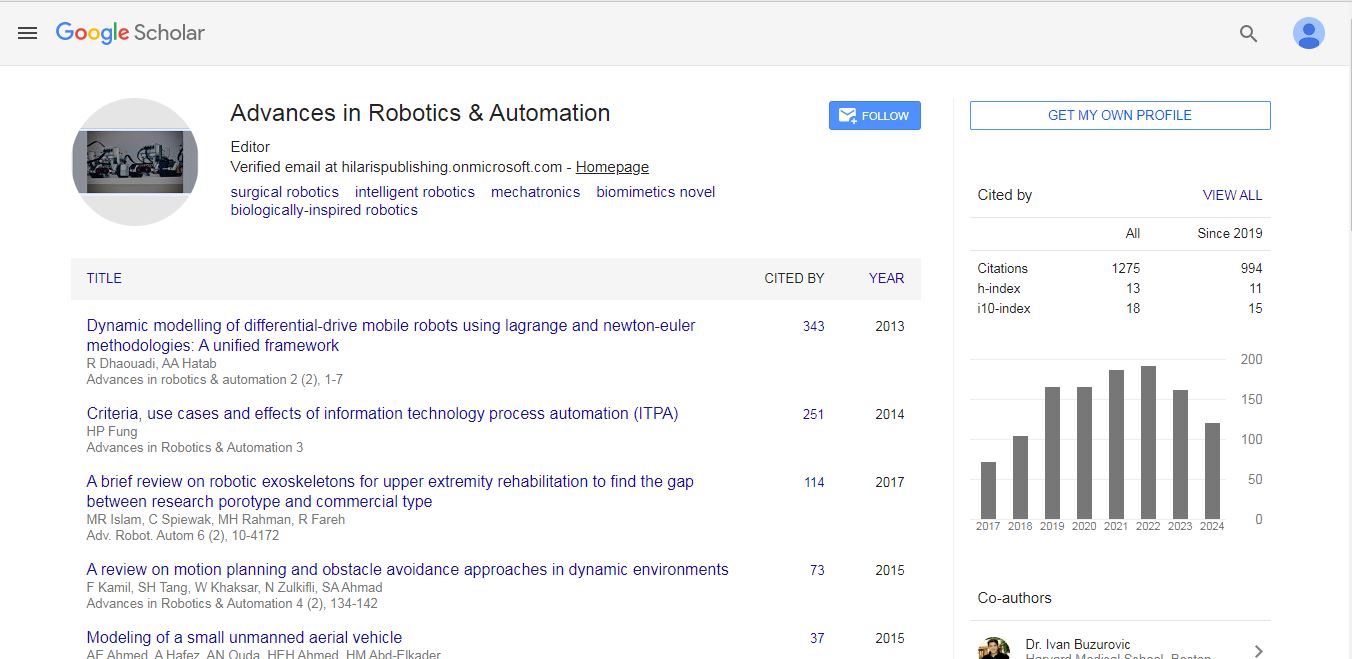
Advances in Robotics & Automation received 1275 citations as per Google Scholar report