Opinion - (2025) Volume 14, Issue 1
Received: 02-Mar-2025
Editor assigned: 04-Mar-2025
Reviewed: 16-Mar-2025
Revised: 23-Mar-2025
Published:
30-Mar-2025
, DOI: 10.37421/2168-9695.2025.14.319
Citation: Nicolas, Samuel. “Integration of Vision and Tactile Sensors for Robotic Grasping Tasks.” Adv Robot Autom 14 (2025): 319.
Copyright: © 2025 Nicolas S. This is an open-access article distributed under the terms of the Creative Commons Attribution License, which permits unrestricted use, distribution and reproduction in any medium, provided the original author and source are credited.
In a robotic grasping context, vision systems are typically employed for object recognition, localization and pose estimation. Cameras, depth sensors and 3D vision systems enable the robot to plan approach trajectories and pre-shape its gripper based on object geometry. However, vision alone may fail when occlusions, lighting variations, or partial views obscure key object features. Tactile sensing compensates for these limitations by providing feedback during contact, enabling robots to refine their grip based on real-world interaction. Modern tactile sensors are equipped to measure pressure distribution, shear forces and even temperature, offering a rich array of data once the object is engaged. By using vision for initial planning and tactile data for in-contact adjustments, robots gain a dynamic feedback loop that enhances both pre-grasp decisions and post-contact corrections, improving their ability to securely and safely manipulate diverse objects.
To integrate these sensing modalities, robots require sophisticated data fusion algorithms and control architectures capable of real-time processing. Sensor fusion techniques, such as Kalman filters, probabilistic models and neural networks, combine vision and tactile data streams into a coherent representation of the grasping event. These algorithms help detect grasp quality, identify slippage and adjust grip strength or finger positioning on-the-fly. For instance, a robot may visually target a cup handle, initiate contact and then refine its grip through tactile feedback to avoid over-squeezing or dropping it. Deep learning techniques, particularly Convolutional Neural Networks (CNNs) and reinforcement learning, are also used to train robots on large datasets that include both visual and tactile information. These methods enable robots to learn complex grasping strategies and generalize to novel objects or conditions, making them more adaptable in real-world environments.
Applications of vision-tactile integration are vast and transformative. In industrial settings, robots can handle fragile items like electronics or glassware with greater confidence and reduced error. In assistive robotics, prosthetic hands embedded with vision and tactile sensors can offer amputees more natural and responsive control. Surgical robots benefit from tactile-augmented precision during delicate procedures, enhancing safety and dexterity. Furthermore, vision-tactile integration is essential in cluttered or deformable object scenarios like grasping soft foods or garments where visual data may be insufficient and tactile feedback becomes critical for determining appropriate manipulation strategies. As sensor technologies become smaller, cheaper and more accurate, their incorporation into robotic platforms will increasingly become standard, enabling richer interaction with complex, human-centric environments [2].
Google Scholar Cross Ref Indeced at
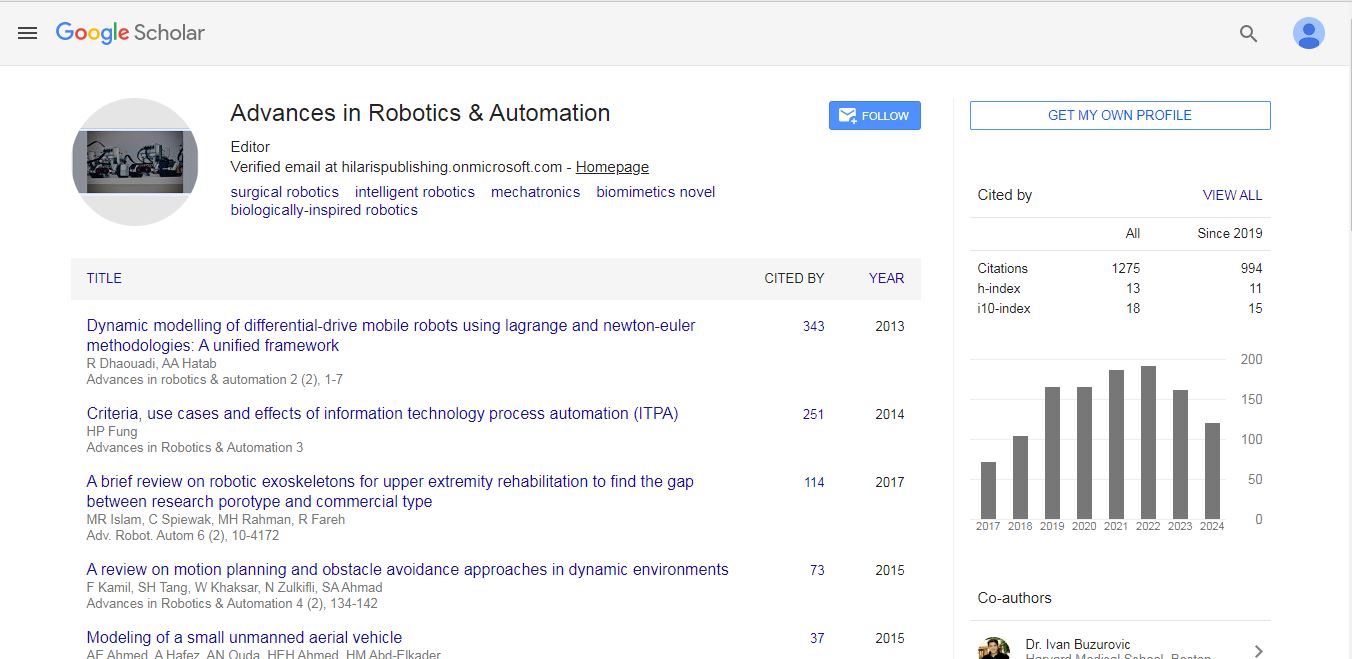
Advances in Robotics & Automation received 1275 citations as per Google Scholar report