Brief Report - (2025) Volume 14, Issue 1
Received: 02-Mar-2025, Manuscript No. ara-25-169082;
Editor assigned: 04-Mar-2025, Pre QC No. P-169082;
Reviewed: 16-Mar-2025, QC No. Q-169082;
Revised: 23-Mar-2025, Manuscript No. R-169082;
Published:
30-Mar-2025
, DOI: 10.37421/2168-9695.2025.14.316
Citation: Shiomi, Mariam. “Design and Control of a Humanoid Robot for Assistive Applications.” Adv Robot Autom 14 (2025): 316.
Copyright: © 2025 Shiomi M. This is an open-access article distributed under the terms of the Creative Commons Attribution License, which permits unrestricted use, distribution and reproduction in any medium, provided the original author and source are credited.
The structural design of a humanoid robot intended for assistive functions typically includes articulated limbs, a torso and a head, mimicking the anthropomorphic layout of a human body. This design facilitates ergonomic compatibility with human environments—such as reaching doorknobs, walking on steps, or using utensils—and supports intuitive interaction with users. Materials used in these robots are chosen for a balance between strength, lightness and safety, often incorporating soft padding or compliant actuators to minimize injury risk during physical contact. Key to their functionality is the integration of sensor networks—such as vision systems, force sensors, IMUs and tactile arrays—which enable the robot to perceive and respond to environmental and user cues in real time. For example, pressure sensors in the feet help maintain balance on uneven terrain, while vision and depth sensors allow the robot to identify people, obstacles and objects.
The control system of an assistive humanoid robot is responsible for generating smooth, safe and context-appropriate movements. This involves hierarchical control architectures, where high-level planners determine the task (e.g., walking to a user), mid-level controllers generate trajectories for limb movements and low-level controllers actuate the motors with real-time feedback loops. Advanced techniques such as inverse kinematics, zero moment point (ZMP) control for bipedal balance and whole-body coordination algorithms are applied to achieve stable locomotion and manipulation. For assistive purposes, safety and adaptability are critical, so control systems must include fall detection, compliant control for unexpected interactions and the ability to modulate behavior based on human emotional or physical state. Some robots are also equipped with AI-driven learning modules that allow them to improve their task performance over time and personalize interactions based on user habits or preferences.
In terms of assistive function, humanoid robots are often designed to provide physical, social, or cognitive assistance. Physically, they can help users with mobility impairments by offering support while walking or transferring between positions. Cognitively, they can remind users to take medication, guide them through daily routines, or communicate with remote caregivers. Socially, these robots serve as companions that reduce loneliness and promote emotional well-being, especially in elderly individuals living alone. Their humanoid appearance and expressive abilities, including speech and gesture, make them more relatable and comforting. Integration with smart home systems further enhances their utility, allowing them to control lights, temperature, or appliances via voice or gesture commands. These multi-modal capabilities enable humanoid robots to function not just as machines, but as interactive assistants that foster independence and engagement [2].
Google Scholar Cross Ref Indexed at
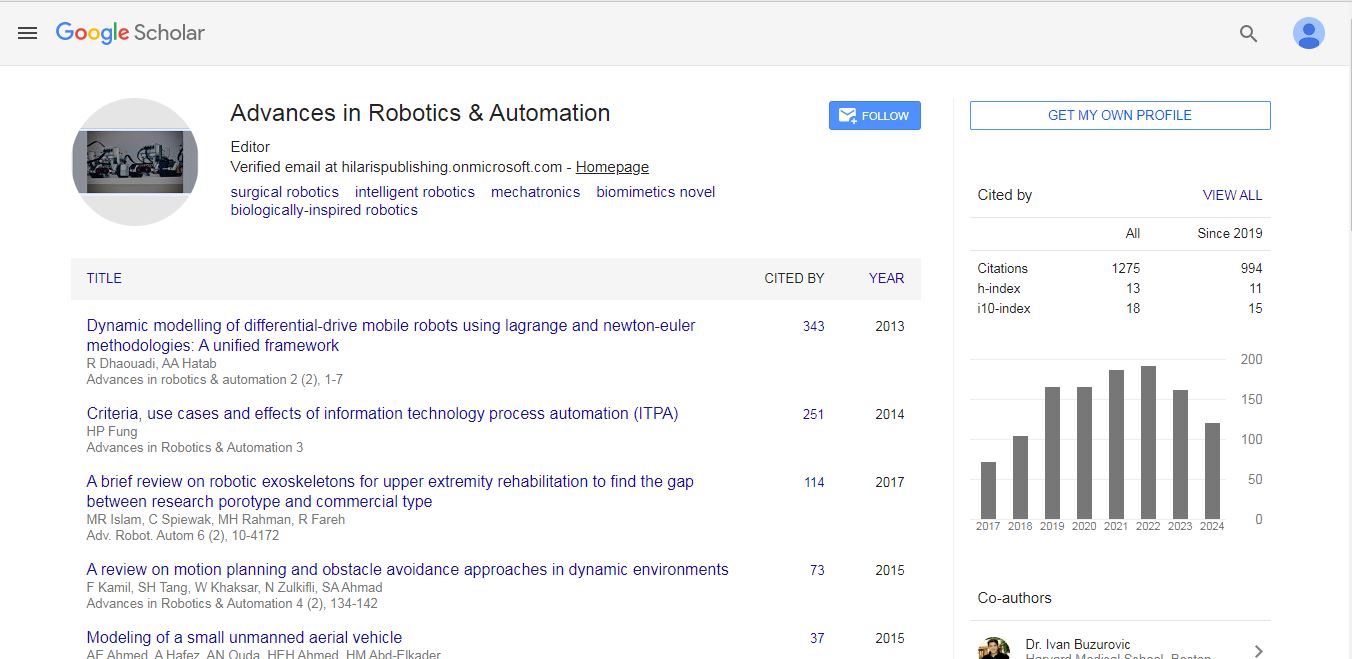
Advances in Robotics & Automation received 1275 citations as per Google Scholar report