Commentary - (2025) Volume 14, Issue 1
Received: 02-Mar-2025, Manuscript No. ara-25-169087;
Editor assigned: 04-Mar-2025, Pre QC No. P-169087;
Reviewed: 16-Mar-2025, QC No. Q-169087;
Revised: 23-Mar-2025, Manuscript No. R-169087;
Published:
30-Mar-2025
, DOI: 10.37421/2168-9695.2025.14.320
Citation: Dragos, Menosi. “Robotics Role in Transforming Agriculture.” Machine Learning Algorithms for Real-time Object Detection in Robotics14 (2025): 320.
Copyright: © 2025 Dragos M. This is an open-access article distributed under the terms of the Creative Commons Attribution License, which permits unrestricted use, distribution and reproduction in any medium, provided the original author and source are credited.
Real-time object detection in robotics relies heavily on the selection and optimization of machine learning algorithms that balance accuracy and computational speed. CNN-based models are the foundation of most detection systems due to their capacity to learn rich visual features. For instance, YOLO divides an image into a grid and predicts bounding boxes and class probabilities in a single forward pass, making it exceptionally fast for real-time tasks. SSD takes a similar approach but utilizes multi-scale feature maps to improve detection of objects at various sizes. In contrast, Faster R-CNN provides higher accuracy through a two-stage process first proposing regions of interest, then classifying them but generally requires more processing power. These models are trained on large datasets such as COCO or ImageNet and are often fine-tuned for domain-specific applications in robotics, such as recognizing tools, humans, or indoor navigation markers. The availability of pre-trained models and frameworks like TensorFlow and PyTorch has made deployment on robotic systems more accessible, while hardware acceleration through GPUs or edge devices like NVIDIA Jetson ensures real-time performance.
In robotic applications, object detection must be tightly integrated with other subsystems such as path planning, grasping and control. For instance, a service robot may use YOLO to detect a cup on a table, then employ inverse kinematics to reach and pick it up. The detection output bounding box coordinates and object class feeds into spatial reasoning and decision-making modules that determine how the robot interacts with the object. In mobile robots, object detection can inform obstacle avoidance, navigation, or interaction with humans. To enhance robustness, many systems use sensor fusion, combining visual input with data from LiDAR, depth cameras, or ultrasonic sensors. Techniques such as 3D object detection using RGB-D data or stereo vision help robots understand object position and orientation in three dimensions, crucial for precise interaction. Furthermore, temporal consistency in detection is maintained using algorithms like Kalman filters or Recurrent Neural Networks (RNNs) to track objects over time, ensuring stability and continuity in dynamic environments.
The field is also seeing rapid advancements with the incorporation of transformer-based models and lightweight neural networks for embedded systems. Vision transformers (ViTs) and models like DETR (DEtection TRansformer) are pushing the boundaries of detection performance by capturing global context in scenes, though they require significant computation and are not yet fully optimized for all real-time applications. On the other hand, models like Tiny-YOLO, MobileNet-SSD and NanoDet are specifically designed for deployment on low-power devices, making them ideal for compact or battery-operated robots. Additionally, continual learning and online adaptation are becoming increasingly important, allowing robots to learn new objects in real-time or update detection models based on user feedback and environmental changes. This adaptability ensures long-term usability in dynamic or unknown environments where pre-trained models alone may not suffice [2].Google Scholar Cross Ref Indexed at
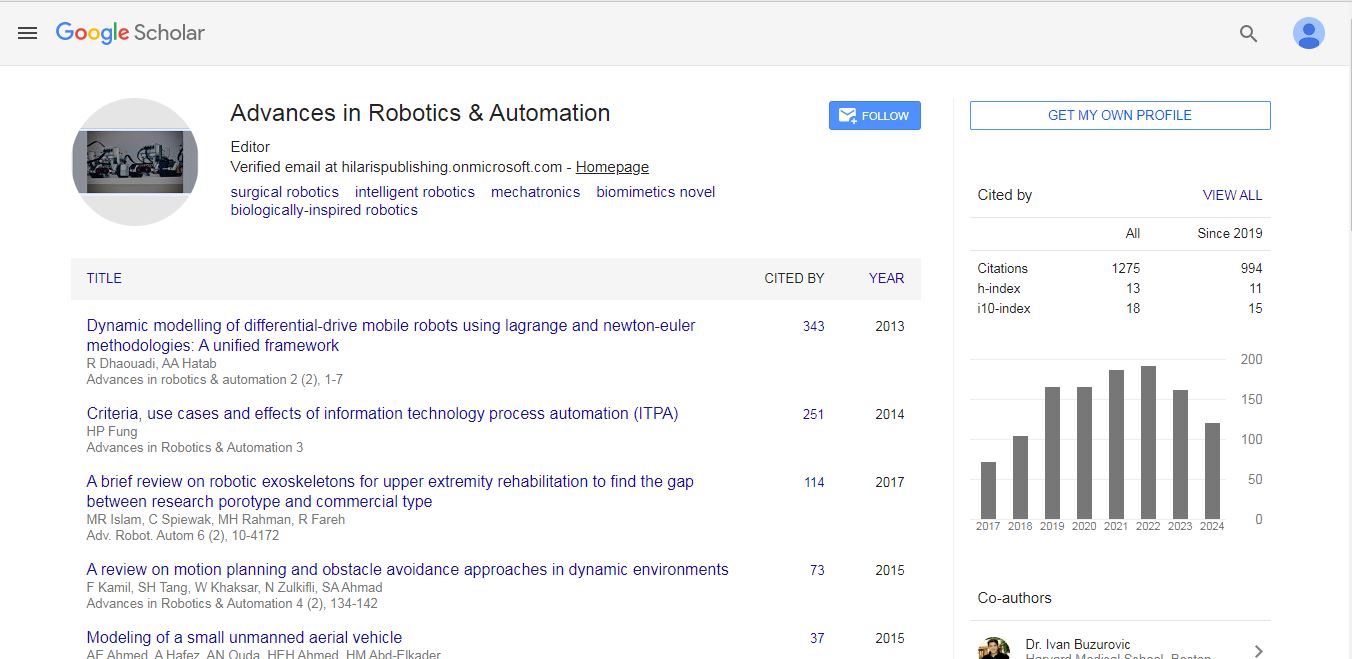
Advances in Robotics & Automation received 1275 citations as per Google Scholar report