Commentary - (2025) Volume 14, Issue 1
Received: 02-Mar-2025, Manuscript No. ara-25-169078;
Editor assigned: 04-Mar-2025, Pre QC No. P-169078;
Reviewed: 16-Mar-2025, QC No. Q-169078;
Revised: 23-Mar-2025, Manuscript No. R-169078;
Published:
30-Mar-2025
, DOI: 10.37421/2168-9695.2025.14.314
Citation: Hanliang, Mueller. “Adaptive Control Strategies for Multi-robot Co-operation in Dynamic Environments.” Adv Robot Autom 14 (2025): 314.
Copyright: © 2025 Hanliang M. This is an open-access article distributed under the terms of the Creative Commons Attribution License, which permits unrestricted use, distribution and reproduction in any medium, provided the original author and source are credited.
At the core of adaptive control in multi-robot systems lies the concept of decentralized decision-making, where each robot maintains autonomy while contributing to a shared objective. These strategies often rely on local sensing and peer-to-peer communication rather than centralized control, which can become a bottleneck in dynamic environments. Algorithms such as consensus protocols, behavior-based control and market-based task allocation allow robots to assign roles, divide tasks and adjust trajectories without needing a central command. Reinforcement learning is increasingly employed to optimize behavior over time, with agents learning to adapt to changing conditions and peer strategies through trial and error. This enables robust coordination even when robots face partial observability or incomplete knowledge of the environment. For example, swarm robotics inspired by biological systems demonstrates how simple adaptive rules at the individual level can produce complex cooperative behaviors at the group level, such as flocking, foraging and formation control.
A key challenge in dynamic environments is ensuring stability and safety while maintaining task efficiency. Adaptive control strategies must consider time-varying constraints such as moving obstacles, changes in terrain, or fluctuating task priorities. Model Predictive Control (MPC) and adaptive sliding mode control are frequently used to provide predictive and responsive adjustments to motion and decision strategies. These controllers incorporate real-time feedback to ensure that robots remain on course even when disturbances occur, such as collisions or loss of communication. The integration of sensor fusion techniques further improves environmental awareness by combining data from LiDAR, GPS, Inertial Measurement Units (IMUs) and vision sensors, enhancing localization, mapping and obstacle detection. In addition, robust communication protocols such as ROS (Robot Operating System) and multi-agent middleware facilitate timely data sharing and synchronization among robots, allowing for cooperative realignment of strategies in fast-changing conditions.
To operate effectively at scale, adaptive strategies must also handle heterogeneity among robots—differences in capabilities, sensors, or energy levels. Task allocation and motion planning algorithms are designed to be capability-aware, dynamically assigning roles based on each robot’s strengths and status. For instance, a robot with higher battery life may be assigned a longer task, while one with a malfunctioning sensor may avoid exploration tasks and instead assist in relay communication. Adaptive algorithms must also manage coordination under communication constraints, such as packet loss or bandwidth limitations. In such cases, predictive models and local autonomy allow the team to continue operating effectively with limited connectivity. Machine learning-based models can also be integrated to anticipate future events and preemptively adjust plans, ensuring seamless cooperation even when external conditions change abruptly [2].
Google Scholar Cross Ref Indexed at
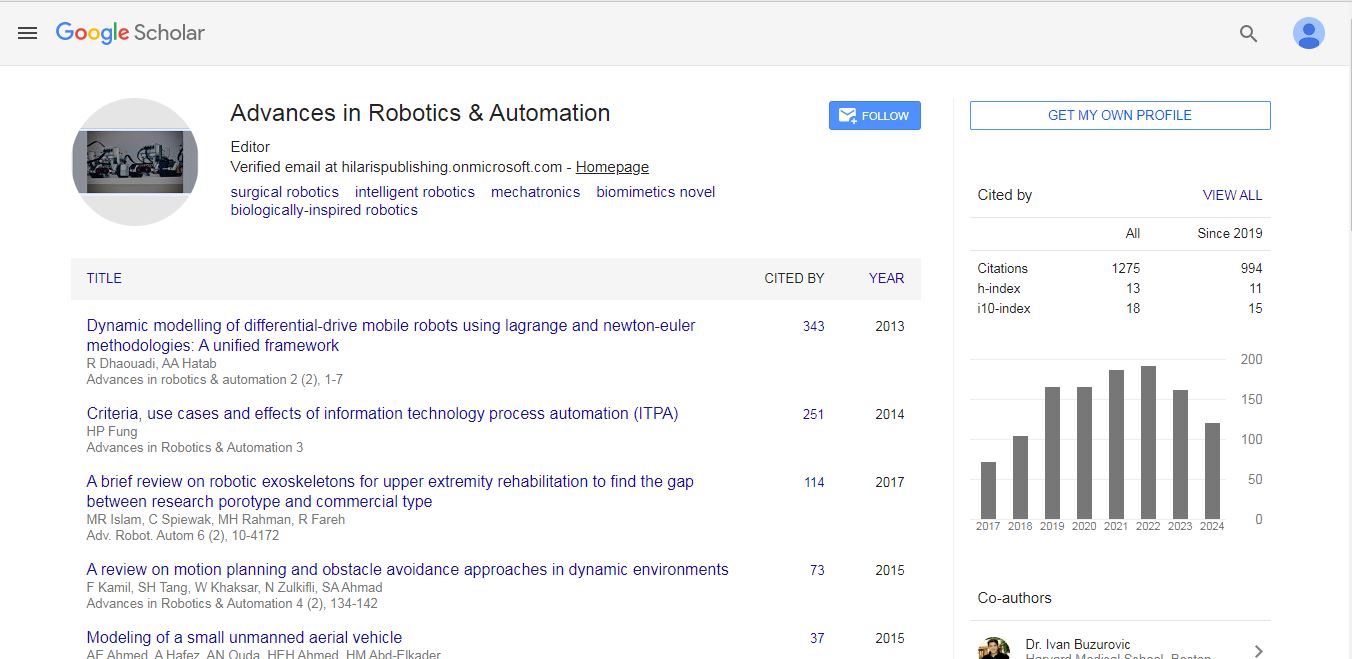
Advances in Robotics & Automation received 1275 citations as per Google Scholar report