Brief Report - (2025) Volume 15, Issue 4
Received: 01-Dec-2025, Manuscript No. jttr-25-175451;
Editor assigned: 03-Dec-2025, Pre QC No. P-175451;
Reviewed: 17-Dec-2025, QC No. Q-175451;
Revised: 22-Dec-2025, Manuscript No. R-175451;
Published:
29-Dec-2025
, DOI: 10.37421/2161-0991.2025.15.315
Citation: Romano, Gianna. ”Transformative Cell & Gene Therapy Innovations.” J Transplant Technol Res 15 (2025):315.
Copyright: © 2025 Romano G. This is an open-access article distributed under the terms of the Creative Commons Attribution License, which permits unrestricted use, distribution and reproduction in any medium, provided the original author and source are credited.
The landscape of modern medicine is continually reshaped by advancements in cell and gene therapy, presenting revolutionary approaches to combat a myriad of diseases. These therapeutic strategies, ranging from targeted immune cell engineering to stem cell applications and sophisticated gene editing, hold immense promise for restoring health and improving patient outcomes. Chimeric Antigen Receptor (CAR) T-cell therapy, for example, represents a significant breakthrough in oncology. This approach explores the latest advancements and future outlook for treating hematologic malignancies. Researchers are consistently highlighting improvements in efficacy, developing strategies to overcome resistance, and conducting ongoing research to expand its application, offering a comprehensive overview of the field's dynamic progress [1].
Beyond cancer, the potential for cellular repair extends to organ-specific conditions. Induced pluripotent stem cell (iPSC)-based cell therapy is a prime example, with current reviews delving into its state and future potential for cardiac repair. Promising preclinical and early clinical studies are underway, though discussions on challenges in safety and efficacy are crucial, alongside outlining pathways for successful clinical translation [2].
Osteoarthritis, a widespread degenerative joint disease, also benefits from these innovations. Mesenchymal Stem Cell (MSC) therapy provides an overview of recent progress and ongoing challenges in this area. This field highlights various therapeutic mechanisms, clinical trial outcomes, and emphasizes the persistent need for standardized protocols and rigorous research to optimize patient outcomes [3].
A fundamental technology driving much of this progress is gene editing. CRISPR/Cas9-based gene editing is transforming cell and gene therapy. This transformative potential covers various applications, from correcting genetic defects to engineering immune cells specifically for cancer treatment, all while carefully addressing safety concerns and ethical considerations that accompany such powerful tools [4].
In the broader fight against cancer, adoptive cell therapy continues to advance rapidly. Recent reviews summarize current advancements for various cancers, covering different types of engineered immune cells, their intricate mechanisms of action, and the significant clinical progress made. The focus remains on emphasizing novel strategies to enhance anti-tumor responses and overcome persistent challenges [5].
Neurological disorders, often debilitating and difficult to treat, are also targets for advanced cellular interventions. A comprehensive review of stem cell therapy examines its current status and future prospects for these conditions. It discusses the types of stem cells employed, their therapeutic potential in conditions like Parkinson's and Alzheimer's, and the inherent challenges associated with clinical translation and ethical considerations [6].
Moreover, the therapeutic utility of extracellular vesicles like exosomes is gaining traction. Articles explore exosomes as a promising therapeutic strategy across various diseases, highlighting their crucial role in cell-to-cell communication and their significant potential as natural drug delivery vehicles. Current research, therapeutic applications, and future directions for harnessing exosomes in clinical settings are actively being reviewed [7].
Regenerative medicine broadly encompasses these innovative approaches. Advanced cell therapies are offering insights into current developments and their clinical translation within this field. This covers a range of innovative approaches, focusing intently on their potential to restore damaged tissues and organs, while simultaneously acknowledging the challenges faced in successfully bringing these therapies to patients who need them most [8].
Specifically for solid tumors, which present unique challenges, gene-modified cell therapy is a critical area of focus. Research discusses current challenges and future directions for this therapy in treating solid tumors. It explores different gene modification strategies designed to enhance anti-tumor immunity and overcome the notoriously immunosuppressive tumor microenvironment, emphasizing innovative approaches to improve treatment efficacy [9].
Finally, the chronic and widespread issue of diabetes is also being addressed through cellular means. Cell therapy for diabetes presents the state of the art and future perspectives. It reviews advancements in pancreatic islet transplantation, stem cell-derived beta cell replacement, and innovative encapsulation technologies, highlighting ongoing efforts to develop curative strategies for both type 1 and type 2 diabetes [10].
These diverse applications underscore a profound shift in medical paradigms, moving towards more precise and biologically driven interventions. The collective research illustrates a future where cellular and genetic manipulations could provide definitive solutions for conditions previously considered intractable, though the path requires careful navigation of scientific, ethical, and practical hurdles.
The field of advanced cell and gene therapies is rapidly evolving, bringing forth innovative solutions for a wide spectrum of challenging diseases. One prominent area of development is in oncology, where Chimeric Antigen Receptor (CAR) T-cell therapy has significantly impacted the treatment of hematologic malignancies. This therapy focuses on enhancing efficacy and developing strategies to overcome resistance, continuously expanding its application. Its progress offers a comprehensive overview of a dynamic and hopeful field [C001]. Concurrently, broader advancements in adoptive cell therapy are summarized, detailing various engineered immune cell types, their action mechanisms, and clinical progress. The aim is to develop novel strategies to enhance anti-tumor responses and circumvent existing treatment challenges across different cancers [C005]. Furthermore, specific challenges posed by solid tumors are being addressed through gene-modified cell therapy. Researchers are exploring distinct gene modification strategies to boost anti-tumor immunity and effectively counter the immunosuppressive tumor microenvironment, seeking to improve treatment efficacy [C009].
Beyond oncology, regenerative medicine benefits immensely from these cellular approaches. For instance, induced pluripotent stem cell (iPSC)-based cell therapy holds significant future potential for cardiac repair. Extensive preclinical and early clinical studies are underway, addressing crucial challenges in ensuring both safety and efficacy, while actively working to outline clear pathways for successful clinical translation [C002]. Similarly, mesenchymal stem cell (MSC) therapy is being explored for osteoarthritis, with research reviewing recent progress and ongoing challenges. This involves a close look at therapeutic mechanisms, clinical trial outcomes, and emphasizes the critical need for standardized protocols and rigorous research to optimize patient benefits [C003]. The overarching progress in advanced cell therapies within regenerative medicine provides insights into current developments and their clinical translation. These approaches concentrate on restoring damaged tissues and organs, navigating the inherent complexities of bringing such innovative therapies to patients [C008].
Neurological disorders, which often lack effective treatments, are also a major focus. Stem cell therapy for these conditions, including Parkinson's and Alzheimer's, is subject to comprehensive review. The discussions encompass the diverse types of stem cells utilized, their therapeutic potential, and the significant challenges associated with successful clinical translation and ethical considerations [C006]. This highlights the complex interplay between scientific discovery and responsible application.
A cornerstone technology empowering many of these advancements is CRISPR/Cas9-based gene editing. This powerful tool carries transformative potential within cell and gene therapy, with applications ranging from correcting specific genetic defects to engineering immune cells for more potent cancer treatments. While its capabilities are vast, careful consideration is always given to safety concerns and complex ethical implications that arise with such profound genetic manipulation [C004]. Moreover, exosomes are emerging as a compelling therapeutic strategy across various diseases. Their natural role in cell-to-cell communication and their potential as efficient drug delivery vehicles are increasingly recognized. Current research is actively reviewing their therapeutic applications and future directions for clinical integration [C007].
Finally, chronic metabolic conditions like diabetes are also witnessing remarkable progress in cell therapy. Research presents the state of the art and future perspectives for treating diabetes, reviewing advancements in pancreatic islet transplantation, stem cell-derived beta cell replacement, and innovative encapsulation technologies. These efforts are geared towards developing truly curative strategies for both type 1 and type 2 diabetes, offering hope for long-term solutions [C010]. Collectively, these diverse therapeutic modalities illustrate a vibrant and rapidly expanding frontier in medical science, promising profound impacts on patient health and disease management.
Current research highlights the dynamic progress in cell and gene therapies, offering transformative potential across various diseases. Chimeric Antigen Receptor (CAR) T-cell therapy shows advancements in treating hematologic malignancies, focusing on efficacy improvements and strategies to overcome resistance. Similarly, induced pluripotent stem cell (iPSC)-based therapies are emerging as promising avenues for cardiac repair, with ongoing preclinical and early clinical studies addressing safety and efficacy challenges for successful translation. Mesenchymal Stem Cell (MSC) therapy is also being explored for osteoarthritis, with a focus on understanding therapeutic mechanisms and standardizing protocols to optimize patient outcomes. Broader advancements in gene editing tools like CRISPR/Cas9 are revolutionizing cell and gene therapy by enabling the correction of genetic defects and the engineering of immune cells for cancer treatment, though safety and ethical considerations remain important. Adoptive cell therapy continues to evolve for various cancers, emphasizing novel strategies to enhance anti-tumor responses and overcome existing hurdles. Stem cell therapies are also under comprehensive review for neurological disorders such as Parkinson's and Alzheimer's, with ongoing efforts to bridge the gap between therapeutic potential and clinical reality. Exosomes are gaining recognition as a promising therapeutic strategy, valued for their role in cell-to-cell communication and potential as drug delivery vehicles across diverse diseases. Regenerative medicine sees significant developments in advanced cell therapies aimed at restoring damaged tissues and organs, navigating the complex path from lab to patient. Gene-modified cell therapy specifically targets solid tumors by enhancing anti-tumor immunity and overcoming the immunosuppressive tumor microenvironment. Lastly, cell therapy for diabetes is advancing with pancreatic islet transplantation, stem cell-derived beta cell replacement, and encapsulation technologies, striving for curative strategies for both type 1 and type 2 diabetes. These collective efforts underscore a vibrant landscape of innovation, addressing critical diseases through advanced cellular and genetic approaches.
None
None
Xiaoming X, Yiping Y, Rui-Han Z. "Chimeric Antigen Receptor T-Cell Therapy for Hematologic Malignancies: Recent Advances and Future Perspectives".Front Immunol 14 (2023):1258605.
Indexed at, Google Scholar, Crossref
Daiki T, Shinichiro S, Ryo O. "Induced pluripotent stem cell-based cell therapy for cardiac repair: Current status and future perspectives".Regen Ther 26 (2024):1-10.
Indexed at, Google Scholar, Crossref
Hao Z, Xin-Sheng W, Jin-Long L. "Mesenchymal Stem Cell Therapy for Osteoarthritis: A Review of Recent Progress and Future Challenges".Stem Cells Int 2022 (2022):8872007.
Indexed at, Google Scholar, Crossref
Xiaolin W, Ruixia H, Jia C. "CRISPR/Cas9-based gene editing for cell and gene therapy".J Transl Med 20 (2022):367.
Indexed at, Google Scholar, Crossref
Bo Z, Jingjing P, Wei W. "Current Advances in Adoptive Cell Therapy for Cancer".Front Oncol 11 (2021):792742.
Indexed at, Google Scholar, Crossref
Jin-Sung P, Hee-Man K, Seul-Ki K. "Stem cell therapy for neurological disorders: A comprehensive review of current status and future prospects".Neural Regen Res 15 (2020):1785-1793.
Indexed at, Google Scholar, Crossref
Yuan T, Jingqiu L, Yi M. "Exosomes as a promising therapeutic strategy for various diseases: current status and future prospects".Transl Med Commun 8 (2023):1.
Indexed at, Google Scholar, Crossref
Stefan SKNK, Eva MAvdR, Maarten dW. "Advanced cell therapies in regenerative medicine: current developments and clinical translation".npj Regen Med 7 (2022):1.
Indexed at, Google Scholar, Crossref
Xiaohui W, Guanjun Z, Jiaxin H. "Gene-modified cell therapy for solid tumors: current challenges and future directions".J Hematol Oncol 14 (2021):178.
Indexed at, Google Scholar, Crossref
Eleonora P, Francesco D, Laura B. "Cell therapy for diabetes: state of the art and perspectives".Front Endocrinol 13 (2022):1033068.
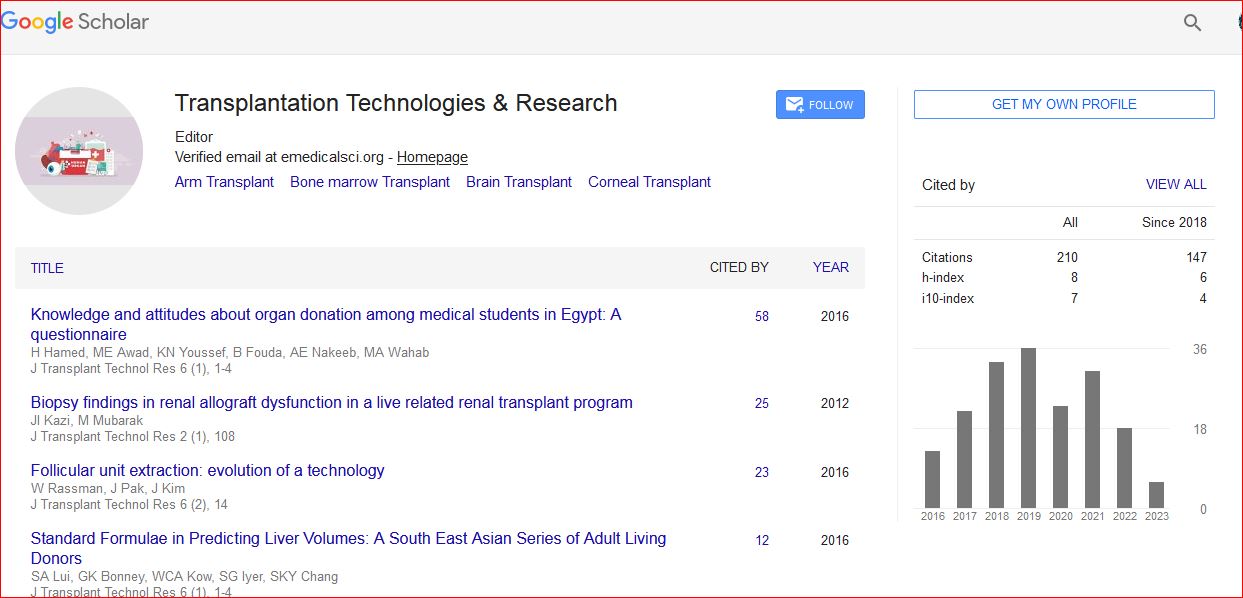
Transplantation Technologies & Research received 223 citations as per Google Scholar report