Commentary - (2025) Volume 14, Issue 5
Received: 01-Sep-2025, Manuscript No. jamk-25-177309;
Editor assigned: 03-Sep-2025, Pre QC No. P-177309;
Reviewed: 17-Sep-2025, QC No. Q-177309;
Revised: 22-Sep-2025, Manuscript No. R-177309;
Published:
29-Sep-2025
, DOI: 10.37421/2168-9601.2025.14.572
Citation: Mendez, Carlos. ”The Evolving Landscape of Corporate Sustainability.” J Account Mark 14 (2025):572.
Copyright: © 2025 Mendez C. This is an open-access article distributed under the terms of the Creative Commons Attribution License, which permits unrestricted use, distribution and reproduction in any medium, provided the original author and source are credited.
This comprehensive study meticulously investigates the intricate relationship between a companys dedication to Sustainable Development Goals and Corporate Social Responsibility, and its subsequent financial performance. A primary focus is placed on elucidating the significant moderating influence of digital transformation within this dynamic. The research underscores the escalating criticality of advanced technologies in enabling businesses to achieve both their crucial societal contributions and robust economic objectives effectively and concurrently.[1] The imperative for integrating sustainability principles into management accounting education is critically examined in this review. It thoroughly assesses the current pedagogical landscape and proposes a forwardlooking agenda for future research, advocating for a more holistic and integrated approach to equipping future professionals with the skills necessary for sustainable financial management. This ensures that accounting practices are aligned with broader environmental and social responsibilities.[2] This scholarly investigation meticulously explores the direct correlation between the adoption of green accounting practices and a firms overall sustainability performance. A central finding illuminates the crucial moderating effect of robust corporate governance structures. The study demonstrates how effective governance mechanisms are instrumental in significantly amplifying the positive outcomes derived from environmentally conscious accounting efforts, thereby enhancing the firms ecological and social impact.[3] This detailed study systematically analyzes the profound impact of adopting integrated reporting frameworks on both corporate social responsibility outcomes and a firms financial performance. The evidence strongly suggests that organizations embracing integrated reporting frequently achieve superior CSR engagements and demonstrate enhanced financial stability and growth. This reinforces the value of a comprehensive, holistic perspective on corporate value creation and stakeholder communication.[4] A systematic literature review provides a comprehensive synthesis of existing research concerning sustainability reporting and corporate social responsibility specifically within the unique context of emerging economies. This review meticulously identifies prevalent trends, highlights significant research gaps, and formulates a clear agenda for future scholarly inquiries. It aims to address the distinctive challenges and opportunities inherent in these developing regions regarding sustainable business practices.[5] This empirical research meticulously investigates the multifaceted impact of board gender diversity on sustainable reporting transparency and a firms overall financial performance, with a specific focus on emerging markets. The findings offer valuable insights into how diversified leadership compositions, particularly concerning gender representation, can profoundly and positively influence a companys commitment to sustainability initiatives and its ultimate financial viability and profitability.[6] This paper rigorously explores the intricate mechanisms through which corporate social responsibility initiatives influence a firms financial performance, employing a sophisticated moderated mediation model. The analysis reveals that strategic green innovation and judicious green investment play pivotal, intermediary roles. These factors are crucial in translating CSR activities into tangible and sustained financial success, demonstrating a sophisticated pathway for value creation.[7] The scholarly investigation presented here meticulously examines the critical role that robust Environmental, Social, and Governance ESG performance plays in effectively mitigating financial risk, drawing compelling evidence from a diverse set of European companies. The core implication is that strong and consistent ESG practices serve as an invaluable protective mechanism, significantly enhancing firms resilience against various financial uncertainties and market volatilities, fostering long term stability.[8] This insightful article meticulously elucidates how the ongoing digital transformation, alongside the strategic application of advanced technologies such as big data analytics and artificial intelligence, is fundamentally reshaping contemporary sustainable business models. It emphatically highlights their indispensable role in significantly augmenting overall corporate sustainability by introducing novel, efficient approaches to resource management, impact assessment, and value creation across various operational domains.[9] This systematic review provides a thorough examination of current sustainability accounting practices within the context of higher education institutions. It offers a comprehensive overview of existing methodologies and delineates a progressive future research agenda. The review strongly advocates for heightened accountability and enhanced transparency in the academic sectors endeavors toward achieving comprehensive environmental and social sustainability targets and reporting.[10]
The paper rigorously analyzes how digital transformation acts as a pivotal factor in shaping the interplay between a firms commitment to Sustainable Development Goals, its Corporate Social Responsibility initiatives, and ultimately its financial outcomes. It highlights the growing importance of technological advancements for companies striving to concurrently meet their social obligations and enhance their economic prosperity. This dual achievement represents a contemporary strategic imperative for businesses worldwide.[1] This critical review underscores the vital necessity of incorporating sustainability into the curriculum of management accounting education. It provides an exhaustive overview of the existing educational framework and articulates a detailed agenda for subsequent research endeavors. The authors strongly advocate for a more allencompassing pedagogical strategy to prepare accounting students for the complexities of a sustainable future, fostering a deeper understanding of ecological and social impacts in financial decisionmaking.[2] The study delves deeply into the fundamental link between an organizations engagement in green accounting practices and its resultant sustainability performance. It particularly emphasizes the significant role of corporate governance as a moderating variable. The research effectively illustrates that sound governance structures are key enablers that augment the beneficial effects of environmentally focused accounting strategies, leading to improved overall corporate sustainability metrics and responsible operational management.[3] The research meticulously evaluates the consequences of integrated reporting on corporate social responsibility and a firms financial results. It conclusively indicates that companies implementing integrated reporting systems often experience improved CSR initiatives and stronger financial health. This suggests that a more unified and comprehensive approach to corporate disclosure is beneficial, providing a holistic view of value creation that resonates with stakeholders and investors alike.[4] This systematic literature review offers an extensive examination of sustainability reporting and corporate social responsibility practices, specifically contextualized within emerging economies. The review successfully identifies prominent research trends and significant gaps in current knowledge, subsequently proposing a detailed agenda for future academic investigations. It addresses the unique operational and reporting challenges faced by businesses in these rapidly developing economic environments, providing crucial guidance for further study.[5] The research systematically explores how board gender diversity influences both the transparency of sustainable reporting and the financial performance of firms, with particular attention to emerging markets. It yields critical insights demonstrating that diverse leadership, including varied gender representation, can significantly bolster a companys dedication to sustainability practices and its economic bottom line. This highlights the strategic advantage of inclusive governance structures in developing regions.[6] The study intricately details the causal relationship between corporate social responsibility and financial performance, utilizing an advanced moderated mediation framework. Key findings underscore the critical intermediary function of both green innovation and green investment. These elements are shown to be essential conduits that effectively transform CSR endeavors into measurable financial gains, thereby presenting a nuanced understanding of how ethical commitments contribute to economic prosperity and competitive advantage.[7] This research thoroughly investigates the instrumental role of strong Environmental, Social, and Governance ESG performance in diminishing financial risk, substantiating its claims with empirical data from European enterprises. The central argument posits that exemplary ESG practices function as a crucial buffer, substantially increasing a firms capacity to withstand financial turbulence and market fluctuations. This emphasizes their strategic importance for achieving enduring corporate stability and investor confidence.[8] The article comprehensively explains how digital transformation, supported by cuttingedge technologies like big data analytics and artificial intelligence, is fundamentally redesigning sustainable business models. It underscores the essential contribution of these technologies in elevating corporate sustainability. This is achieved through facilitating innovative methods for resource optimization, precise environmental and social impact evaluations, and diversified value creation strategies in the modern economic landscape.[9] This systematic review meticulously scrutinizes the present state of sustainability accounting practices as implemented within higher education institutions. It furnishes a comprehensive survey of prevailing methodologies and outlines a forwardlooking research framework. The review vigorously champions the cause of increased accountability and greater transparency within the academic spheres persistent efforts to meet and report on its environmental and social sustainability objectives, promoting best practices.[10]
This collection of research underscores the growing importance of sustainability and corporate social responsibility CSR in modern business, examining their multifaceted impacts across various domains. Key themes include the influence of digital transformation on achieving Sustainable Development Goals SDGs and enhancing financial performance, highlighting technologys critical role in balancing societal and economic objectives. The integration of sustainability into management accounting education is emphasized as crucial for developing future professionals capable of navigating complex environmental and social responsibilities. Studies also explore the relationship between green accounting practices and sustainability performance, particularly moderated by effective corporate governance. The impact of integrated reporting on CSR outcomes and financial results is noted, advocating for a holistic view of corporate value. Research specifically investigates sustainability reporting and CSR in emerging economies, identifying unique challenges and opportunities. Board gender diversity is shown to positively influence sustainable reporting and financial performance, especially in emerging markets. Furthermore, the role of green innovation and green investment in translating CSR into financial success is explored through sophisticated models. The critical function of Environmental, Social, and Governance ESG performance in mitigating financial risk for European companies is demonstrated, positioning ESG as a resilience buffer. Digital transformation, powered by big data and AI, is identified as a key driver for sustainable business models, optimizing resource management and impact assessment. Finally, sustainability accounting practices in higher education institutions are reviewed, pushing for greater accountability and transparency in the academic sectors sustainability efforts. Together, these studies paint a comprehensive picture of the evolving landscape of corporate sustainability.
None
None
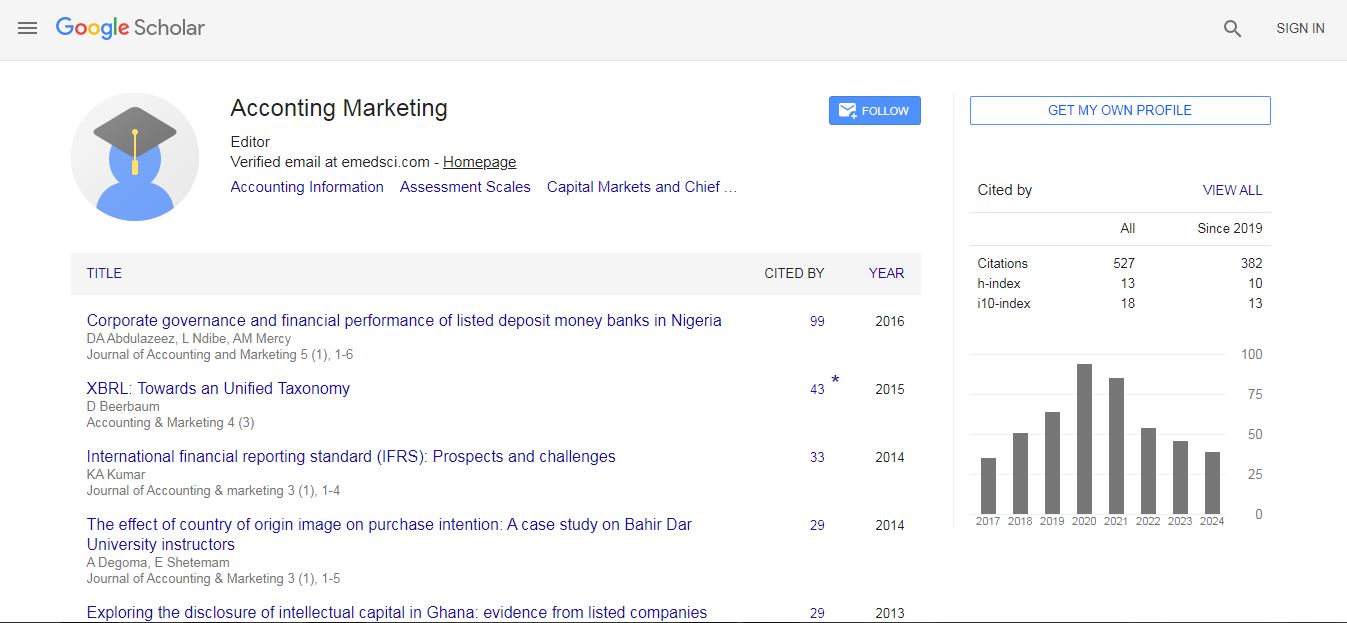
Accounting & Marketing received 487 citations as per Google Scholar report