Brief Report - (2025) Volume 14, Issue 4
Received: 02-Jul-2025, Manuscript No. jamk-25-177292;
Editor assigned: 04-Jul-2025, Pre QC No. P-177292;
Reviewed: 18-Jul-2025, QC No. Q-177292;
Revised: 23-Jul-2025, Manuscript No. R-177292;
Published:
30-Jul-2025
, DOI: 10.37421/2168-9601.2025.14.564
Citation: Tanaka, Aiko. ”Technologies Reshaping Accounting Information Systems and Audit.” J Account Mark 14 (2025):564.
Copyright: © 2025 Tanaka A. This is an open-access article distributed under the terms of the Creative Commons Attribution License, which permits unrestricted use, distribution and reproduction in any medium, provided the original author and source are credited.
Cloud computing adoption significantly reshapes AIS in small and medium sized enterprises SMEs, delivering substantial benefits such as improved data accessibility, enhanced scalability, and notable cost efficiencies. However, this transformative shift also introduces considerable challenges, primarily concerning data security and the complexities associated with system integration, which require careful strategic planning for successful implementation.[1] Blockchain technology is rapidly emerging as a foundational element within AIS, offering groundbreaking potential to elevate transparency, security, and operational efficiency across financial reporting and auditing processes. Current systematic reviews underscore its capacity to revolutionize data integrity and transactional verification, while simultaneously identifying critical areas for future research focused on addressing scalability concerns and navigating complex regulatory landscapes.[2] Artificial intelligence AI is proving to be a potent catalyst for improving the efficiency of AIS, fundamentally altering how accounting tasks are performed. By automating routine operations, AI enhances data analysis capabilities, leading to superior decision making, and significantly bolsters fraud detection mechanisms, thereby ushering in a new era of modernized accounting practices.[3] The broader trend of digital transformation profoundly impacts AIS, especially within the industrial sector, fostering the development of more agile, integrated, and responsive accounting processes. This strategic embrace of digital technologies is critical for organizations aiming to secure a competitive advantage in a dynamically evolving market, by enabling seamless information flow and operational adaptability.[4] Big data analytics plays a pivotal role in augmenting the quality of AIS, as demonstrated by empirical research. The strategic utilization of large datasets markedly improves the accuracy, relevance, and timeliness of accounting information, thereby providing a robust foundation for more informed strategic and operational decisions across various organizational tiers.[5] The Internet of Things IoT extends its influence into AIS and audit processes by facilitating the collection of real time data from interconnected devices. This rich stream of granular information significantly enhances the reliability and depth of accounting data, automates various transactional processes, and strengthens the evidentiary basis for audits, promising greater precision and efficiency.[6] A comprehensive systematic review illustrates how artificial intelligence intersects with AIS to fundamentally transform key areas such as financial reporting, auditing, and decision support functions. AI achieves this through the automation of complex tasks, the provision of predictive insights, and the enhancement of overall risk management frameworks, marking a significant paradigm shift in information processing.[7] Robotic Process Automation RPA presents both compelling opportunities and notable challenges for implementation within AIS. RPA is highly effective at streamlining repetitive accounting tasks, substantially improving data accuracy, and reallocating human capital to more analytical and strategic roles, despite common hurdles encountered during its adoption.[8] In developing countries, several key factors critically influence the adoption of AIS in small and medium sized enterprises SMEs. These factors encompass an organizations technological readiness, the perceived benefits of adoption, the level of internal organizational support, and the various external pressures that collectively shape the implementation success of these crucial systems.[9] The impact of artificial intelligence extends to the audit profession, fundamentally reshaping its integration with AIS. AI substantially elevates audit efficiency, accuracy, and scope through advanced automation of data analysis and sophisticated fraud detection capabilities, simultaneously necessitating that auditors cultivate new and adaptive skill sets to remain effective.[10]
The adoption of cloud computing in small and medium sized enterprises SMEs has fundamentally altered their accounting information systems, introducing a suite of advantages such as unparalleled data accessibility and robust scalability. It also provides significant cost efficiencies by reducing the need for extensive on premise infrastructure. Nevertheless, these benefits are balanced against the imperative to manage critical concerns like data security vulnerabilities and the inherent complexities of integrating cloud solutions with existing systems.[1] Blockchain technology is increasingly recognized for its transformative potential within accounting information systems, particularly in fortifying trust and integrity. By leveraging its decentralized and immutable ledger, blockchain offers unprecedented enhancements in financial reporting transparency, bolstering security protocols, and improving the overall efficiency of audit trails. Ongoing research continues to explore its full implications, especially concerning its long term scalability and the evolving regulatory frameworks required for widespread adoption.[2] Artificial intelligence AI serves as a powerful enabler for augmenting the operational efficiency of accounting information systems. Its capacity to automate mundane, repetitive tasks frees up human resources, allowing them to focus on more strategic activities. Furthermore, AI driven analytics tools facilitate deeper insights from financial data, leading to superior strategic decision making and significantly enhancing the accuracy and speed of fraud detection mechanisms.[3] Digital transformation initiatives are demonstrably reshaping accounting information systems, particularly within the industrial sector, by fostering greater agility and seamless integration. This strategic embrace of advanced digital technologies is instrumental in creating more responsive accounting processes that can adapt quickly to market changes, providing a crucial advantage for organizations striving for sustained competitiveness.[4] Empirical studies confirm that big data analytics substantially elevates the quality of accounting information systems. By processing vast and complex datasets, organizations can derive more accurate, relevant, and timely accounting insights. This analytical capability is indispensable for supporting strategic planning and operational decisions, allowing businesses to react proactively to emerging trends and challenges.[5] The Internet of Things IoT is increasingly interweaving with accounting information systems and audit functions, primarily through its ability to generate real time data from connected devices. This constant stream of granular data enhances the precision and reliability of accounting records, facilitates the automation of transactional processes, and provides a richer, more verifiable source of audit evidence, thereby modernizing traditional practices.[6] A systematic review of current literature highlights the multifaceted impact of artificial intelligence on accounting information systems, emphasizing its role in revolutionizing various facets of financial operations. AIs capabilities extend to automating complex financial reporting procedures, delivering predictive analytical insights, and significantly strengthening risk management frameworks, ultimately optimizing organizational performance and strategic foresight.[7] Robotic Process Automation RPA is being implemented within accounting information systems to address the need for greater operational efficiency. RPA tools excel at automating high volume, rules based tasks, which not only improves the accuracy of data processing but also allows human accountants to dedicate their expertise to more value added analytical and interpretive responsibilities, albeit with considerations for integration challenges.[8] The adoption of accounting information systems in small and medium sized enterprises SMEs in developing countries is contingent upon several critical factors. These include the technological readiness of the enterprise, the perceived value and benefits that management anticipates from the system, the extent of organizational support provided for implementation, and external pressures that might mandate or incentivize such technological upgrades.[9] The profound influence of artificial intelligence also extends directly to the audit profession, fundamentally altering its interaction with accounting information systems. AIs advanced algorithms enhance audit efficiency and expand the scope of analysis by automating intricate data reviews and improving fraud detection capabilities, consequently requiring auditors to acquire and refine new technical and analytical competencies.[10]
The provided research highlights the profound impact of advanced technologies on Accounting Information Systems AIS, particularly within SMEs and various industrial sectors. Cloud computing enhances data accessibility, scalability, and cost efficiency for SMEs, despite security and integration challenges. Blockchain technology promises increased transparency, security, and efficiency in financial reporting and auditing, necessitating further research into scalability and regulatory aspects. Artificial intelligence significantly improves AIS efficiency by automating routine tasks, enhancing data analysis for better decision making, and bolstering fraud detection, with systematic reviews underscoring its transformative role in financial reporting, auditing, and risk management. Digital transformation initiatives drive AIS towards more agile and integrated processes, crucial for competitive advantage. Big data analytics improves the accuracy, relevance, and timeliness of accounting information, supporting informed strategic decisions. The Internet of Things enhances AIS and audit processes through real time data, automating transactions and improving audit evidence. Robotic Process Automation streamlines repetitive accounting tasks, improving data accuracy and reallocating human resources to analytical roles, while also presenting implementation hurdles. Furthermore, factors such as technological readiness, perceived benefits, organizational support, and external pressures are critical for AIS adoption in SMEs in developing countries. Collectively, these technologies are reshaping the audit profession, demanding new skills and capabilities from auditors.
None
None
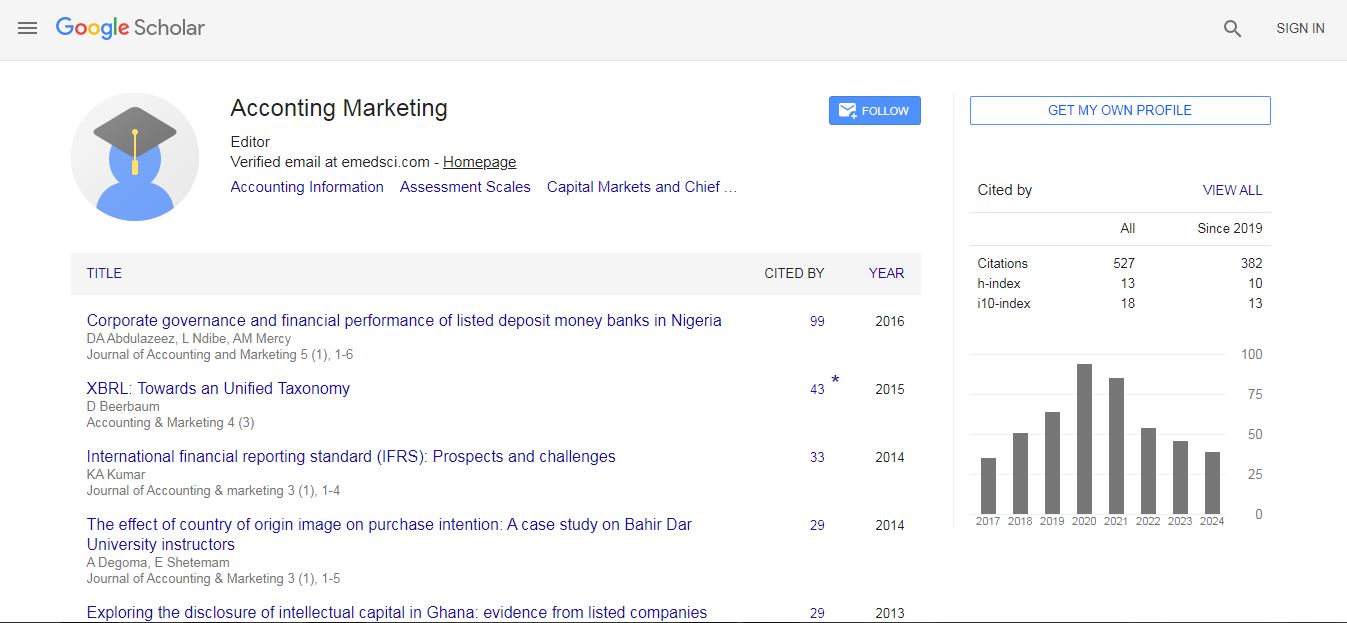
Accounting & Marketing received 487 citations as per Google Scholar report