Brief Report - (2025) Volume 14, Issue 2
Received: 01-Mar-2025, Manuscript No. jamk-25-177262;
Editor assigned: 03-Mar-2025, Pre QC No. P-177262;
Reviewed: 17-Mar-2025, QC No. Q-177262;
Revised: 24-Mar-2025, Manuscript No. R-177262;
Published:
31-Mar-2025
, DOI: 10.37421/2168-9601.2025.14.544
Citation: Verma, Neha. ”Strategic Marketing: Fueling Outcomes and Customer Loyalty.” J Account Mark 14 (2025):544.
Copyright: © 2025 Verma N. This is an open-access article distributed under the terms of the Creative Commons Attribution License, which permits unrestricted use, distribution and reproduction in any medium, provided the original author and source are credited.
The dynamic landscape of modern commerce necessitates effective digital marketing strategies, particularly for small and medium-sized enterprises (SMEs). This paper systematically reviews how these strategies influence organizational performance, highlighting key digital tactics that drive growth. It offers a clear roadmap for future research, identifying effective approaches tailored for SMEs to foster sustained competitive advantage and market expansion [1].
Understanding the power of content marketing is paramount in the digital age. This research explores how content quality, customer trust, and the perceived value of content collectively drive engagement and foster loyalty. It demonstrates that strategic content marketing is instrumental in building strong customer relationships, ultimately leading to measurable business benefits and reinforcing market position [2].
Social media has become a critical instrument for brand development. This study reveals how strategic social media marketing activities build brand equity by enhancing brand trust and loyalty. It highlights the direct and indirect mechanisms through which effective social media engagement consistently contributes to stronger brands, creating a powerful competitive advantage [3].
Effective Customer Relationship Management (CRM) strategies are indispensable for lasting customer connections, especially in competitive service sectors like banking. This paper investigates how CRM influences customer satisfaction and loyalty. Well-implemented CRM initiatives are crucial for cultivating enduring customer relationships and driving sustained business success, enhancing stakeholder value in the financial industry [4].
The era of big data offers unprecedented opportunities for personalized marketing. This research demonstrates that personalized marketing effectively drives consumer purchasing intention by enhancing perceived value and trust. It highlights the critical importance of data-driven personalization in capturing consumer interest and efficiently converting it into concrete sales, optimizing market conversion rates [5].
Influencer marketing is a potent force, requiring a deep understanding of its mechanisms. This study examines how influencer marketing drives purchase intention, focusing on source credibility, engaging content characteristics, and para-social interaction. It illustrates that selecting the right influencers and crafting authentic messages are key to truly effective and impactful campaigns [6].
Creating memorable customer journeys is vital for brand distinction. This research demonstrates that experiential marketing significantly boosts brand loyalty through enhanced brand experiences and customer satisfaction. It emphasizes the strategic imperative of creating truly unforgettable customer interactions to build strong, lasting brand connections and foster long-term allegiance [7].
Marketing automation adoption represents a pivotal shift towards enhanced efficiency. This study explores the factors driving its adoption and its impact on performance. It identifies key determinants that consistently lead to successful implementation and demonstrably improved marketing efficiency, heightened effectiveness, and ultimately, superior business outcomes [8].
As environmental concerns grow, green marketing strategies are essential for market differentiation. This research investigates how green marketing influences consumer buying behavior, mediated by environmental concern and brand image. Findings show that authentic green initiatives can significantly drive consumer preference and boost sales, aligning business objectives with ecological responsibility [9].
Building enduring customer relationships is a cornerstone of sustained business success, especially in the hospitality sector. This study explores how relationship marketing strategies foster customer loyalty. It identifies key elements of relationship building that lead to sustained customer engagement and repeat business, crucial for long-term growth and competitive advantage [10].
Digital marketing strategies are increasingly vital for enterprises, particularly Small and Medium-sized Enterprises (SMEs), where resource optimization is critical. This comprehensive paper offers a systematic review, detailing how digital marketing tactics impact the overall performance of these businesses. It pinpoints effective digital strategies that stimulate growth and outlines a structured research agenda to refine approaches for SMEs, ensuring market penetration [1]. In the competitive digital landscape, content marketing is a powerful tool for cultivating strong customer bonds. This study delves into how content quality, customer trust, and perceived value work in concert to drive increased engagement and foster profound loyalty. Findings confirm that a well-orchestrated content marketing strategy is fundamental to building robust customer relationships, yielding substantial and quantifiable business benefits [2]. The pervasive influence of social media in contemporary business makes understanding its strategic impact on brand equity imperative. This research reveals how diligently executed social media marketing activities contribute to strengthening a brand's market value. It highlights enhancing brand trust and cultivating brand loyalty as key drivers, detailing pathways through which engagement strengthens brand perception and market presence [3]. Customer Relationship Management (CRM) is a cornerstone of modern business, particularly pronounced in customer-centric industries like banking. This paper investigates how robust CRM strategies influence customer satisfaction and loyalty. It elucidates that thoughtfully designed and effectively implemented CRM initiatives are crucial for constructing enduring customer relationships, pivotal in driving sustained business success within the dynamic banking sector [4]. The advent of big data analytics has revolutionized marketing, enabling unprecedented personalization. This compelling research provides empirical evidence that personalized marketing is highly effective in stimulating consumer purchasing intention. This effect is predominantly mediated by an increase in consumers' perceived value and heightened trust, underscoring the critical importance of leveraging data-driven personalization for tangible sales [5]. Influencer marketing has become a dominant force in shaping consumer decisions. This study analyzes the core components through which influencer marketing drives purchase intention, focusing on source credibility, engaging content characteristics, and para-social interaction. It articulates that judiciously selecting influencers and meticulously crafting authentic messages are essential for achieving truly effective and impactful marketing campaigns [6]. Creating distinctive and memorable customer experiences is a powerful differentiator. This research definitively illustrates that experiential marketing significantly contributes to boosting brand loyalty. This outcome is achieved through the enhancement of brand experiences and a consequent increase in customer satisfaction, emphasizing the strategic necessity of designing unforgettable customer interactions for lasting brand connections and allegiance [7]. The strategic implementation of marketing automation is recognized as a catalyst for efficiency. This study investigates antecedent factors contributing to its adoption and assesses its impact on performance. It identifies key determinants leading to successful technological integration, demonstrating how automation leads to improvements in marketing efficiency and effectiveness, thereby enhancing a company's competitive posture [8]. With growing global environmental awareness, green marketing strategies gain traction in influencing consumer behavior. This research systematically examines how green marketing initiatives influence buying decisions. It identifies environmental concern and a strong green brand image as crucial mediating factors. Findings suggest genuine green initiatives profoundly shape consumer preferences and significantly boost sales, aligning business objectives with ecological responsibility [9]. Developing and nurturing strong customer relationships is foundational for long-term commercial viability, particularly in the hospitality sector. This study explores the efficacy of relationship marketing strategies in fostering unwavering customer loyalty. It delineates essential components of effective relationship building that consistently result in sustained customer engagement and repeat business, critical for enduring success in a service-driven environment [10].
The collective body of research underscores the multifaceted nature of modern marketing strategies and their profound impact on various business outcomes. Digital marketing, content marketing, social media marketing, and personalized marketing consistently emerge as pivotal drivers for enterprise growth, brand equity, customer engagement, and purchase intention across diverse sectors. Key insights reveal that for small and medium-sized enterprises, digital tactics are crucial for performance enhancement, while content quality, trust, and perceived value are central to fostering customer loyalty. Social media engagement significantly builds brand trust and loyalty, thereby elevating brand equity. Furthermore, effective Customer Relationship Management (CRM) strategies are vital for ensuring customer satisfaction and fostering long-term loyalty, exemplified in the banking sector. The power of personalization, particularly in the big data era, is shown to directly influence consumer purchasing decisions through increased perceived value and trust. Influencer marketing, when built on credibility and authentic content, proves effective in driving purchase intention, while experiential marketing enhances brand loyalty through memorable customer interactions. The adoption of marketing automation is identified as a key factor for improving marketing efficiency and effectiveness. Lastly, green marketing strategies, by addressing environmental concerns and building a strong green brand image, significantly influence consumer buying behavior, and relationship marketing fundamentally ensures customer loyalty, especially in hospitality. These studies collectively emphasize the strategic imperative of integrated, customer-centric approaches to achieve sustained business success and competitive advantage.
None
None
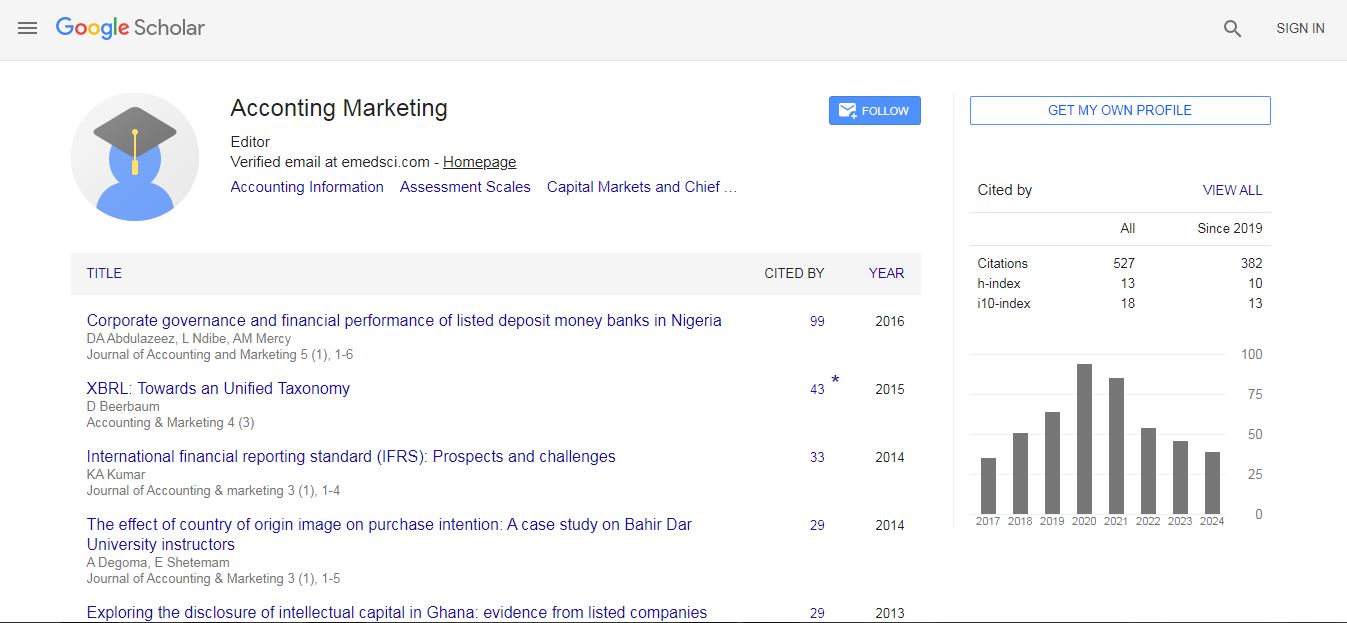
Accounting & Marketing received 487 citations as per Google Scholar report