Short Communication - (2025) Volume 14, Issue 6
Received: 01-Nov-2025, Manuscript No. jamk-25-177334;
Editor assigned: 03-Nov-2025, Pre QC No. P-177334;
Reviewed: 17-Nov-2025, QC No. QQ-177334;
Revised: 24-Nov-2025, Manuscript No. R-177334;
Published:
29-Nov-2025
, DOI: 10.37421/2168-9601.2025.14.590
Citation: Horváth, Eva. ”Social Media Marketing: Evolving Impact and Ethics.” J Account Mark 14 (2025):590.
Copyright: © 2025 Horváth E. This is an open-access article distributed under the terms of the Creative Commons Attribution License, which permits unrestricted use, distribution and reproduction in any medium, provided the original author and source are credited.
Research by Khan, Safdar, and Shahbaz elucidates the profound influence of social media influencers on consumer trust and subsequent purchasing behaviors. These digital figures transcend traditional advertising paradigms by cultivating genuine connections with their audience, thereby establishing a unique form of persuasion. For brands, a nuanced comprehension of the psychological underpinnings of influencer endorsements is paramount to effectively engage and sway target demographics, prioritizing authenticity and perceived relatability [1].
Shahriar, Khan, and Akter investigate the intricate relationship between social media marketing initiatives and organizational performance. Their work underscores the pivotal roles of customer engagement and brand equity as crucial mediators in this dynamic. Effective social media strategies are not merely promotional but are instrumental in fostering robust customer relationships and augmenting brand value, which collectively drive superior business outcomes [2].
Al-Momen, Al-Malkawi, and Al-Maqaleh explore the burgeoning impact of artificial intelligence within the realm of social media marketing. Their analysis outlines contemporary trends, identifies inherent challenges, and forecasts future trajectories for this transformative technology. AI is increasingly redefining how brands interact with consumers, automating processes, personalizing content, and optimizing campaign efficacy, albeit introducing new complexities for marketing professionals [3].
Irfan, Khan, and Shabbir present an empirical examination of how user-generated content influences brand trust and purchase intent within social media marketing contexts. Their findings suggest that authentic content produced by users often resonates more deeply with potential customers than conventional brand communications. This peer endorsement significantly enhances consumer confidence and purchase consideration, highlighting the potency of genuine advocacy [4].
Abebe, Eshete, and Mitku conduct a meta-analysis to comprehensively understand the factors contributing to the effectiveness of social media advertising. This synthesis of numerous studies pinpoints key determinants influencing consumer responses to advertisements on digital platforms. Such insights are invaluable for marketers aiming to optimize campaigns, ensuring messages cut through digital noise and genuinely connect with target audiences, ultimately improving return on investment [5].
Brindley, Watson, and Smith investigate how sustainability-focused brands leverage social media to engage consumers. Their research highlights the specific strategies green brands employ to communicate their ethical values and cultivate online communities aligned with environmental consciousness. Social media platforms serve not only as sales channels but also as powerful instruments for constructing a brand's ethical image and mobilizing consumers around shared ecological objectives [6].
Kemperman, Muijres, and Van Vuuren provide a systematic literature review on the phenomenon of employee advocacy on social media. This review identifies current trends and proposes future research avenues, demonstrating how empowered employees can become influential brand ambassadors. An engaged workforce actively promoting their employer online represents a valuable, yet frequently underutilized, marketing asset capable of expanding reach and enhancing reputation [7].
Parnaby, Smith, and Jones examine consumer privacy concerns and the management of personal data within social media marketing from a consumer-centric viewpoint. Their work emphasizes the critical balance marketers must maintain between offering personalized experiences and respecting user privacy. Transparency in data utilization is paramount for building trust and preventing alienation of consumers who are increasingly vigilant about their personal information online [8].
Miller, Rauschnabel, and Schliesing offer a systematic review mapping the nascent field of marketing within the metaverse. This study delineates current knowledge and suggests future research directions for this novel digital environment. The metaverse is posited as a new frontier where brands can craft immersive experiences and direct consumer engagement, necessitating marketer preparation for virtual economies and interactive brand spaces [9].
Krupina, Blatov, and Starostina summarize existing research on B2B social media marketing and identify gaps for future scholarly inquiry. Their review underscores how businesses utilize social platforms not merely for broad consumer outreach but for strategic objectives such as building professional networks, generating leads, and fostering partnerships. B2B social media focuses on establishing authority, demonstrating value, and nurturing relationships throughout complex sales cycles [10].
Khan, Safdar, and Shahbaz delve into the psychological mechanisms through which social media influencers cultivate consumer trust. They argue that the authenticity perceived in influencer endorsements creates a more profound impact on purchase decisions compared to traditional advertising. This necessitates brands to strategically align with influencers whose values resonate with their target audience to foster genuine connections and bolster credibility [1]. Shahriar, Khan, and Akter further elaborate on the synergistic relationship between robust social media marketing efforts and subsequent improvements in firm performance. Their model proposes that customer engagement, nurtured through consistent and meaningful interactions, directly contributes to enhanced brand equity. This strengthened brand equity, characterized by increased recognition and perceived value, then acts as a direct catalyst for superior business outcomes and competitive advantage [2]. Al-Momen, Al-Malkawi, and Al-Maqaleh detail the practical applications and theoretical implications of artificial intelligence in social media marketing. They discuss how AI-powered tools facilitate advanced data analytics, enabling marketers to gain deeper insights into consumer behavior, automate content creation and distribution, and optimize campaign targeting with unprecedented precision. However, they also caution about the ethical considerations and skill gaps that arise with AI adoption [3]. Irfan, Khan, and Shabbir empirically demonstrate that user-generated content (UGC) significantly outperforms brand-generated content in fostering brand trust and influencing purchase intent. Their study suggests that UGC is perceived as more credible and authentic, particularly when it originates from peers or trusted individuals within a consumerâ??s social network. This organic advocacy serves as a powerful testament to a productâ??s value, driving consumer conversion [4]. Abebe, Eshete, and Mitku conduct a rigorous meta-analysis, synthesizing findings across diverse studies to identify universal drivers of social media advertising effectiveness. Their research provides a framework for understanding how factors such as ad creativity, message relevance, platform choice, and audience targeting collectively impact consumer engagement, recall, and ultimately, purchase likelihood, offering actionable insights for campaign optimization [5]. Brindley, Watson, and Smith articulate the specific strategies employed by green brands to effectively communicate their sustainability ethos via social media platforms. They highlight the importance of transparent reporting on environmental initiatives, engaging storytelling that reflects brand values, and fostering interactive communities where consumers can share their environmentally conscious practices, thereby reinforcing the brand's ethical standing [6]. Kemperman, Muijres, and Van Vuuren systematically review the emerging literature on employee advocacy on social media. They outline how organizations can empower their employees to become authentic brand voices, leveraging personal networks to disseminate positive messages about the company culture, products, or services. This strategy not only expands brand reach but also enhances employer branding and talent acquisition efforts through genuine testimonials [7]. Parnaby, Smith, and Jones offer a critical examination of consumer perceptions regarding privacy and data management in social media marketing. Their study reveals a pervasive tension between consumers' desire for personalized experiences and their concerns about the collection and use of their personal data. They advocate for clear privacy policies and transparent data practices to build and maintain consumer trust in an increasingly data-driven marketing landscape [8]. Miller, Rauschnabel, and Schliesing provide a foundational overview of marketing opportunities and challenges within the nascent metaverse. They envision a future where brands establish persistent virtual presences, engage consumers through immersive experiences, and participate in decentralized economies. Their review emphasizes the need for marketers to develop new strategies for virtual product placement, avatar-based interactions, and digital asset ownership [9]. Krupina, Blatov, and Starostina present a comprehensive review of B2B social media marketing, distinguishing it from B2C approaches. They detail how businesses leverage platforms like LinkedIn for thought leadership, lead generation, and nurturing client relationships through targeted content and professional engagement. This strategic use of social media fosters trust, establishes credibility, and ultimately shortens the B2B sales cycle by providing valuable resources [10].
The collected research comprehensively explores various facets of social media marketing, emphasizing its evolving landscape and profound impact on consumer behavior and business performance. Key themes include the critical role of social media influencers and user-generated content in building consumer trust and driving purchase decisions. Studies also highlight the mediating effects of customer engagement and brand equity on firm performance in response to social media marketing efforts. The integration of advanced technologies like artificial intelligence is identified as a significant trend, transforming content personalization and campaign optimization while presenting new challenges. Furthermore, specialized applications of social media marketing are examined, such as strategies for sustainability-focused brands, the phenomenon of employee advocacy, and the unique dynamics of B2B marketing. Emerging frontiers, particularly marketing within the metaverse, are also reviewed, signaling future directions for brand engagement. Throughout these explorations, consumer privacy concerns and ethical data management are recurring considerations, underscoring the need for transparency and trust in digital interactions.
None
None
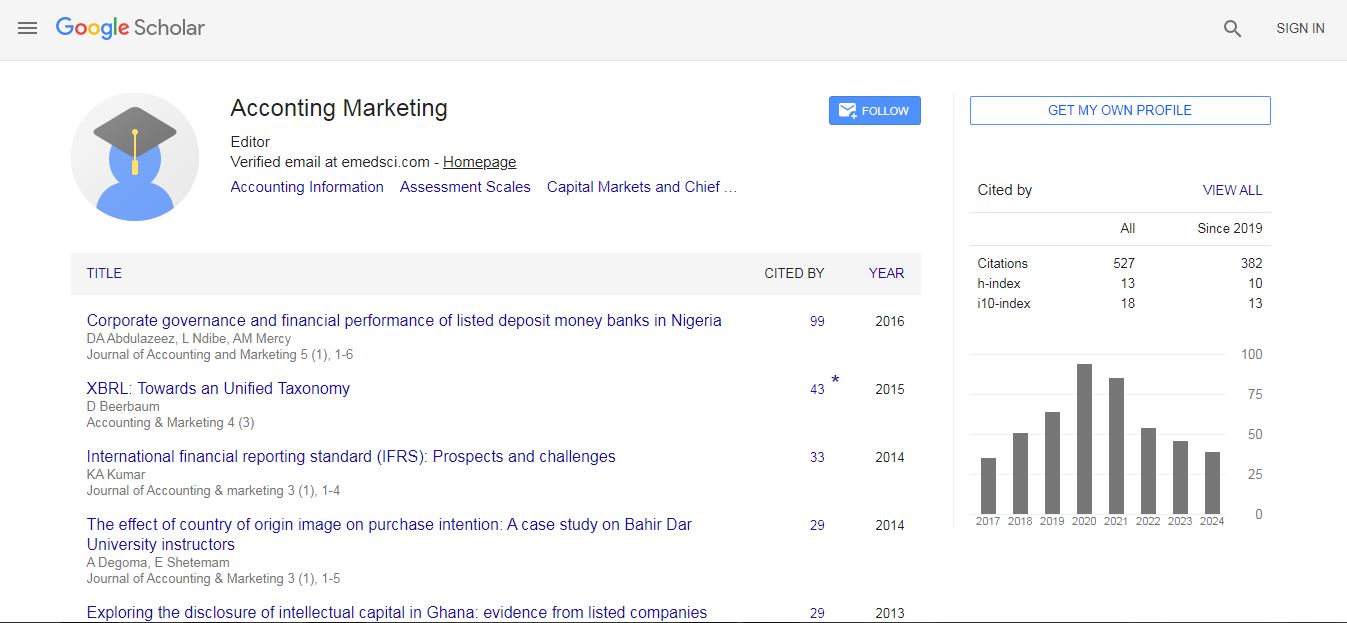
Accounting & Marketing received 487 citations as per Google Scholar report