Commentary - (2025) Volume 14, Issue 2
Received: 01-Mar-2025, Manuscript No. jamk-25-177260;
Editor assigned: 03-Mar-2025, Pre QC No. P-177260;
Reviewed: 17-Mar-2025, QC No. Q-177260;
Revised: 24-Mar-2024, Manuscript No. R-177260;
Published:
31-Mar-2025
, DOI: 10.37421/2168-9601.2025.14.542
Citation: Sharma, Ananya. ”SME Success: Literacy, Accounting, Technology Integration.” J Account Mark 14 (2025):542.
Copyright: © 2025 Sharma A. This is an open-access article distributed under the terms of the Creative Commons Attribution License, which permits unrestricted use, distribution and reproduction in any medium, provided the original author and source are credited.
Financial literacy is critically important for small business owners, directly influencing their financial management practices. This includes understanding basic accounting concepts and engaging in sound financial planning, which are shown to contribute significantly to business stability and overall growth. Entrepreneurs are thus compelled to grasp their financial statements and acquire the ability to make well-informed decisions. [1].
Research confirms that the adoption of proper accounting practices leads to a direct improvement in the performance of small and medium enterprises. Systematic record-keeping, strict adherence to established accounting standards, and regular financial reporting are not merely compliance obligations; they are identified as fundamental drivers for achieving operational efficiency and enhancing profitability. [2].
Key factors that influence the quality of financial reporting in small and medium-sized enterprises have been pinpointed. These encompass strong internal controls, the appropriate utilization of accounting software, and the demonstrated competence of accounting personnel. Such elements are crucial for ensuring the accuracy and reliability of financial statements, which in turn facilitates better decision-making and fosters greater transparency. [3].
The fundamental role of robust bookkeeping and comprehensive financial literacy for the long-term sustainability of small and medium enterprises has been extensively emphasized. Maintaining precise and accurate records, alongside a deep understanding of financial concepts, is considered vital. These practices serve not just as compliance requirements but as essential tools for strategic planning, optimal resource allocation, and ultimately, ensuring business survival and enduring success. [4].
This body of research explores how various managerial accounting practices directly influence the performance metrics of small and medium enterprises. Effective budgeting, thorough cost analysis, and precise performance measurement tools are illustrated to provide invaluable insights. These insights are instrumental for implementing operational improvements, guiding strategic decision-making processes, and consistently achieving superior financial outcomes for businesses. [5].
The transformative impact of digital accounting solutions on financial management for small and medium-sized enterprises is a significant focus. Adopting modern digital tools is explained to streamline bookkeeping operations, substantially enhance reporting accuracy, and provide real-time financial insights. These capabilities are critically important for agile decision-making and maintaining high operational efficiency in today's dynamic business environment. [6].
Research clearly demonstrates the significant positive effect that robust accounting information systems AIS have on the overall performance of small and medium enterprises. A well-implemented AIS improves data accuracy, simplifies complex financial processes, and effectively supports strategic planning initiatives. This directly contributes to heightened operational effectiveness and sustainable business growth within these organizations. [7].
Financial literacy plays a critical and undeniable role in the success trajectory of small businesses. Entrepreneurs who possess a strong foundational understanding of financial concepts are consistently better equipped to manage cash flow effectively, make sagacious investment decisions, and adeptly navigate various economic challenges. This enhanced capability ultimately fosters sustained business growth and strengthens overall resilience. [8].
This study investigates the profound influence of the quality of accounting information on managerial decision-making processes within small and medium enterprises. It firmly concludes that accurate, timely, and highly relevant accounting data forms the bedrock for effective strategic planning, efficient resource allocation, and achieving superior overall business performance. This underscores the imperative for developing and maintaining robust information systems. [9].
Key factors that drive the successful adoption of accounting software among small and medium enterprises have been thoroughly identified. These include the perceived benefits of such software, its ease of use, and the crucial element of strong management support. Embracing technology in accounting can significantly enhance operational efficiency, improve data accuracy, and provide strategic financial oversight for businesses, leading to competitive advantages. [10].
An in-depth study highlights that financial literacy is essential for small business owners, directly shaping their approach to financial management. The study emphasizes that possessing basic accounting knowledge and engaging in meticulous financial planning are vital for achieving business stability and growth, thereby requiring entrepreneurs to fully comprehend their financial statements and execute knowledgeable decisions. [1]. This investigation confirms that the implementation of sound accounting practices directly correlates with improved performance in small and medium enterprises. It stresses that diligent record-keeping, strict compliance with accounting standards, and consistent financial reporting are not merely administrative duties but fundamental catalysts for boosting operational efficiency and maximizing profitability across the organization. [2]. Factors that significantly impact the quality of financial reporting within small and medium-sized enterprises are thoroughly examined. This analysis identifies strong internal controls, the judicious selection and deployment of accounting software, and the inherent proficiency of accounting personnel as indispensable elements. These components are vital for producing financial statements that are both accurate and reliable, facilitating superior decision-making and enhancing organizational transparency. [3]. The foundational importance of robust bookkeeping and comprehensive financial literacy for the enduring sustainability of small and medium enterprises is profoundly asserted. It argues that meticulous record maintenance and a thorough understanding of financial concepts are more than just obligatory requirements. Instead, they represent critical instruments for sophisticated strategic planning, efficient resource allocation, and ultimately, securing the long-term survival of the business. [4]. This research delves into how managerial accounting practices profoundly influence the performance of small and medium enterprises. It vividly illustrates that the adept application of budgeting strategies, comprehensive cost analysis, and rigorous performance measurement tools offers invaluable insights. These insights are crucial for driving substantial operational improvements, facilitating astute strategic decision-making, and systematically achieving enhanced financial outcomes. [5]. The article elucidates the profound and transformative impact of digital accounting solutions on the financial management landscape for small and medium-sized enterprises. It explains that the adoption of these advanced digital tools substantially streamlines bookkeeping processes, significantly elevates reporting accuracy, and delivers real-time financial insights. These benefits are indispensable for fostering agile decision-making and optimizing operational efficiency within the contemporary business environment. [6]. This study provides compelling evidence of the substantial positive effect that well-established accounting information systems have on the holistic performance of small and medium enterprises. It clarifies that such robust AIS implementations actively improve data precision, streamline intricate financial processes, and effectively bolster strategic planning efforts. This collective impact contributes directly to superior operational effectiveness and sustained business expansion. [7]. The pivotal role that financial literacy assumes in determining the success of small businesses is explicitly highlighted. It emphasizes that entrepreneurs endowed with a profound understanding of financial concepts are distinctly better equipped to proficiently manage cash flow, execute judicious investment decisions, and adeptly navigate complex economic challenges. This proficiency is instrumental in fostering sustainable business growth and enhancing overall resilience. [8]. This research meticulously investigates the degree to which the quality of accounting information influences managerial decision-making within small and medium enterprises. It definitively concludes that accurate, timely, and genuinely relevant accounting data serves as the cornerstone for effective strategic planning, optimized resource allocation, and achieving superior overall business performance. This underscores the paramount need for developing and maintaining robust information systems. [9]. Key factors that significantly influence the adoption rates of accounting software among small and medium enterprises are systematically identified. The research reveals that perceived advantages, the intuitive ease of use, and unwavering management support are crucial determinants. This highlights how embracing technological advancements in accounting can profoundly enhance operational efficiency, bolster data accuracy, and provide strategic financial oversight for businesses, yielding significant competitive advantages. [10].
The aggregated research consistently demonstrates the paramount significance of effective financial management practices for the vitality and sustained success of small and medium enterprises SMEs. A foundational insight across these studies is the critical role of financial literacy, which empowers business owners to interpret financial data, manage liquidity, and formulate strategic decisions, thereby directly fostering business stability and growth. Furthermore, the systematic application of sound accounting practices, encompassing meticulous record-keeping, adherence to accounting standards, and regular financial reporting, is shown to be a direct catalyst for improved operational efficiency and enhanced profitability. The quality of financial reporting itself is significantly bolstered by robust internal controls, appropriate accounting software, and competent personnel, ensuring accuracy and transparency in financial disclosures. Managerial accounting tools, such as budgeting and cost analysis, offer crucial analytical insights for operational refinements. In the contemporary business landscape, the integration of digital accounting solutions and advanced accounting information systems is increasingly vital. These technologies streamline processes, elevate data accuracy, and enable agile decision-making and proactive strategic planning. The impetus for adopting such technological innovations stems from their perceived benefits, user-friendliness, and essential management endorsement. In essence, the synergistic interplay of financial literacy, diligent accounting practices, high-quality financial reporting, and technological integration forms the bedrock of SME performance, resilience, and their ability to achieve long-term sustainability.
None
None
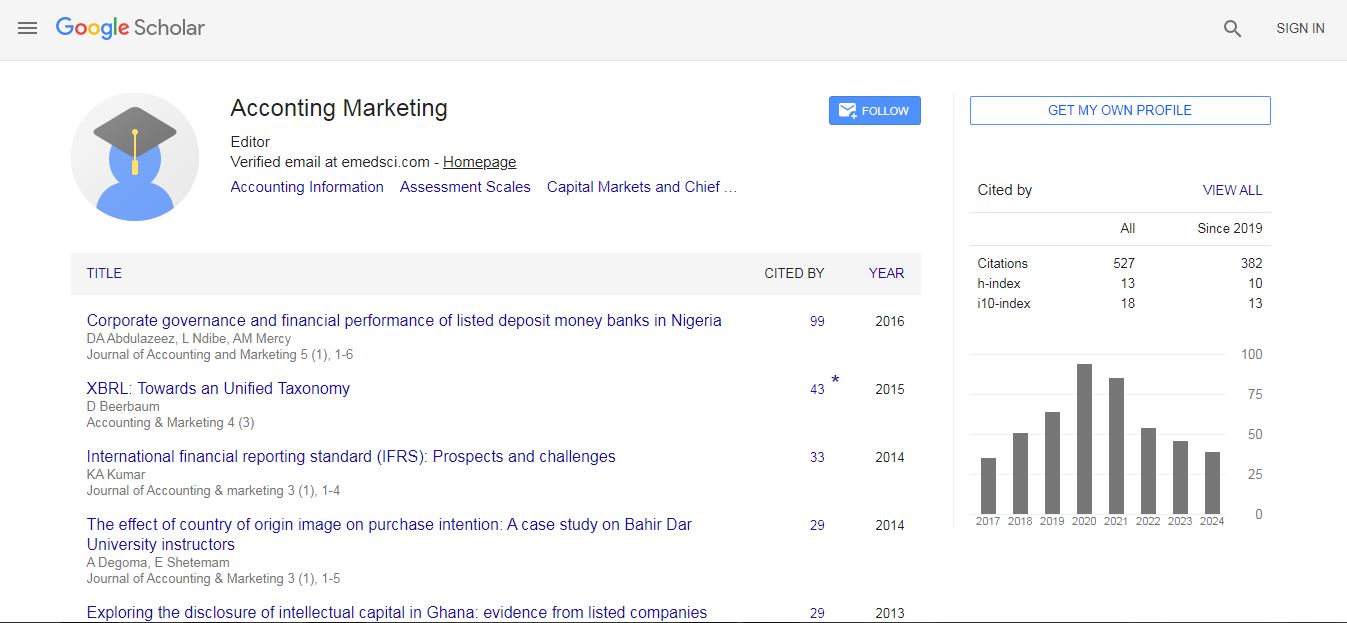
Accounting & Marketing received 487 citations as per Google Scholar report