Commentary - (2025) Volume 11, Issue 5
Received: 01-Oct-2025, Manuscript No. jctt-26-188424;
Editor assigned: 03-Oct-2025, Pre QC No. P-188424;
Reviewed: 17-Oct-2025, QC No. Q-188424;
Revised: 22-Oct-2025, Manuscript No. R-188424;
Published:
29-Oct-2025
, DOI: 10.37421/2471-9323.2024.10.342
Citation: Popescu, Andrei. ”Scientific Advancements in Hair and Skin Health.” J Cosmo Tricho 11 (2025):342.
Copyright: © 2025 Popescu A. This is an open-access article distributed under the terms of the Creative Commons Attribution License, which permits unrestricted use, distribution and reproduction in any medium, provided the original author and source are credited.
The intricate relationship between genetics and environmental factors significantly influences the aging process of both hair and skin, necessitating a deep understanding of the underlying biological mechanisms to develop effective therapeutic strategies [1].
Cosmetic science and dermatological research are continually exploring novel approaches aimed at enhancing hair vitality and skin radiance by focusing on advancements in ingredient formulation and delivery systems. This field of study is increasingly recognizing the pivotal role of the scalp microbiome in maintaining healthy hair follicles and promoting hair growth [2].
Bacterial and fungal communities on the scalp can profoundly influence follicular function and modulate inflammatory responses, opening avenues for targeted microbiome therapies to combat common hair loss and scalp conditions. Recent advancements in cosmetic science have highlighted the efficacy of novel peptide complexes in stimulating collagen production and improving skin elasticity [3].
These findings provide a strong basis for their application in anti-aging formulations, addressing the complex mechanisms of dermal aging and the persistent need for effective cosmetic interventions. Furthermore, the protective capabilities of antioxidants derived from natural sources against UV-induced skin damage are being extensively investigated [4].
These compounds play a crucial role in mitigating oxidative stress and preserving the integrity of the skin barrier, offering valuable insights for the development of sun protection and skin repair products. In the realm of hair regeneration, research into plant stem cell extracts has shown promising results in stimulating hair follicle growth [5].
Studies indicate that these extracts can enhance hair density and thickness, presenting a new and innovative avenue for treating alopecia through advanced botanical cosmetic science. The unique challenges posed by extreme environments, such as microgravity, on skin structure and function are also under scrutiny [6].
Understanding cellular changes and adaptations in such conditions is vital for developing specialized skincare solutions, underscoring the importance of comprehensive skin physiology research. Exosome technology is emerging as a powerful tool for targeted delivery of therapeutic agents to hair follicles, with significant potential for enhancing hair regeneration and treating hair loss disorders [7].
The mechanisms of exosome uptake and their therapeutic implications are key areas of focus in advanced trichology. The application of botanical extracts with anti-inflammatory properties offers a promising approach for managing common skin conditions like eczema and psoriasis [8].
These natural ingredients demonstrate potential in soothing irritated skin and reinforcing the skin barrier function. Innovative treatment modalities such as microneedling, when combined with topical agents, are showing enhanced efficacy in addressing hair loss and improving scalp health [9].
This approach capitalizes on increased penetration of active ingredients and stimulation of regenerative processes within the scalp. Finally, the critical role of the skin barrier in protecting against environmental pollutants and preventing premature skin aging and sensitivity is paramount [10].
Strategies focused on strengthening the skin barrier through carefully selected cosmetic ingredients and formulations are essential for maintaining skin health.
The interplay between genetics and environmental exposures presents a complex challenge in understanding and mitigating hair and skin aging [1].
Cosmetic science and dermatological research are actively pursuing novel strategies to enhance hair vitality and skin radiance through sophisticated ingredient formulation and delivery systems. The scalp microbiome has emerged as a critical factor in maintaining scalp health and fostering robust hair growth [2].
The composition of bacterial and fungal communities on the scalp influences follicular activity and inflammatory pathways, suggesting that microbiome-targeted therapies could be highly effective for prevalent hair loss and scalp issues. Recent scientific investigations have demonstrated the significant efficacy of novel peptide complexes in boosting collagen synthesis and improving dermal elasticity [3].
These findings strongly support their integration into anti-aging cosmetic formulations, addressing the multifaceted nature of skin aging and the ongoing demand for efficacious treatments. In photoprotection, natural antioxidants are being recognized for their ability to shield the skin from UV-induced damage [4].
Their capacity to counteract oxidative stress and fortify the skin barrier is crucial for developing advanced sunscreens and restorative skincare products. Botanical cosmetic science is exploring the potential of plant stem cell extracts for stimulating hair follicle regeneration and promoting hair growth [5].
Preliminary research indicates these extracts can effectively increase hair density and thickness, offering a novel therapeutic direction for alopecia. Understanding skin physiology under extreme conditions, such as the microgravity experienced in space, is a growing area of research [6].
This investigation into cellular and structural adaptations highlights the necessity for specialized skincare solutions tailored to such unique environments. Exosomes are being investigated for their capacity to deliver therapeutic substances directly to hair follicles, offering a promising route for hair regeneration and the treatment of hair loss disorders [7].
Research is focusing on how exosomes are taken up by cells and their broader potential in advanced trichological applications. Certain botanical extracts are exhibiting notable anti-inflammatory properties that are beneficial for common dermatological conditions like eczema and psoriasis [8].
These natural compounds show promise in calming inflamed skin and reinforcing the skin's protective barrier. Microneedling, particularly when used in conjunction with topical treatments, is proving to be an effective method for managing hair loss and enhancing scalp health [9].
This approach leverages improved drug delivery and the stimulation of natural regenerative processes within the scalp. The integrity of the skin barrier is fundamentally important for defending against environmental pollutants and preventing the onset of skin aging and sensitivity [10].
Developing cosmetic ingredients and formulations that effectively strengthen this barrier is a key objective in skincare research.
This compilation of research explores various scientific advancements in the fields of hair and skin health. It covers the impact of genetics and environment on skin and hair aging, highlighting novel therapeutic strategies in cosmetic dermatology [1].
The role of the scalp microbiome in hair follicle cycling and health is examined, suggesting potential microbiome-targeted therapies for hair loss [2].
The efficacy of peptide complexes in improving skin elasticity and stimulating collagen production for anti-aging purposes is discussed [3].
The protective effects of natural antioxidants against UV damage and their role in skin barrier function are investigated [4].
Research on plant stem cell extracts shows promise for hair growth stimulation and regeneration [5].
The paper also touches upon skin physiology in microgravity, emphasizing the need for specialized skincare in space [6].
Exosome-mediated delivery of growth factors for hair follicle regeneration is presented as a novel approach [7].
Botanical extracts are explored for their anti-inflammatory properties and benefits in soothing skin conditions [8].
The combined use of microneedling and topical agents for treating hair loss is reviewed [9].
Lastly, the importance of the skin barrier against pollutants and its role in preventing aging and sensitivity is detailed, with strategies for barrier strengthening proposed [10].
None
None
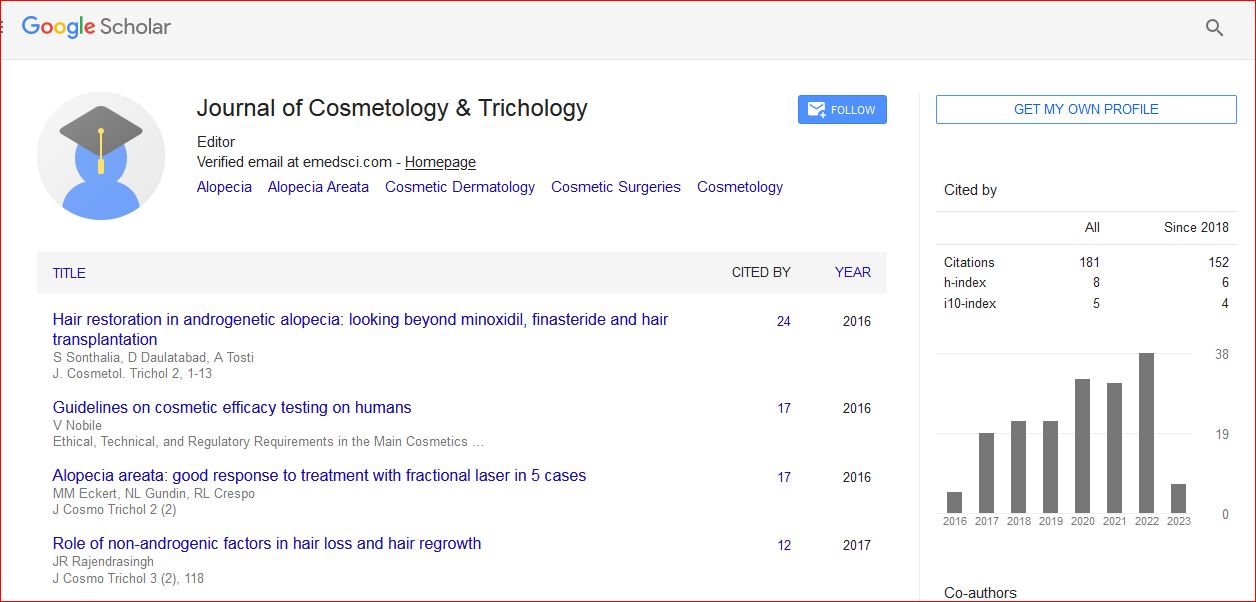
Journal of Cosmetology & Trichology received 180 citations as per Google Scholar report