Xiaoyan Yu, Gloria Roveda, MediAbout s.r.l. Medical Department* and Vincenzo Nobile
DOI: 10.37421/2471-9323.2026.12.365
The study's primary goal is to create a multi-herbal hair oil formulation that can be used to stop hair loss, dandruff, balding, and dry hair. Evaluation of the developed formulations was done. It also includes physical metrics like pH, viscosity, specific gravity, refractive index, acid value, and saponification value as well as the evaluation of phytochemicals and organoleptic properties. Chrysopogon zizanioides roots, dried seeds of Psoralea corylifolia, dried fruits of Phyllanthus embolic, dried fruits of Zingiber officinale, dried seed of Trigonella forenum-graecum L., dried leaves of Cyperus scariosus, and dried flowers of Rosa rubiginosa are among the various herbal ingredients used in the formulation at hand. The herbal hair oil formulations were made by steeping the ingredients in coconut oil for 15 minutes at a temperature of 80°C. The F1 hair oil formulation exhibits the most colour intensity of the developed F1, F2, and F3 formulations, and the same intensity is maintained even after three shampooings. According to reports, the polyherbal hair oil formulations contain qualities including those that promote hair development, are anti-dandruff, moisturizing, and have a calming impact on the skin. Along with phytochemical, organoleptic, and physical characteristics, hair shine is also evaluated.
The human scalp, like other regions of the body, harbors a unique and dynamic microbial ecosystem that plays a crucial role in maintaining skin and hair health. Recent advances in microbiome research have illuminated the complex interactions between the scalp's microbial communities and various hair-related disorders, such as dandruff, seborrheic dermatitis, alopecia, and scalp infections. Understanding these microbial populations and their functions opens new avenues for targeted treatments, preventative strategies, and personalized hair care regimens. This article explores the latest findings in scalp microbiome research, focusing on the microbial diversity of the scalp, its potential impact on hair health, and the clinical implications for treating scalp-related conditions.
Sedratul Muntha, Silma Subah, Nathasha Bogoda and Amanda Rao*
DOI: 10.37421/2471-9323.2026.12.385
Canities, more commonly known as greying hair, results from the progressive loss of melanin in the hair shaft due to dysfunction of follicular melanocytes. Oxidative stress has been identified as a major contributor to melanocyte damage and impaired pigmentation. Accordingly, antioxidant-containing formulations, such as Ageratum conyzoides, may help protect melanocytes from oxidative damage. This study aimed to evaluate the efficacy of a topical Ageratum conyzoides formulation on reducing grey hair in adults over a 12-week period. In this 12-week single arm clinical study, a topical hair serum containing 0.5% Ageratum conyzoides was applied to the scalp twice daily. The primary outcome was the change from baseline of grey hair density in a 1cm2 temporal scalp section measured by manual count from digital photographs. Secondary outcome measures included change from baseline of the percentage of grey hairs by scalp region, and results from a hair self-assessment questionnaire. The safety of the serum was also assessed. Daily topical application over 12 weeks resulted in a significant reduction in grey hair density (p<0.05). There was also a significant reduction in grey hair percentage in the temporal, frontal and vertex regions (p<0.05), as well as a significant decrease in the average across scalp regions (p<0.05). Self-assessment showed observations of improved hair thickness and health, darker hair appearance and reduction of grey hair. These results show that daily application of a topical Ageratum conyzoides formulation over 12 weeks improved the appearance of grey hair.
Gregory Luke Smith* and Shannon M. Powell
DOI: 10.37421/2471-9323.2023.9.226
Cannabinoids derived from hemp, known as phytocannabinoids, are a group of approximately 120 bioactive compounds found in the Cannabis sativa plant. They have gained increasing attention in recent years, emerging as promising ingredients in the cosmetics industry due to their proven therapeutic and cosmetic benefits for skin and hair. It is worth noting that they do not produce psychoactive effects associated with tetrahydrocannabinol (THC). This paper summarizes the available published in vitro, in vivo and human studies on cosmetic benefits of cannabinoids for hair and skin. Several of the mechanisms of action of cannabinoids are novel and entirely different from all other cosmetic ingredients because they interact with specific receptors in the hair and skin cells to turn “on” or “off” cellular processes. In addition, there are issues related to the formulation, legal requirements and regulatory considerations associated with incorporating cannabinoids into cosmetics formulations as discussed.
Bernard Murino* and Herny B
DOI: 10.37421/2471-9323.2023.9.216
HIFU is a non-invasive cosmetic procedure that uses high-intensity ultrasound waves to target and heat deep tissue layers, stimulating collagen production and tightening the skin. Several studies have evaluated its efficacy and safety in skin tightening for various areas of the face and body, including the crow's feet wrinkles around the eyes.
One such study published in the journal of cosmetic and laser therapy in 2018 evaluated the efficacy and safety of HIFU for non-invasive skin tightening of crow's feet wrinkles in 20 female participants. The study found that a single session of HIFU resulted in a significant improvement in skin tightness and reduction in wrinkles at 12 weeks post-treatment. Moreover, this improvement was maintained at 24 weeks post-treatment, suggesting that HIFU can provide long-lasting skin tightening effects.
However, it is important to note that the effectiveness of HIFU may vary depending on the individual's skin condition, age, and other factors, and multiple sessions may be required to achieve optimal results. Additionally, as with any cosmetic procedure, there may be some risks and potential side effects associated with HIFU, including temporary redness, swelling, and tingling sensations.
Sean M Davidson
In studies of the oldest solar system bodies – comets and asteroids – it is their fragments – meteoroids – that provide the most accessible planetary material for detailed laboratory analysis in the form of dust particles or meteorites. Some asteroids and comets were visited by spacecrafts and returned interplanetary samples to Earth, while missions Hayabusa 2 and OSIRIX-REx visiting asteroids Ryugu and Bennu are ongoing. However, the lack of representative samples of comets and asteroids opens the space to gain more knowledge from direct observations of meteoroids. At collision with the Earth’s atmosphere, meteoroids produce light phenomena known as meteors. Different methods can be used to observe meteors, allowing us to study small interplanetary fragments, which would otherwise remain undetected. Numerous impressive meteor showers, storms and meteorite impacts have occurred throughout the recorded history and can now be predicted and analyzed in much more detail. By understanding the dynamics, composition and physical properties of meteoroids, we are able to study the formation history and dynamical evolution of the solar system. This work presents an introduction to meteor astronomy, its fundamental processes and examples of current research topics.
Shanker Kumar*
Hair coloration, often known as hair dyeing, is the process of changing one's hair colour. The most common reasons are cosmetic: to hide grey or white hair, to change to a more fashionable or beautiful hue, or to restore the original hair colour after hairdressing or sun bleaching has harmed it. The four most common classifications are permanent, demi-permanent, semi-permanent, and temporary.
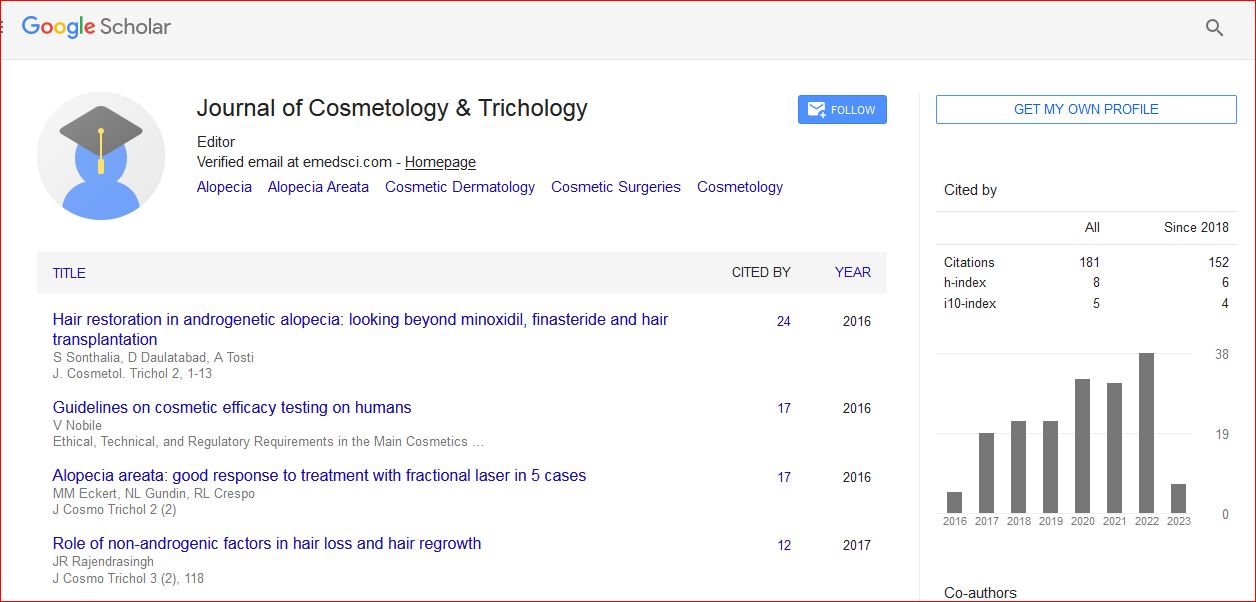
Journal of Cosmetology & Trichology received 180 citations as per Google Scholar report
 Spanish
  Chinese
  Russian
  German
  French
  Japanese
  Portuguese
  Hindi
Hindi 