Commentary - (2025) Volume 11, Issue 6
Received: 01-Dec-2025, Manuscript No. jctt-26-188434;
Editor assigned: 03-Dec-2025, Pre QC No. P-188434;
Reviewed: 17-Dec-2025, QC No. Q-188434;
Revised: 22-Dec-2025, Manuscript No. R-188434;
Published:
29-Dec-2025
, DOI: 10.37421/2471-9323.2024.10.352
Citation: AlFarsi, Hassan. "Science of Radiant Hair and Skin Health." J Cosmo Tricho 11 (2025):352.
Copyright: © 2025 AlFarsi H. This is an open-access article distributed under the terms of the Creative Commons Attribution License, which permits unrestricted use, distribution and reproduction in any medium, provided the original author and source are credited.
The intricate relationship between hair and skin health is a focal point in modern cosmetology and trichology, with advancements offering novel strategies for enhancement. This field delves into biochemical pathways and cellular mechanisms influencing hair growth, scalp condition, and overall skin appearance, highlighting the role of specific nutrients, topical agents, and emerging technologies in promoting a 'blooming glow' by addressing issues like hair thinning and skin aging [1].
The efficacy of peptides in cosmetic formulations for improving hair growth and skin texture is a significant area of research. These peptides signal cellular activity, promote collagen synthesis, and influence hair follicle stem cells, presenting evidence as potent ingredients for achieving a radiant appearance and robust hair [2].
Environmental stressors, such as pollution and UV radiation, significantly impact hair and skin, accelerating aging and compromising the integrity of the hair shaft and scalp barrier. Research explores protective strategies and reparative treatments, including antioxidant-rich formulations and advanced haircare technologies, to counteract damage and promote vitality [3].
The scalp microbiome plays a crucial role in hair health and aesthetic outcomes. Imbalances in scalp microflora can lead to conditions like dandruff and hair loss, affecting overall appearance. The use of prebiotics, probiotics, and postbiotics in haircare aims to restore microbial balance, fostering a healthy scalp environment conducive to hair growth and shine [4].
Stem cell therapy is emerging as a promising avenue for hair regeneration and skin rejuvenation. Stem cells, particularly those derived from adipose tissue or hair follicles, can stimulate new hair growth and improve skin elasticity and texture, offering personalized treatments for a youthful and vibrant appearance [5].
Nutrition is fundamental to hair and skin vitality, with essential vitamins, minerals, and fatty acids maintaining structural integrity and aesthetic quality. Specific dietary recommendations and nutritional supplementation are beneficial for combating issues like hair breakage and dull skin [6].
Natural compounds possess significant photoprotective properties for skin and hair. Antioxidants derived from plants can neutralize free radicals, reduce UV-induced damage, and contribute to a healthier, more radiant appearance, finding application in sunscreens and hair care products [7].
The chemistry, safety, and health implications of hair colorants are extensively examined. Various dyeing techniques and chemical agents impact hair protein and scalp irritation, prompting research into safer alternatives and post-coloring care regimens to maintain hair strength and shine [8].
Low-level laser therapy (LLLT) shows efficacy in treating androgenetic alopecia and improving skin quality. Its photobiological mechanisms stimulate hair follicles and enhance collagen production, providing evidence for LLLT as a non-invasive treatment for promoting hair growth and skin radiance [9].
Microneedling is recognized as a novel therapeutic approach for androgenetic alopecia and skin aging. This technique involves controlled skin injury to stimulate collagen production and activate hair follicle stem cells, with clinical findings demonstrating its effectiveness in enhancing hair density and skin appearance [10].
The interplay between scalp health and facial skin aesthetics is comprehensively reviewed, underscoring how cosmetology and trichology advancements provide new strategies. This exploration includes biochemical pathways and cellular mechanisms that govern hair growth, scalp condition, and overall skin appearance, emphasizing the contribution of specific nutrients, topical agents, and novel technologies to achieve a 'blooming glow' by addressing concerns such as hair thinning, scalp inflammation, and skin aging [1].
Peptides are recognized for their efficacy in cosmetic formulations aimed at enhancing hair growth and skin texture. The mechanisms by which peptides influence cellular activity, stimulate collagen synthesis, and modulate hair follicle stem cells are discussed, with supporting evidence highlighting their potency for achieving a radiant look and robust hair [2].
Environmental factors, including pollution and UV radiation, profoundly affect skin and hair, accelerating the aging process and degrading the integrity of the hair shaft and the scalp's protective barrier. Consequently, protective strategies and restorative treatments, such as formulations rich in antioxidants and sophisticated haircare technologies, are investigated to mitigate damage and revitalize hair and skin [3].
The scalp microbiome's significance in maintaining hair health and aesthetic qualities is a critical research area. Dysbiosis of the scalp microflora can manifest in conditions like dandruff and hair loss, detracting from overall appearance. The strategic application of prebiotics, probiotics, and postbiotics in hair care products aims to re-establish microbial equilibrium, thereby cultivating a healthy scalp environment conducive to hair growth and luster [4].
Stem cell therapy represents a burgeoning field for both hair regeneration and skin rejuvenation. Particularly, stem cells derived from adipose tissue or hair follicles possess the capacity to promote new hair growth and enhance skin elasticity and texture, positioning personalized stem cell treatments as a promising pathway toward achieving a youthful and vibrant appearance [5].
Nutrition plays an indispensable role in the vitality of hair and skin, with essential vitamins, minerals, and fatty acids being crucial for maintaining their structural integrity and aesthetic appeal. This area examines specific dietary recommendations and the benefits derived from nutritional supplementation in counteracting problems like hair breakage and skin dullness [6].
Natural compounds are explored for their photoprotective capabilities, offering protection to both skin and hair. Plant-derived antioxidants are effective in neutralizing free radicals and mitigating UV-induced damage, contributing to a healthier and more luminous appearance. Their integration into sunscreens and hair care products is a notable application [7].
The chemical aspects, safety profiles, and health ramifications associated with hair colorants are subjects of detailed scrutiny. Various dyeing methodologies and the chemical agents employed are analyzed for their impact on hair protein structure and potential for scalp irritation. Furthermore, the development of safer alternatives and effective post-coloring care routines is emphasized for preserving hair strength and sheen [8].
Low-level laser therapy (LLLT) is investigated for its therapeutic potential in managing androgenetic alopecia and improving overall skin quality. The underlying photobiological processes that LLLT utilizes to stimulate hair follicles and boost collagen production are elucidated, providing a basis for its use as a non-invasive modality for enhancing hair growth and skin radiance [9].
Microneedling is presented as an innovative therapeutic option for addressing androgenetic alopecia and refining skin texture. The procedure involves inducing controlled micro-injuries to the skin, which subsequently stimulates collagen synthesis and activates hair follicle stem cells. Clinical studies have documented microneedling's effectiveness in improving hair density and overall skin appearance [10].
This collection of research explores multifaceted approaches to enhancing hair and skin health. Advancements in cosmetology and trichology, including the use of peptides, stem cell therapy, and low-level laser therapy, offer promising strategies for hair regeneration and skin rejuvenation. The crucial roles of nutrition, scalp microbiome balance, and protective measures against environmental stressors like UV radiation and pollution are emphasized. Natural compounds and innovative techniques such as microneedling are also highlighted for their ability to improve hair growth, density, and skin aesthetics. The science behind hair colorants and their impact on hair and scalp health is also addressed, along with the importance of proper care regimens.
None
None
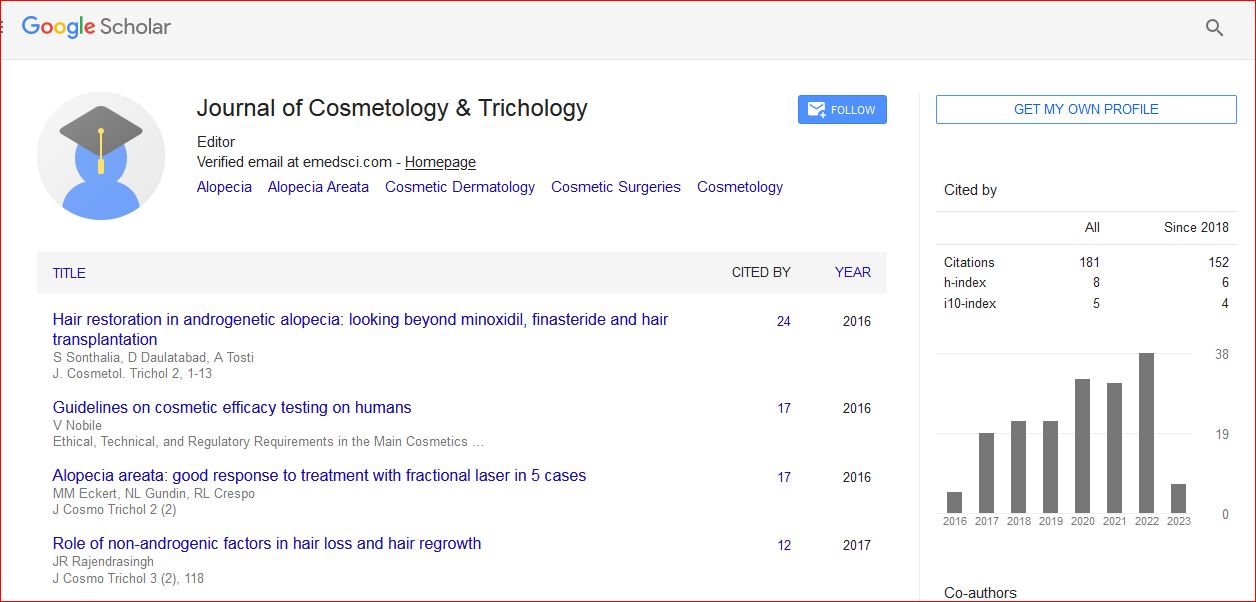
Journal of Cosmetology & Trichology received 180 citations as per Google Scholar report