Commentary - (127) Volume 14, Issue 6
Received: 01-Dec-2025, Manuscript No. MBL-26-182630;
Editor assigned: 03-Dec-2025, Pre QC No. P-182630;
Reviewed: 17-Dec-2025, QC No. Q-182630;
Revised: 22-Dec-2025, Manuscript No. R-182630;
Published:
29-Dec-2025
, DOI: 10.37421/2168-9547.2025.14.523
Citation: Kovalenko, Tatiana. ”Molecular Atlasing: Mapping Life’s
Complexity and Function.” Mol Biol 14 (2025):523.
Copyright: © 2025 Kovalenko T. This is an open-access article distributed under the terms of the Creative Commons Attribution License, which permits unrestricted use,
distribution and reproduction in any medium, provided the original author and source are credited.
The field of molecular atlasing is rapidly transforming our understanding of biological complexity, providing unprecedented resolution into the organization and function of living systems. This approach enables the creation of detailed molecular maps that illuminate intricate cellular and community structures, particularly in environments previously inaccessible to detailed study. This review delves into the emerging field of molecular atlasing, focusing on its application to understand the complex molecular composition and organization of microbial communities, particularly in environments previously considered inaccessible. It highlights how advanced sequencing technologies and computational approaches are enabling the creation of detailed molecular maps of 'hidden worlds,' revealing novel metabolic pathways, ecological interactions, and the potential for biotechnological discovery [1].
Explores the technological advancements driving the creation of single-cell molecular atlases, emphasizing the insights gained into cellular heterogeneity and developmental processes. The article discusses how integrating multi-omics data at the single-cell level provides an unprecedented resolution for understanding cell states and functions, crucial for dissecting complex biological systems [2].
This study presents a spatial transcriptomics approach that allows for the reconstruction of cellular and molecular organization within intact tissues. It highlights the ability to map gene expression in situ, bridging the gap between single-cell resolution and tissue context, which is vital for understanding 'hidden worlds' within multicellular organisms [3].
Focuses on the development of computational tools and algorithms for integrating diverse molecular datasets to build comprehensive atlases. It underscores the importance of sophisticated bioinformatics for making sense of the vast amount of data generated by high-throughput technologies, enabling the interpretation of complex biological systems [4].
Discusses the application of molecular atlasing to uncover the functional diversity of microorganisms in extreme environments, such as deep-sea hydrothermal vents and Antarctic ice. The article highlights how these approaches reveal unique adaptations and metabolic capabilities that can be harnessed for novel biotechnological applications [5].
This paper explores the potential of creating detailed molecular atlases of the human gut microbiome, revealing the complex interactions between microbes, their hosts, and their environment. It emphasizes how such atlases can deepen our understanding of health and disease, particularly in the context of host-microbe metabolism and immune system modulation [6].
Focuses on the challenges and opportunities in building molecular atlases of the plant root microbiome. It highlights the application of advanced molecular techniques to unravel the intricate microbial communities associated with plant roots and their impact on plant health, nutrient acquisition, and stress tolerance [7].
This article discusses the development and application of cryo-electron tomography (cryo-ET) in constructing molecular atlases of cellular structures. It emphasizes how cryo-ET allows for the visualization of macromolecular complexes in their native cellular environment at near-atomic resolution, revealing the intricate organization of 'hidden worlds' within cells [8].
This review explores the potential of linking molecular atlases with functional studies to understand the dynamics of microbial communities. It highlights how combining high-throughput sequencing with functional assays can reveal how microbial 'hidden worlds' respond to environmental changes and how these responses impact ecosystem processes [9].
The article presents a novel computational framework for reconstructing metabolic networks from draft genomes, a key step in building molecular atlases of uncultured microorganisms. This approach allows for the prediction of metabolic capabilities and ecological roles of microbes in 'hidden worlds' where cultivation is challenging [10].
Molecular atlasing encompasses a suite of technologies and analytical strategies aimed at generating comprehensive maps of molecular components and their spatial arrangements within biological entities, ranging from individual cells to complex ecosystems. This review delves into the emerging field of molecular atlasing, focusing on its application to understand the complex molecular composition and organization of microbial communities, particularly in environments previously considered inaccessible. It highlights how advanced sequencing technologies and computational approaches are enabling the creation of detailed molecular maps of 'hidden worlds,' revealing novel metabolic pathways, ecological interactions, and the potential for biotechnological discovery [1].
Explores the technological advancements driving the creation of single-cell molecular atlases, emphasizing the insights gained into cellular heterogeneity and developmental processes. The article discusses how integrating multi-omics data at the single-cell level provides an unprecedented resolution for understanding cell states and functions, crucial for dissecting complex biological systems [2].
This study presents a spatial transcriptomics approach that allows for the reconstruction of cellular and molecular organization within intact tissues. It highlights the ability to map gene expression in situ, bridging the gap between single-cell resolution and tissue context, which is vital for understanding 'hidden worlds' within multicellular organisms [3].
Focuses on the development of computational tools and algorithms for integrating diverse molecular datasets to build comprehensive atlases. It underscores the importance of sophisticated bioinformatics for making sense of the vast amount of data generated by high-throughput technologies, enabling the interpretation of complex biological systems [4].
Discusses the application of molecular atlasing to uncover the functional diversity of microorganisms in extreme environments, such as deep-sea hydrothermal vents and Antarctic ice. The article highlights how these approaches reveal unique adaptations and metabolic capabilities that can be harnessed for novel biotechnological applications [5].
This paper explores the potential of creating detailed molecular atlases of the human gut microbiome, revealing the complex interactions between microbes, their hosts, and their environment. It emphasizes how such atlases can deepen our understanding of health and disease, particularly in the context of host-microbe metabolism and immune system modulation [6].
Focuses on the challenges and opportunities in building molecular atlases of the plant root microbiome. It highlights the application of advanced molecular techniques to unravel the intricate microbial communities associated with plant roots and their impact on plant health, nutrient acquisition, and stress tolerance [7].
This article discusses the development and application of cryo-electron tomography (cryo-ET) in constructing molecular atlases of cellular structures. It emphasizes how cryo-ET allows for the visualization of macromolecular complexes in their native cellular environment at near-atomic resolution, revealing the intricate organization of 'hidden worlds' within cells [8].
This review explores the potential of linking molecular atlases with functional studies to understand the dynamics of microbial communities. It highlights how combining high-throughput sequencing with functional assays can reveal how microbial 'hidden worlds' respond to environmental changes and how these responses impact ecosystem processes [9].
The article presents a novel computational framework for reconstructing metabolic networks from draft genomes, a key step in building molecular atlases of uncultured microorganisms. This approach allows for the prediction of metabolic capabilities and ecological roles of microbes in 'hidden worlds' where cultivation is challenging [10].
Molecular atlasing is a transformative approach in biological research, creating detailed molecular maps of various systems. It leverages advanced sequencing and computational techniques to reveal the complexity of microbial communities in diverse environments, from deep-sea vents to the human gut and plant roots. Single-cell atlasing offers unprecedented resolution into cellular heterogeneity and developmental processes by integrating multi-omics data. Spatial transcriptomics bridges single-cell insights with tissue context, mapping gene expression in situ. Computational tools are crucial for integrating diverse datasets and interpreting biological complexity. Cryo-electron tomography visualizes cellular structures at near-atomic resolution in their native environment. Linking molecular atlases with functional studies helps understand community dynamics and responses to environmental changes. Reconstructing metabolic networks from genomic data aids in characterizing uncultured microorganisms. These advancements unlock potential for biotechnological discovery and deepen our understanding of health, disease, and ecological processes.
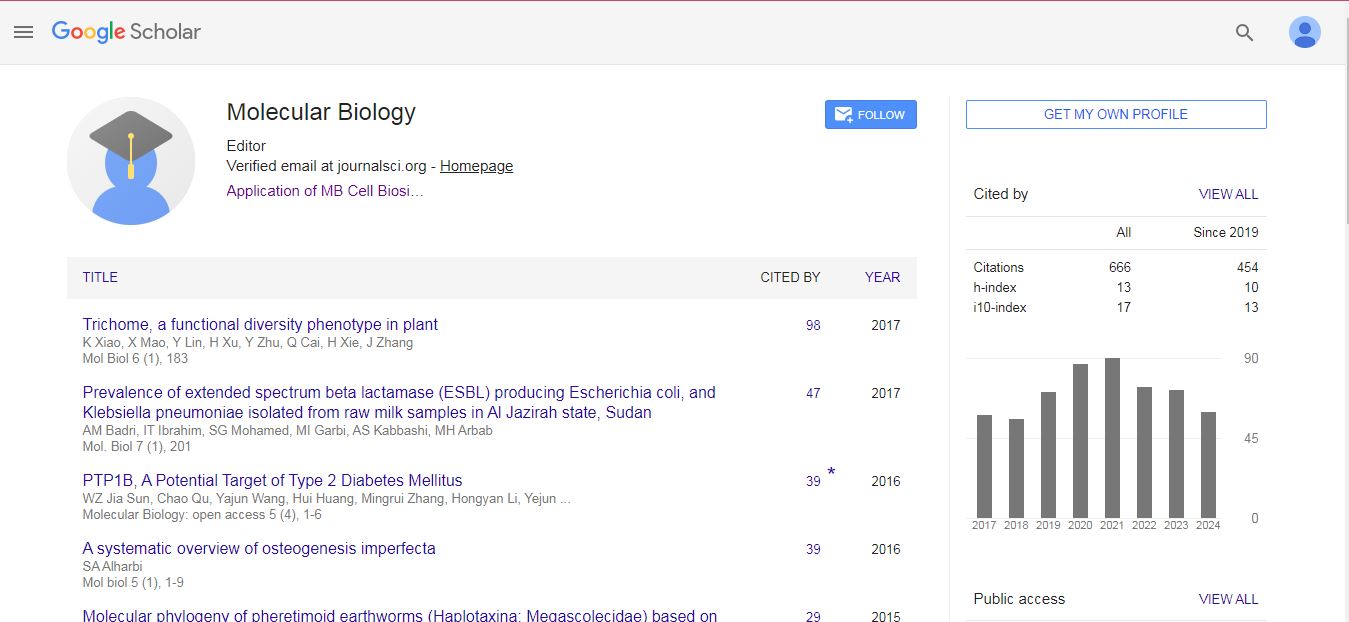
Molecular Biology: Open Access received 607 citations as per Google Scholar report