Commentary - (2025) Volume 14, Issue 6
Received: 01-Nov-2025, Manuscript No. jamk-25-177326;
Editor assigned: 03-Nov-2025, Pre QC No. P-177326;
Reviewed: 17-Nov-2025, QC No. Q-177326;
Revised: 24-Nov-2025, Manuscript No. R-177326;
Published:
29-Nov-2025
, DOI: 10.37421/2168-9601.2025.14.582
Citation: Novak, Peter. ”Modern Marketing: AI, Data, and Sustainable Engagement.” J Account Mark 14 (2025):582.
Copyright: © 2025 Novak P. This is an open-access article distributed under the terms of the Creative Commons Attribution License, which permits unrestricted use, distribution and reproduction in any medium, provided the original author and source are credited.
Research into marketing strategy reveals its direct correlation with organizational performance, underscoring the necessity for robust frameworks that facilitate growth. A critical insight suggests that firms excel when they cultivate superior market sensing capabilities and foster marketing innovation. These elements act as vital intermediaries, enabling businesses to meticulously understand customer requirements and subsequently develop novel, impactful solutions that significantly contribute to overall success [1].
The traditional perception of the customer journey is evolving, demanding a broader perspective that extends beyond individual transactional touchpoints. Contemporary scholarship advocates for incorporating societal implications, recognizing that consumer experiences are deeply influenced by wider systemic factors. This holistic framework is essential for marketing managers to accurately interpret and respond to the complex paths consumers navigate within a broader social context [2].
An integrative review of brand purpose elucidates its multifaceted nature and strategic significance within modern marketing discourse. This concept involves aligning a brand with a meaningful societal objective, which has been shown to profoundly enhance consumer engagement and cultivate loyalty. Further research is imperative to fully explore its evolving dynamics and strategic implementation across various industries [3].
Digital transformation represents a pivotal shift in how organizations cultivate and leverage their marketing capabilities. A key finding highlights the mediating role of marketing agility, indicating that merely adopting new digital tools is insufficient for competitive advantage. Instead, businesses must develop the flexibility and responsiveness to rapidly adapt to fluid market conditions, thereby optimizing their overall marketing effectiveness [4].
The pervasive influence of artificial intelligence is fundamentally reshaping consumer behavior and the mechanisms of value creation. As consumers increasingly interact with sophisticated AI-driven systems, their decision-making processes and expectations are undergoing a significant transformation. This necessitates a critical re-evaluation of traditional marketing strategies to effectively deliver value in an increasingly algorithmic marketplace [5].
Sustainable marketing strategies are gaining increasing prominence, reflecting a global imperative for businesses to integrate environmental and social concerns into their core operations. This field moves beyond superficial "greenwashing" initiatives, advocating for genuine contributions to sustainability goals while simultaneously achieving business objectives. Future research must continue to refine and explore the efficacy of these integrated approaches [6].
In the current data-intensive business environment, marketing's strategic role has been redefined by the advent of advanced analytics and artificial intelligence. A proposed framework emphasizes that marketers must adeptly utilize these technologies to extract actionable insights, optimize decision-making, and significantly enhance overall organizational performance. This marks a departure from reliance on purely intuition-based marketing approaches [7].
Services marketing is experiencing a paradigm shift, driven by the increasing importance of co-creation and digitalization. Future success in this sector will largely depend on actively involving customers in the value creation process. Simultaneously, leveraging digital technologies to deliver personalized and seamless service experiences is crucial, fundamentally transforming the traditional models of service delivery [8].
Within dynamic emerging markets, the interplay between market orientation and innovation capability significantly influences firm performance. Studies reveal that organizations with a deep customer focus and a strong capacity for developing novel solutions are better equipped to succeed. These insights are critical for crafting effective strategic marketing decisions in resource-constrained yet rapidly evolving environments [9].
Consumer engagement in the digital era is characterized by a complex interplay of drivers and outcomes, requiring an integrative framework for comprehensive understanding. In a hyper-connected world, fostering active and meaningful interactions across diverse digital touchpoints is paramount for cultivating customer loyalty and inspiring brand advocacy. This understanding is essential for shaping effective modern marketing efforts [10].
A firm's ability to achieve superior organizational performance is intricately linked to its marketing strategy, as evidenced by studies highlighting key mediating factors. Specifically, the development of robust market sensing capabilities enables organizations to accurately perceive customer needs and market shifts. Concurrently, a commitment to marketing innovation allows for the creation of differentiated solutions, both of which are critical for sustainable success and competitive advantage [1]. Reframing the customer journey from an individualistic to a societal perspective offers a more comprehensive understanding of consumer behavior. This broader view acknowledges that systemic factors, such as cultural norms, economic conditions, and technological infrastructure, significantly shape how individuals interact with brands and products. Marketing managers can leverage this understanding to design more impactful and contextually relevant strategies [2]. Brand purpose, as a strategic marketing concept, extends beyond mere corporate social responsibility, aiming to embed a meaningful societal mission within the brand's core identity. This approach fosters deeper emotional connections with consumers, leading to enhanced engagement and sustained loyalty. Ongoing research seeks to further delineate best practices and potential pitfalls in implementing effective brand purpose initiatives [3]. The pervasive influence of digital transformation on marketing capabilities is profound, yet its effectiveness hinges on more than technological adoption. Research underscores marketing agility as a crucial mediating factor, emphasizing the need for organizations to possess the organizational flexibility and strategic responsiveness required to navigate rapid technological shifts and evolving consumer expectations. This dynamic adaptability ensures marketing efforts remain potent and relevant [4]. Artificial intelligence is fundamentally altering the landscape of consumer behavior and the paradigms of value creation. The increasing ubiquity of AI-driven systems means consumers' decision-making processes are becoming intertwined with algorithmic recommendations and personalized experiences. Marketers are challenged to innovate their strategies, focusing on how to genuinely deliver value within these new, algorithmically mediated interactions [5]. The imperative for sustainable marketing strategies is driven by increasing environmental awareness and social responsibility, urging businesses to integrate these concerns deeply into their operational ethos. This involves moving beyond superficial environmental claims to implement genuinely sustainable practices that benefit both the planet and society, while simultaneously contributing to long-term business viability and stakeholder trust [6]. Marketing's strategic evolution in a data-driven world necessitates a sophisticated framework that integrates data analytics and artificial intelligence. This approach empowers marketers to derive actionable insights from vast datasets, enabling optimized decision-making across various functions, from product development to customer engagement. Such data-centric methodologies are vital for bolstering overall organizational performance in competitive markets [7]. A significant paradigm shift is occurring in services marketing, characterized by a heightened emphasis on co-creation and digitalization. The future success of service providers will increasingly depend on actively involving customers in shaping their service experiences and leveraging digital tools to deliver highly personalized and seamless interactions. This transformation promises more agile and customer-centric service delivery models [8]. In emerging markets, the synergistic relationship between market orientation and innovation capability is a powerful determinant of firm performance. Firms that prioritize understanding and responding to customer needs, coupled with a robust capacity for innovation, are uniquely positioned to overcome market challenges and capitalize on opportunities. These insights are indispensable for strategic planners operating in such dynamic environments [9]. Understanding consumer engagement in the digital age requires an integrative framework that considers the multifaceted drivers and outcomes of online interactions. In a world saturated with digital touchpoints, cultivating meaningful and active engagement is paramount for building enduring customer loyalty and fostering potent brand advocacy. Effective digital engagement strategies are therefore central to contemporary marketing success [10].
Modern marketing emphasizes strategic alignment with organizational performance, driven by market sensing and innovation. The customer journey is viewed holistically, incorporating societal factors, while brand purpose enhances engagement through societal alignment. Digital transformation reshapes marketing capabilities, with agility being critical for adapting to market changes. Artificial intelligence profoundly impacts consumer behavior and value creation, necessitating a re-evaluation of traditional strategies in an algorithmic environment. Sustainable marketing is crucial, requiring genuine integration of environmental and social concerns. Marketing's strategic role in a data-driven world involves leveraging analytics and AI for insights and optimized decisions. Services marketing undergoes a shift towards co-creation and digitalization for personalized experiences. In emerging markets, market orientation and innovation capability are key to firm performance. Finally, consumer engagement in the digital era, across various touchpoints, is vital for loyalty and brand advocacy. These themes collectively highlight marketing's evolving, data-centric, and socially conscious role in driving business success and shaping consumer interactions.
None
None
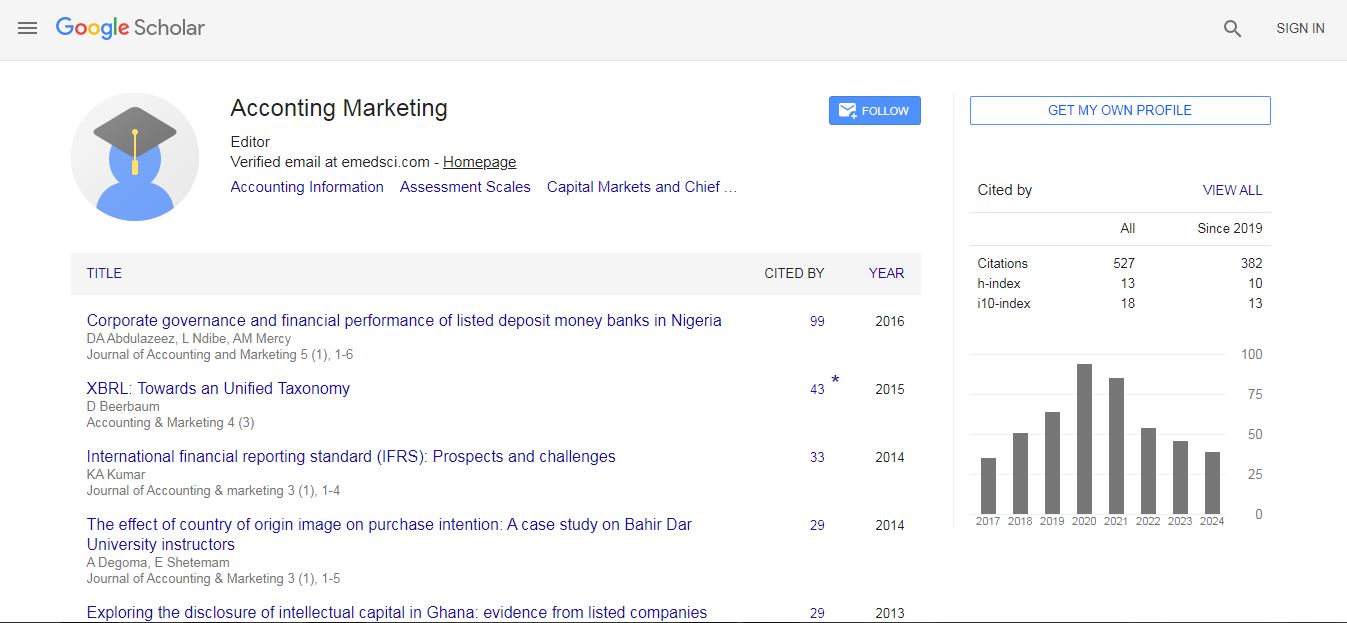
Accounting & Marketing received 487 citations as per Google Scholar report