Brief Report - (2025) Volume 14, Issue 3
Received: 01-May-2025, Manuscript No. jamk-25-177277;
Editor assigned: 03-May-2025, Pre QC No. P-177277;
Reviewed: 17-May-2025, QC No. Q-177277;
Revised: 24-May-2025, Manuscript No. R-177277;
Published:
31-May-2025
, DOI: 10.37421/2168-9601.2025.14.555
Citation: Lee, Jason. ”Modern Financial Reporting: Quality, Innovation and Governance.” J Account Mark 14 (2025):555.
Copyright: Copyright: © 2025 Lee J. This is an open-access article distributed under the terms of the Creative Commons Attribution License, which permits unrestricted use, distribution and reproduction in any medium, provided the original author and source are credited.
The quality of integrated reporting significantly impacts financial reporting transparency and a company's market value. Organizations providing comprehensive reports, blending financial and non-financial information, improve the clarity of financial statements. This enhanced transparency is then perceived by investors as a driver of increased firm value[1].
Individual investors' financial literacy and proactive information search profoundly influence their investment decisions. A solid understanding of financial concepts, including the ability to interpret financial statements, combined with active information gathering, enables more informed and effective investment choices[2].
A practical case study approach is effective for teaching financial statement analysis, particularly when integrating actual company data into the curriculum. Using real-world examples and hands-on application substantially helps students grasp complex financial concepts and improves their analytical abilities for interpreting balance sheets and income statements effectively[3].
Artificial intelligence is reshaping financial statement analysis and impacting the quality of audits. AI tools can dramatically enhance the precision and depth of financial statement reviews, allowing for quicker detection of unusual patterns and providing robust insights into a company's financial health, potentially leading to better audit outcomes[4].
Sustainability reporting practices are directly related to a company's financial performance, particularly for European firms. Companies with stronger, more transparent sustainability disclosures tend to exhibit improved financial metrics, indicating that integrating ESG factors into reporting positively influences perceptions of financial stability and long-term value[5].
The implementation of big data analytics affects the quality of accounting information and a firm's overall performance. Big data tools allow for more granular and timely analysis of financial data, leading to enhanced accuracy and relevance in financial statements, ultimately contributing to better operational and strategic outcomes[6].
International Financial Reporting Standards (IFRS) adoption has a consistent effect on the quality of financial reporting. A meta-analysis reveals that transitioning to IFRS generally improves the transparency, comparability, and overall quality of financial statements, offering a more reliable representation of a company's balance sheet and income performance[7].
Effective corporate governance frameworks are crucial for high-quality financial reporting. Strong board oversight, independent audit committees, and robust internal controls are essential for ensuring the accuracy and reliability of financial statements, fostering greater trust in a company's reported balance sheet and income performance[8].
Blockchain technology holds transformative potential for financial reporting and auditing processes. It can significantly enhance the integrity, transparency, and immutability of financial data, leading to more reliable balance sheets and income statements, and potentially streamlining audit procedures by providing an unalterable record of transactions[9].
Environmental accounting disclosures are connected to a company's financial performance, especially in emerging economies. Greater transparency in environmental reporting, which influences asset and liability valuation and expense recognition, can positively correlate with improved financial outcomes and a more robust financial standing[10].
A deeper examination of integrated reporting quality reveals its direct causation in improved financial reporting transparency. When organizations purposefully construct comprehensive and highly interconnected reports, explicitly blending both quantitative financial metrics and qualitative non-financial insights, the overall clarity and interpretability of their financial statements are substantially elevated. This heightened transparency, in turn, fosters increased confidence among the investor community, thereby contributing positively to the company's perceived market value[1]. The exploration into individual investors' financial literacy underscores its critical role alongside a proactive information search in shaping investment decisions. This research delineates that a profound grasp of core financial concepts, encompassing the nuanced ability to dissect and interpret complex financial statements, when coupled with diligent and active information acquisition, empowers individuals to consistently make more judicious, informed, and ultimately, more efficacious investment selections[2]. This case study advocates for an empirically driven pedagogical approach to financial statement analysis education, specifically through the integration of authentic corporate data. The findings compellingly illustrate that the consistent use of real-world examples, combined with hands-on, practical application exercises, provides a superior learning environment. Such methods significantly facilitate students' comprehension of intricate financial concepts and profoundly enhance their practical analytical capabilities necessary for adeptly interpreting balance sheets and income statements[3]. Research concerning artificial intelligence demonstrates its profound transformative capacity within financial statement analysis and its consequential impact on audit quality. It posits that advanced AI-driven tools possess the unique capability to dramatically augment the precision, depth, and efficiency of financial statement reviews. This technological integration enables the rapid identification of atypical patterns and yields more robust, data-driven insights into a company's true financial health, thereby culminating in superior and more reliable audit outcomes[4]. This investigation into sustainability reporting practices and their nexus with financial performance centers on European companies. The study's conclusions strongly suggest a positive correlation: firms demonstrating more robust, meticulously transparent sustainability disclosures consistently exhibit superior financial metrics. This evidence highlights that the strategic integration of Environmental, Social, and Governance (ESG) factors into corporate reporting practices can substantially enhance stakeholder perceptions of financial stability and cultivate long-term shareholder value[5]. The analytical framework presented scrutinizes the implementation of big data analytics and its multifaceted effects on the veracity of accounting information and, subsequently, a firm's aggregate performance. The core tenet is that leveraging sophisticated big data tools facilitates an exceptionally granular and remarkably timely analysis of vast financial datasets. This analytical capability translates directly into significantly enhanced accuracy and heightened relevance in financial statements, ultimately serving as a catalyst for improved operational efficiencies and more astute strategic decision-making[6]. A comprehensive meta-analysis synthesizes existing scholarly work regarding the impact of International Financial Reporting Standards (IFRS) adoption on the inherent quality of financial reporting. The cumulative evidence consistently corroborates that the transition to IFRS typically engenders marked improvements in the transparency, cross-jurisdictional comparability, and overall integrity of financial statements. This standardization provides a demonstrably more reliable and internationally consistent representation of a company's intricate balance sheet and its underlying income performance[7]. This scholarly work meticulously details how meticulously constructed and rigorously implemented corporate governance frameworks are instrumental in cultivating superior financial reporting quality. It emphasizes that the convergence of strong, proactive board oversight, the presence of truly independent and diligent audit committees, and the establishment of robust, effective internal control systems are paramount. These elements collectively ensure the accuracy, reliability, and ultimate trustworthiness of financial statements, thereby engendering greater public and investor confidence in reported financial performance[8]. The potential of blockchain technology in revolutionizing financial reporting and auditing procedures is thoroughly explored in this research. It advances the proposition that blockchain can fundamentally augment the integrity, transparency, and immutability of financial data. This technological advancement promises to yield demonstrably more reliable balance sheets and income statements, while simultaneously streamlining complex audit processes through the provision of an unalterable, cryptographically secured ledger of all financial transactions[9]. Investigating the intricate link between environmental accounting disclosures and corporate financial performance, particularly within the unique context of emerging economies, this study yields crucial insights. The findings unequivocally suggest that heightened transparency in environmental reporting, which directly influences the valuation of assets and liabilities and the recognition of various expenses, correlates positively with enhanced financial outcomes and the establishment of a more resilient and robust financial standing for firms[10].
The provided research comprehensively examines various facets influencing financial reporting quality, transparency, and corporate performance. Key themes include the positive impact of integrated reporting, sustainability disclosures, and environmental accounting on firm value and financial outcomes. The crucial role of financial literacy and proactive information search for individual investors' decision-making is highlighted. Pedagogical improvements in teaching financial statement analysis through real-world data are also discussed. Furthermore, the transformative effects of emerging technologies such as Artificial Intelligence, Big Data Analytics, and Blockchain on audit quality, information accuracy, and data integrity are thoroughly explored. The adoption of International Financial Reporting Standards consistently enhances comparability and reliability. Finally, the critical function of robust corporate governance frameworks, including strong board oversight and independent audit committees, in ensuring the accuracy and trustworthiness of financial statements is emphasized across multiple studies, demonstrating a holistic view of modern financial reporting challenges and solutions.
None
None
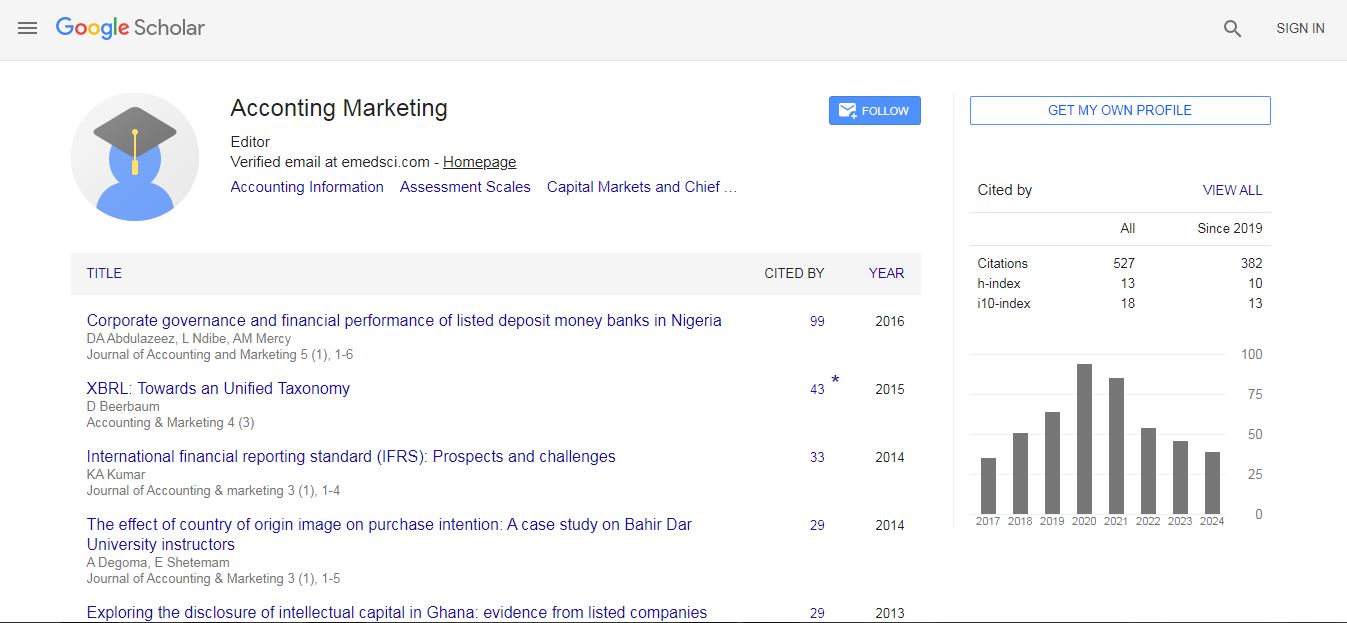
Accounting & Marketing received 487 citations as per Google Scholar report