Perspective - (2025) Volume 15, Issue 2
Received: 02-Jun-2025, Manuscript No. jpdbd-25-164661;
Editor assigned: 04-Jun-2025, Pre QC No. P-164661;
Reviewed: 16-Jun-2025, QC No. Q-164661;
Revised: 23-Jun-2025, Manuscript No. R-164661;
Published:
30-Jun-2025
, DOI: 10.37421/2153-0769.2025.15.418
Citation: Roberts, Peter. “Metabolomics Driven Insights into Biology through Pathway Analysis.” Metabolomics 15 (2025): 418.
Copyright: © 2025 Roberts P. This is an open-access article distributed under the terms of the Creative Commons Attribution License, which permits unrestricted use, distribution, and reproduction in any medium, provided the original author and source are credited.
Metabolomics is an emerging and dynamic field in the realm of systems biology which enables the comprehensive analysis of metabolites within a biological system. By capturing the snapshot of metabolic activity in a cell tissue or organism at a given point in time metabolomics provides a valuable tool to understand biochemical pathways and their roles in health and disease. Pathway analysis in metabolomics serves as a cornerstone for translating the abundance of data generated by high-throughput technologies into biologically meaningful insights. This process allows researchers to identify disrupted metabolic pathways and understand the functional significance of observed metabolite changes across different physiological and pathological states. Through the integration of metabolomics data with pathway analysis scientists can deepen their understanding of cellular function and regulation which has implications for diagnostics therapeutics and personalized medicine.
At the heart of metabolomics lies the ability to detect and quantify small molecules or metabolites which are the end products of cellular processes. These metabolites reflect the underlying biochemical activity and state of cells and tissues thereby serving as direct signatures of biochemical pathways. The application of pathway analysis to metabolomics datasets allows researchers to identify which pathways are enriched with altered metabolites in a given condition. This enrichment provides clues into the functional changes taking place within the biological system and enables hypothesis generation for further experimental validation. In this sense pathway analysis serves not only as an interpretative framework but also as a discovery engine that highlights novel areas of biological relevance [1].
The process of pathway analysis typically begins with the identification of significantly altered metabolites between experimental conditions such as disease versus healthy states treated versus untreated groups or stressed versus no stressed systems. Once these metabolites are identified they are mapped onto known metabolic pathways using databases such as KEGG HMDB Reactome and MetaCyc. These databases provide curated information on metabolic reactions enzymes and pathways which serve as the blueprint for the interpretation of metabolomics data. The mapping of metabolites to pathways helps to contextualize the metabolomics changes and can reveal whether specific biochemical processes are upregulated downregulated or dysregulated in the system under study.
One of the key strengths of metabolomics-driven pathway analysis is its ability to detect changes in metabolism that may not be evident at the transcriptomic or proteomic level. This is because metabolite levels are influenced by a combination of gene expression enzyme activity substrate availability and environmental factors. As such metabolomics offers a unique and integrative view of cellular function that complements other omics approaches. For instance a gene encoding an enzyme may not show significant changes in expression yet its activity might be altered due to posttranslational modifications leading to shifts in metabolite levels. In this scenario metabolomics would capture the metabolic consequences of such changes even if transcriptomic or proteomic analyses do not [2].
Furthermore pathway analysis can uncover the systemic impact of localized perturbations. For example a mutation in a single gene affecting one enzyme can lead to a cascade of changes across multiple interconnected pathways. By analyzing the broader metabolic network pathway analysis can reveal how such perturbations ripple through the system leading to alterations in energy metabolism amino acid biosynthesis lipid turnover or oxidative stress response. These insights are particularly valuable in complex diseases such as cancer neurodegeneration and metabolic disorders where multiple pathways interact and contribute to disease progression. In addition metabolomics-driven pathway analysis is instrumental in biomarker discovery. By identifying pathways consistently altered in specific conditions researchers can pinpoint key metabolites that serve as indicators of disease presence severity or response to treatment. These biomarkers can then be validated and potentially developed into diagnostic tools or therapeutic targets. For example altered levels of metabolites in the tricarboxylic acid cycle or glycolysis have been linked to cancer metabolism offering targets for intervention or monitoring. Similarly shifts in amino acid metabolism have been associated with neurodegenerative diseases suggesting possible avenues for early detection or therapeutic modulation [3].
Another area where pathway analysis proves invaluable is in the understanding of host microbiome interactions. The human microbiome contributes significantly to the host metabolome and changes in microbial composition can lead to significant alterations in host metabolic pathways. Through metabolomics and pathway analysis scientists can identify microbial metabolites that influence host physiology and pathophysiology. This approach has revealed roles for microbial metabolites in modulating immune responses regulating energy balance and influencing neurological function. As such pathway analysis provides a framework for integrating host and microbial metabolic data leading to a more holistic understanding of health and disease.
Moreover pathway analysis enhances the interpretation of timecourse or longitudinal metabolomics studies. By examining how metabolic pathways change over time researchers can infer dynamic biological processes and track the progression or resolution of physiological responses. This temporal dimension is critical in studies of development aging drug response or disease progression where static snapshots may miss important transitions or feedback mechanisms. Pathway analysis allows for the reconstruction of these dynamic trajectories and helps to identify critical time points or regulatory nodes within the metabolic network. The integration of metabolomics with other omics layers further amplifies the power of pathway analysis. By combining metabolomic data with transcriptomics proteomics and epigenomics researchers can build multilayered models of biological systems. These integrative analyses enable the dissection of regulatory hierarchies and the identification of key drivers of metabolic reprogramming. For example a multiomics approach might reveal that changes in gene expression lead to altered enzyme levels which in turn modify metabolite concentrations and feedback into gene regulation. Such insights are only possible through the coordinated analysis of multiple data types with pathway analysis serving as the connective tissue that links them together [4].
Technological advances in mass spectrometry and nuclear magnetic resonance spectroscopy have significantly expanded the scope and resolution of metabolomics studies. High-resolution instruments now enable the detection of thousands of metabolites in a single sample allowing for a more comprehensive coverage of the metabolic landscape. This expansion enhances the depth and accuracy of pathway analysis as more metabolites can be mapped to known pathways and previously undetected changes can be captured. However this increase in data complexity also necessitates the development of robust computational tools and statistical methods for effective pathway analysis. Algorithms for metabolite annotation enrichment analysis network modeling and machine learning are increasingly employed to handle these challenges and to extract biologically meaningful patterns from high dimensional data. Despite these advances there are still challenges in pathway analysis that must be addressed. One major issue is the incomplete annotation of metabolites and pathways in existing databases. Many detected metabolites remain unidentified or lack clear pathway associations limiting the interpretability of results. Additionally pathway databases may not capture the full complexity of metabolic networks especially in no model organisms or under no canonical conditions. As a result there is a growing interest in community driven curation the use of predictive modeling and the development of dynamic pathway representations that account for context dependent variation in metabolic networks [5].
Google Scholar Cross Ref Indexed at
Google Scholar Cross Ref Indexed at
Google Scholar Cross Ref Indexed at
Google Scholar Cross Ref Indexed at
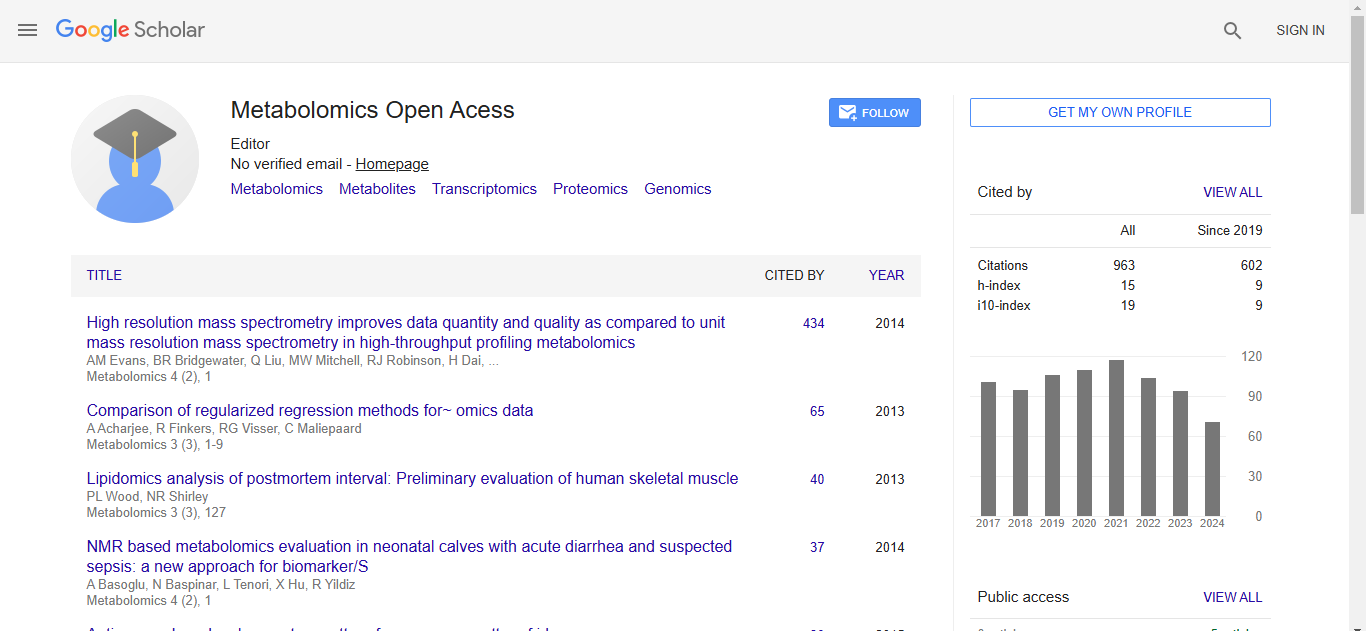
Metabolomics:Open Access received 895 citations as per Google Scholar report