Brief Report - (2025) Volume 14, Issue 5
Received: 01-Sep-2025, Manuscript No. jamk-25-177316;
Editor assigned: 03-Sep-2025, Pre QC No. P-177316;
Reviewed: 17-Sep-2025, QC No. Q-177316;
Revised: 22-Sep-2025, Manuscript No. R-177316;
Published:
29-Sep-2025
, DOI: 10.37421/2168-9601.2025.14.575
Citation: Al-Farhan, Yusuf. ”Marketing Automation: Strategic Tool for Firm Performance.” J Account Mark 14 (2025):575.
Copyright: © 2025 Al-Farhan Y. This is an open-access article distributed under the terms of the Creative Commons Attribution License, which permits unrestricted use, distribution and reproduction in any medium, provided the original author and source are credited.
Marketing automation has emerged as a critical strategic imperative for contemporary businesses, revolutionizing how organizations engage with customers and manage their promotional efforts. A systematic review of the literature on marketing automation synthesizes existing knowledge, highlighting key themes such as technology adoption, enhancing customer experience, and the intricate processes of performance measurement. This foundational work also proposes a comprehensive research agenda, guiding future inquiry into the strategic implications and operational challenges inherent in automation [1].
Further expanding on this domain, the integration of artificial intelligence (AI) with marketing automation represents a significant evolutionary step. A systematic review meticulously explores this intersection, mapping current research landscapes and identifying fertile grounds for future scholarly endeavors. This research particularly underscores how AI amplifies automation capabilities, facilitates advanced personalization, and refines predictive analytics, while concurrently acknowledging the ethical considerations and practical implementation hurdles that must be addressed [2].
The adoption of marketing automation platforms is not uniformly driven but is instead influenced by a confluence of internal and external factors, as revealed by cross-country studies. Investigations into these drivers indicate that organizational readiness, the intensity of competitive pressure within a market, and the perceived benefits of automation significantly influence its uptake. Ultimately, these adoption factors play a crucial role in shaping overall marketing performance and operational efficiency across diverse geographical contexts [3].
The direct impact of marketing automation on sales performance is a subject of considerable interest, with research indicating a complex relationship. Studies suggest that while automation possesses the inherent capacity to augment sales outcomes, its efficacy is substantially moderated by an organization's underlying customer orientation and the robustness of its existing marketing capabilities. This implies that technological implementation alone is insufficient; strategic alignment with customer-centric principles is paramount for optimal results [4].
From a service-dominant logic perspective, the influence of marketing automation extends to fostering customer value co-creation and enhancing loyalty. Strategic implementation of automation tools can cultivate deeper customer engagement, leading to more resilient long-term relationships. This is achieved through the delivery of highly personalized interactions and the provisioning of tailored service offerings, which resonate more profoundly with individual customer needs and preferences [5].
Advancements in data science and machine learning are continually reshaping the capabilities of marketing automation. A novel approach leveraging machine learning for customer segmentation and targeting within automation systems has been introduced. This method demonstrates how sophisticated algorithms can dramatically improve the precision of customer outreach initiatives, thereby leading to more effective campaign execution and a more judicious allocation of marketing resources [6].
In the specialized realm of business-to-business (B2B) marketing, automation plays a pivotal role in refining personalized communication and enhancing customer engagement. Empirical investigations reveal that automation facilitates the delivery of highly relevant and timely interactions, which are crucial for B2B contexts. This focused approach significantly boosts customer engagement levels and strengthens invaluable business relationships, underscoring its strategic importance [7].
The psychological dimension of marketing automation's effectiveness is explored through the lens of perceived value and brand loyalty. Research indicates a strong relationship between the perceived value derived from marketing automation, the degree of perceived customization experienced by customers, and their subsequent loyalty to a brand. Crucially, perceived customization acts as a mediating factor, amplifying the impact of automation on value perception and loyalty [8].
The broader agenda of digital marketing transformation necessitates a structured framework that integrates marketing automation with comprehensive customer experience management. A proposed framework highlights the symbiotic interplay between these elements, illustrating how the strategic deployment of automation tools can systematically optimize customer journeys. This integration ensures the delivery of consistent, positive experiences across all customer touchpoints, fostering a cohesive brand narrative [9].
Ultimately, the effective implementation of marketing automation systems yields tangible benefits for overall firm performance across a spectrum of industries. Empirical evidence substantiates that such systems contribute significantly to improved operational efficiency, drive higher sales revenue, and enhance customer retention rates. These collective improvements culminate in superior firm outcomes, affirming the substantial return on investment achievable through sophisticated marketing automation [10].
A foundational systematic literature review on marketing automation has provided a comprehensive synthesis of existing knowledge, meticulously identifying several key thematic areas. These include the intricate processes of technology adoption within organizations, the profound impact on customer experience management, and the crucial methodologies for performance measurement. The review further establishes a robust research agenda designed to direct future scholarly investigation into both the strategic implications and the operational challenges presented by the increasing prevalence of marketing automation technologies [1]. Building upon the core concepts of marketing automation, recent scholarship has thoroughly examined its convergence with artificial intelligence. This systematic review delineates the current landscape of research at this intersection, highlighting how AI capabilities are instrumental in augmenting automation functionalities. Specifically, it underscores the role of AI in enabling advanced personalization, enhancing predictive analytics, and optimizing decision-making. Concurrently, the study draws attention to pressing ethical considerations and practical implementation hurdles that organizations must navigate when integrating AI into their marketing automation strategies [2]. The dynamics of marketing automation adoption have been rigorously investigated through a cross-country study, revealing a multifaceted array of influencing factors. Key findings indicate that an organization's internal readiness, characterized by its technological infrastructure and employee skills, significantly impacts adoption rates. Furthermore, external pressures such as the competitive landscape and the perceived benefits, including increased efficiency and improved customer engagement, are pivotal in driving the uptake of marketing automation solutions across different national contexts. These factors ultimately shape marketing performance and overall operational efficiency [3]. The relationship between marketing automation and sales performance is a nuanced area of study, with research demonstrating its conditional effectiveness. Investigations reveal that while marketing automation can indeed enhance sales outcomes, its influence is not universal. Rather, its effectiveness is critically moderated by two significant organizational attributes: the degree of customer orientation embedded within the organization's culture and the strength of its existing marketing capabilities. This implies that a robust customer-centric approach and well-developed marketing functions are prerequisites for maximizing the sales benefits of automation [4]. From a service-dominant logic perspective, the impact of marketing automation extends beyond transactional efficiencies to fostering deeper customer value co-creation and cultivating enduring loyalty. Research in this area illustrates that when marketing automation is strategically deployed, it can profoundly enhance customer engagement. This is primarily achieved through the facilitation of highly personalized interactions and the provision of meticulously tailored service offerings, which together contribute to stronger, more meaningful long-term relationships with customers [5]. Technological innovation, particularly in machine learning, is revolutionizing how marketing automation systems perform critical functions like customer segmentation and targeting. A cutting-edge research initiative has introduced a novel machine learning-based approach designed to enhance these processes. This method rigorously demonstrates how advanced algorithms can significantly improve the precision and accuracy of customer outreach efforts, leading to more efficacious marketing campaigns and a more optimized allocation of valuable marketing resources [6]. The specific application and effects of marketing automation within business-to-business (B2B) contexts have been a focal point of recent empirical study. This research highlights how marketing automation fundamentally influences personalized communication and subsequent customer engagement in B2B environments. Findings consistently indicate that automation facilitates the delivery of highly relevant and timely communications, which are instrumental in bolstering B2B customer engagement and strengthening strategic relationships between businesses [7]. Exploring the psychological and perceptual aspects of marketing automation, research has elucidated the intricate link between its perceived value and brand loyalty. This study posits that when marketing automation delivers experiences perceived as highly customized, customers inherently attribute a higher value to these interactions. This enhanced perception of value, in turn, acts as a powerful mediator, consequently strengthening their loyalty and attachment to the brand, thereby underscoring the importance of tailored automation [8]. A comprehensive framework for digital marketing transformation has been advanced, emphasizing the strategic interdependence between marketing automation and customer experience management. This framework meticulously outlines how integrating sophisticated automation tools can systematically optimize the entire customer journey. The strategic objective is to deliver consistent, positive, and seamless experiences across all diverse customer touchpoints, thereby ensuring a coherent and superior overall customer experience [9]. Finally, the tangible and broad-reaching impact of marketing automation on overall firm performance has been empirically substantiated through multi-industry studies. This research provides compelling evidence that the effective and strategic implementation of marketing automation systems yields significant organizational benefits. These include marked improvements in operational efficiency, a demonstrable increase in sales revenue, and enhanced rates of customer retention, collectively contributing to superior firm outcomes and sustained competitive advantage [10].
Marketing automation is a transformative strategic tool that optimizes customer engagement and promotional efforts. Research highlights its foundational themes, including technology adoption, customer experience enhancement, and performance measurement. The integration of artificial intelligence further amplifies its capabilities, driving personalization and predictive analytics, though ethical considerations persist. Adoption factors like organizational readiness and competitive pressure significantly influence its uptake and impact on marketing performance. Automation positively affects sales performance, especially when moderated by customer orientation and strong marketing capabilities. It also fosters customer value co-creation and loyalty through personalized interactions, aligning with a service-dominant logic. Advanced techniques, such as machine learning, refine customer segmentation and targeting for more effective campaigns. In B2B contexts, it boosts personalized communication and engagement. Perceived customization from automation enhances customer value and brand loyalty. A framework for digital marketing transformation integrates automation with customer experience management to optimize customer journeys. Ultimately, effective marketing automation systems improve operational efficiency, increase sales revenue, and enhance customer retention, leading to superior firm performance across various industries.
None
None
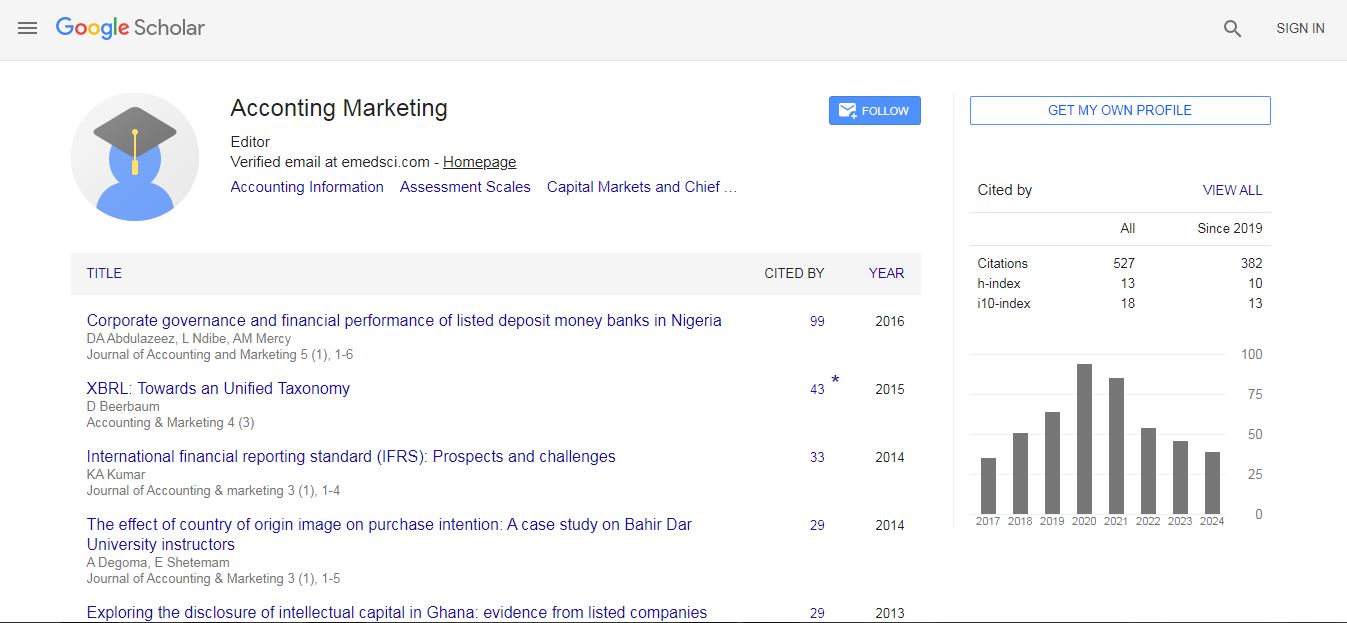
Accounting & Marketing received 487 citations as per Google Scholar report