Short Communication - (127) Volume 15, Issue 4
Received: 01-Dec-2025, Manuscript No. jttr-25-175459;
Editor assigned: 03-Dec-2025, Pre QC No. P-175459;
Reviewed: 17-Dec-2025, QC No. Q-175459;
Revised: 22-Dec-2025, Manuscript No. R-175459;
Published:
29-Dec-2025
, DOI: 10.37421/2161-0991.2025.15.323
Citation: Kulkarni, Arjun V.. ”Kidney Transplants: Precision, Outcomes, Equity.” J Transplant Technol Res 15 (2025):323.
Copyright: © 2025 Kulkarni V. Arjun This is an open-access article distributed under the terms of the Creative Commons Attribution License, which permits unrestricted use, distribution and reproduction in any medium, provided the original author and source are credited.
Immunosuppression remains central to kidney transplant success, evolving with new agents and strategies. This article reviews current approaches, highlighting the balance between preventing rejection and minimizing side effects, including infections and malignancies. Personalized medicine and precision immunosuppression are key themes in optimizing long-term graft and patient outcomes [1].
Understanding the mechanisms behind allograft rejection is crucial for improving kidney transplant outcomes. This review details the complex cellular and humoral immune responses involved in both acute and chronic rejection, emphasizing the evolving diagnostic tools and therapeutic targets aimed at preventing graft loss [2].
Achieving excellent long-term outcomes in kidney transplant recipients remains a primary goal. This perspective examines factors influencing graft and patient survival beyond the initial post-transplant period, discussing strategies for managing comorbidities, promoting medication adherence, and addressing late complications to ensure sustained success [3].
Living donor kidney transplantation offers significant advantages over deceased donor options. This update discusses advancements in donor evaluation, surgical techniques, and recipient management, alongside ethical considerations and efforts to expand the living donor pool while ensuring donor safety and long-term well-being [4].
Precision medicine is transforming kidney transplantation by tailoring immunosuppression and surveillance strategies to individual patient profiles. This article explores how advancements in genomics, transcriptomics, and immunomonitoring are enabling more personalized care, aiming to optimize efficacy, minimize toxicity, and improve long-term outcomes for transplant recipients [5].
Infectious complications remain a significant cause of morbidity and mortality in kidney transplant recipients due to immunosuppression. This comprehensive review discusses the epidemiology, diagnosis, and management of various infections, including viral, bacterial, fungal, and parasitic pathogens, highlighting preventive strategies and personalized risk assessment [6].
Cardiovascular disease is a leading cause of death in kidney transplant recipients, necessitating aggressive risk factor management. This article examines the heightened cardiovascular risk profile in this population, outlining current diagnostic and therapeutic strategies for conditions like hypertension, dyslipidemia, and post-transplant diabetes, and exploring future directions for prevention [7].
Kidney transplant allocation systems aim to optimize access and outcomes but face ongoing challenges. This review discusses the complexities of current allocation policies, including factors like cold ischemia time, donor risk assessment, and equity, while exploring potential future directions for improving fairness and efficiency in organ distribution [8].
Effective patient education is vital for empowering kidney transplant recipients to manage their health and adhere to complex post-transplant regimens. This systematic review synthesizes evidence on the impact and effectiveness of various educational interventions, highlighting best practices and identifying gaps in current approaches to optimize patient engagement and outcomes [9].
Significant racial and ethnic disparities persist in access to and outcomes of kidney transplantation. This review examines the multifaceted factors contributing to these inequities, including socioeconomic status, healthcare access, and implicit biases, and discusses various interventions aimed at promoting health equity and improving outcomes for underserved populations [10].
Immunosuppression remains central to kidney transplant success, evolving with new agents and strategies. This article reviews current approaches, highlighting the balance between preventing rejection and minimizing side effects, including infections and malignancies. Personalized medicine and precision immunosuppression are key themes in optimizing long-term graft and patient outcomes [1].
Understanding the mechanisms behind allograft rejection is crucial for improving kidney transplant outcomes. This review details the complex cellular and humoral immune responses involved in both acute and chronic rejection, emphasizing the evolving diagnostic tools and therapeutic targets aimed at preventing graft loss [2].
Achieving excellent long-term outcomes in kidney transplant recipients remains a primary goal. This perspective examines factors influencing graft and patient survival beyond the initial post-transplant period, discussing strategies for managing comorbidities, promoting medication adherence, and addressing late complications to ensure sustained success [3].
Living donor kidney transplantation offers significant advantages over deceased donor options. This update discusses advancements in donor evaluation, surgical techniques, and recipient management, alongside ethical considerations and efforts to expand the living donor pool while ensuring donor safety and long-term well-being [4].
Precision medicine is transforming kidney transplantation by tailoring immunosuppression and surveillance strategies to individual patient profiles. This article explores how advancements in genomics, transcriptomics, and immunomonitoring are enabling more personalized care, aiming to optimize efficacy, minimize toxicity, and improve long-term outcomes for transplant recipients [5].
Infectious complications remain a significant cause of morbidity and mortality in kidney transplant recipients due to immunosuppression. This comprehensive review discusses the epidemiology, diagnosis, and management of various infections, including viral, bacterial, fungal, and parasitic pathogens, highlighting preventive strategies and personalized risk assessment [6].
Cardiovascular disease is a leading cause of death in kidney transplant recipients, necessitating aggressive risk factor management. This article examines the heightened cardiovascular risk profile in this population, outlining current diagnostic and therapeutic strategies for conditions like hypertension, dyslipidemia, and post-transplant diabetes, and exploring future directions for prevention [7].
Kidney transplant allocation systems aim to optimize access and outcomes but face ongoing challenges. This review discusses the complexities of current allocation policies, including factors like cold ischemia time, donor risk assessment, and equity, while exploring potential future directions for improving fairness and efficiency in organ distribution [8].
Effective patient education is vital for empowering kidney transplant recipients to manage their health and adhere to complex post-transplant regimens. This systematic review synthesizes evidence on the impact and effectiveness of various educational interventions, highlighting best practices and identifying gaps in current approaches to optimize patient engagement and outcomes [9].
Significant racial and ethnic disparities persist in access to and outcomes of kidney transplantation. This review examines the multifaceted factors contributing to these inequities, including socioeconomic status, healthcare access, and implicit biases, and discusses various interventions aimed at promoting health equity and improving outcomes for underserved populations [10].
Kidney transplantation success relies on evolving immunosuppression strategies, balancing rejection prevention with minimizing side effects like infections and malignancies. Precision medicine is transforming care by tailoring immunosuppression and surveillance through genomics and immunomonitoring to optimize individual patient outcomes. Understanding allograft rejection mechanisms, including cellular and humoral immune responses, is crucial for preventing graft loss through improved diagnostics and therapies. Long-term outcomes demand comprehensive management beyond the initial post-transplant period, focusing on comorbidities, medication adherence, and late complications. Infectious complications are a significant challenge, requiring thorough diagnostic, management, and preventive strategies. Cardiovascular disease remains a primary cause of mortality, highlighting the need for aggressive risk factor management in transplant recipients. Advancements in living donor transplantation, from evaluation to recipient management and ethical considerations, aim to expand the donor pool while ensuring safety. Challenges in kidney transplant allocation systems persist, focusing on fairness, efficiency, and factors like donor risk. Patient education is vital for adherence to complex post-transplant regimens, with systematic reviews guiding effective interventions. Addressing persistent racial and ethnic disparities in access and outcomes is also a key area for promoting health equity.
None
None
Jean Z, Alexandre H, Antoine D. "Immunosuppression in Kidney Transplantation: Where Are We Now?".Nephrol Dial Transplant 38 (2023):2335â??2344.
Indexed at, Google Scholar, Crossref
Masayuki N, Junki H, Eiji K. "Mechanisms of allograft rejection in kidney transplantation: an update.".Int J Mol Sci 22 (2021):4227.
Indexed at, Google Scholar, Crossref
Lorenzo D, Eleonora M, Enver A. "Long-Term Outcomes in Kidney Transplant Recipients: An Updated Perspective.".Front Med 8 (2021):785087.
Indexed at, Google Scholar, Crossref
Andrew CK, Mark AP, Peter PR. "Living Donor Kidney Transplantation: An Update.".Semin Nephrol 41 (2021):463-471.
Indexed at, Google Scholar, Crossref
Hannah HY, Olivia HC, Michael RR. "Precision Medicine in Kidney Transplantation: From Genomics to Immunomonitoring.".J Am Soc Nephrol 34 (2023):1690-1704.
Indexed at, Google Scholar, Crossref
Maria LG, Manuel L, Jose MM. "Infectious Complications after Kidney Transplantation: A Comprehensive Review.".J Clin Med 11 (2022):1410.
Indexed at, Google Scholar, Crossref
Paolo MR, Antonio CG, Alberto CG. "Cardiovascular Risk after Kidney Transplantation: Current Management and Future Perspectives.".J Pers Med 13 (2023):1019.
Indexed at, Google Scholar, Crossref
Sumit K, Emily AM, Didier AM. "Current Challenges and Future Directions in Kidney Transplant Allocation.".Curr Transpl Rep 8 (2021):198-207.
Indexed at, Google Scholar, Crossref
M. vB, M. vR, A.E.W.M. vdP. "Patient education in kidney transplantation: A systematic review.".Patient Educ Couns 103 (2020):2373-2384.
Indexed at, Google Scholar, Crossref
Kevin AK, Megan AK, John WM. "Racial and Ethnic Disparities in Kidney Transplantation: A Review of Current Issues and Interventions.".Clin J Am Soc Nephrol 17 (2022):902-911.
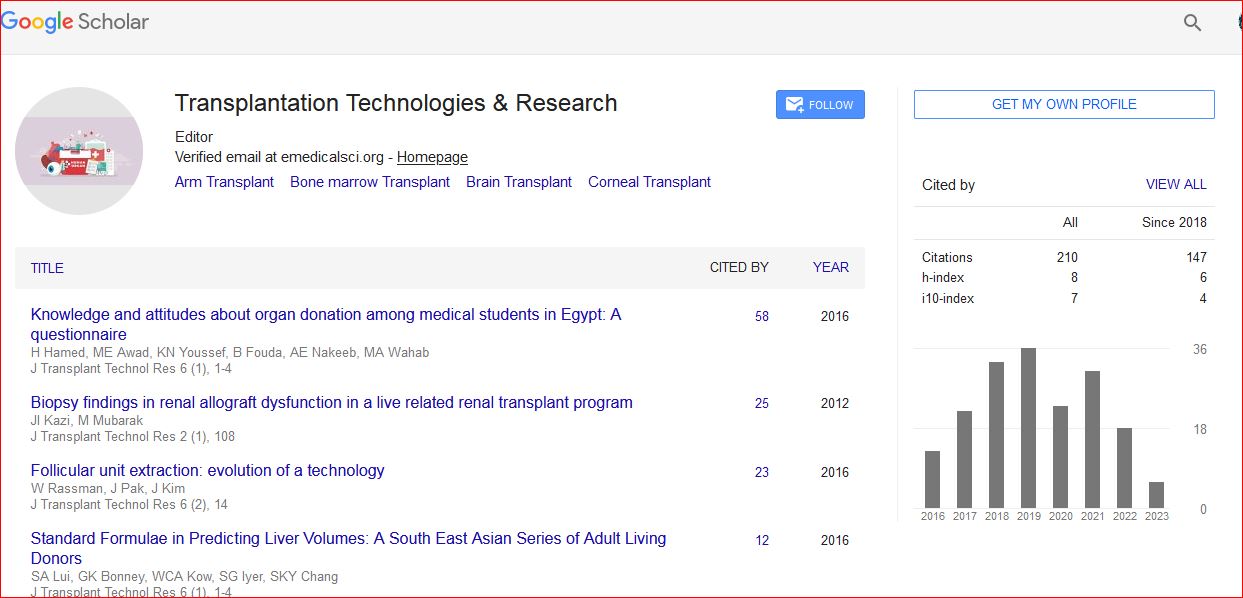
Transplantation Technologies & Research received 223 citations as per Google Scholar report