Expert Review - (2025) Volume 10, Issue 4
Received: 01-Dec-2025, Manuscript No. jib-25-175299;
Editor assigned: 03-Dec-2025, Pre QC No. P-175299;
Reviewed: 17-Dec-2025, QC No. Q-175299;
Revised: 22-Dec-2025, Manuscript No. R-175299;
Published:
29-Dec-2025
, DOI: 10.37421/2476-1966.2025.10.296
Citation: Reyes, Liliana. ”Innate RNA Sensing: Antiviral Defense and Autoimmunity.” J Immuno Biol 10 (2025):296.
Copyright: © 2025 Reyes L. This is an open-access article distributed under the terms of the Creative Commons Attribution License, which permits unrestricted use, distribution and reproduction in any medium, provided the original author and source are credited.
The intricate mechanisms by which RIG-I-like receptors (RLRs) detect viral RNA are crucial for initiating potent antiviral immune responses. This process involves critical steps from RNA sensing to downstream signaling pathways, emphasizing how these receptors differentiate self from non-self RNA and the implications for host defense against a broad spectrum of viruses[1].
A detailed examination of the RLR signaling pathway further traces events from initial viral RNA recognition to the activation of downstream effector molecules, orchestrating antiviral immunity. This includes focusing on the structural basis of RNA binding, conformational changes, and the subsequent assembly of signaling complexes that drive interferon production[5].
In-depth structural insights reveal how RLRs specifically recognize and bind diverse viral RNA species. Discussions cover critical domains involved in RNA binding, the conformational changes triggering receptor activation, and how these structural features enable precise discrimination between self and non-self RNA, essential for appropriate antiviral responses[6].
Simultaneously, RNA-sensing Toll-like receptors (TLR3, TLR7, TLR8) play pivotal functions in mediating antiviral immunity. Their distinct subcellular localizations, ligand specificities, and downstream signaling pathways lead to interferon and inflammatory cytokine production, underscoring their importance in recognizing viral RNA and shaping immune responses[2].
These Toll-like receptor family members, specifically TLR3, TLR7, and TLR8, elucidate distinct ligand specificities, endosomal localization, and signaling cascades that culminate in type I interferons and other inflammatory mediators, providing a comprehensive view of their contribution to antiviral innate immunity[8].
A comprehensive overview of recent discoveries showcases how innate immune pattern recognition receptors (PRRs) detect viral RNA. This includes various PRR families like RLRs and TLRs, highlighting their mechanisms of sensing diverse viral RNA structures and sequences, and the subsequent activation of antiviral signaling pathways crucial for host defense[3].
The fascinating connection between RNA modifications and their influence on innate immune recognition is also explored. Chemical alterations in viral and host RNA can either promote or evade detection by RNA recognition receptors, shedding light on a critical regulatory layer in antiviral immunity and self-non-self discrimination[4].
There's also an intricate relationship between double-stranded RNA (dsRNA) recognition receptors, particularly RLRs, and mitochondria in orchestrating antiviral immune responses. Mitochondria act as critical signaling hubs, facilitating the recruitment and activation of downstream adaptors like MAVS, integrating cellular metabolic state with innate immune signaling[9].
Recent progress characterizes how innate immune RNA recognition receptors detect SARS-CoV-2 RNA. It discusses specific viral RNA motifs recognized by different receptor families and how these interactions trigger antiviral signaling pathways, offering crucial insights into the host's immune response to COVID-19 and potential therapeutic targets[10].
Finally, an expanding understanding addresses how these RNA-sensing innate immune receptors, while crucial for antiviral defense, can paradoxically contribute to the pathogenesis of autoimmune diseases. Aberrant activation or dysregulation by self-RNA can trigger chronic inflammation and immune responses targeting host tissues, highlighting their dual role in immunity and disease[7].
The innate immune system relies on a sophisticated network of pattern recognition receptors (PRRs) to detect viral RNA and mount effective antiviral responses. These PRRs, which include families such as RIG-I-like receptors (RLRs) and Toll-like receptors (TLRs), are central to host defense. They identify distinct viral RNA structures and sequences, triggering downstream signaling pathways vital for immunity [3]. This initial recognition is a foundational step in distinguishing foreign invaders from self-components, setting off a cascade of protective actions within the host cell.
RIG-I-like receptors (RLRs) are key cytoplasmic sensors that intricately detect viral RNA, initiating potent antiviral immune responses [1]. These receptors operate through complex mechanisms, beginning with precise RNA sensing and leading to the activation of extensive downstream signaling pathways. Critically, RLRs possess the ability to differentiate between self and non-self RNA, a distinction vital for preventing autoimmune reactions while effectively combating a broad spectrum of viruses [1, 6]. A detailed look at the RLR signaling pathway reveals how initial viral RNA recognition leads to the activation of effector molecules, orchestrating robust antiviral immunity. This process involves the structural basis of RNA binding, significant conformational changes in the receptor, and the subsequent assembly of signaling complexes responsible for driving interferon production [5]. Further structural investigations highlight the specific domains involved in RNA binding and the conformational shifts that activate the receptor, showcasing how these features enable accurate discrimination between host and pathogen RNA [6]. The interplay between double-stranded RNA (dsRNA) recognition receptors, particularly RLRs, and mitochondria is also critical for orchestrating antiviral immune responses. Mitochondria function as important signaling hubs, facilitating the recruitment and activation of downstream adaptors such as MAVS, thereby integrating the cell's metabolic state with its innate immune signaling capabilities [9].
In parallel, RNA-sensing Toll-like receptors (TLR3, TLR7, TLR8) fulfill pivotal roles in mediating antiviral immunity. These receptors exhibit distinct subcellular localizations and specific ligand preferences, which dictate their recognition patterns of viral RNA. Their activation culminates in downstream signaling pathways that lead to the robust production of interferons and inflammatory cytokines, essential for shaping adaptive immune responses [2, 8]. The TLR family members TLR3, TLR7, and TLR8 are particularly noted for their specific ligand recognition and their presence in endosomal compartments. The signaling cascades they initiate are crucial for generating type I interferons and other inflammatory mediators, providing a comprehensive understanding of their contributions to innate antiviral immunity [8].
Beyond primary recognition, the immune system also navigates the intricate relationship between RNA modifications and innate immune sensing. Chemical alterations in both viral and host RNA can significantly influence whether these RNAs are detected or evade recognition by the relevant receptors [4]. This represents a critical regulatory layer in antiviral immunity, deeply impacting the fundamental process of self-non-self discrimination. Understanding these modifications offers insight into viral strategies for immune evasion and potential targets for enhancing host defense [4].
The expanding knowledge of RNA-sensing innate immune receptors also extends to specific viral threats, such as SARS-CoV-2. Recent advances illustrate how these receptors identify specific viral RNA motifs from SARS-CoV-2, and how these interactions trigger essential antiviral signaling pathways. This understanding provides crucial insights into the hostâ??s immune response to COVID-19 and offers potential avenues for therapeutic intervention [10]. However, these powerful immune components can also have a paradoxical dark side. While indispensable for antiviral defense, RNA-sensing innate immune receptors can contribute to the pathogenesis of autoimmune diseases. Aberrant activation or dysregulation of these receptors by self-RNA can provoke chronic inflammation and immune responses that inadvertently target host tissues, revealing their complex and sometimes dual role in immunity and disease [7].
The innate immune system effectively defends against viruses by employing specialized pattern recognition receptors (PRRs) that detect viral RNA. Key among these are RIG-I-like receptors (RLRs) and Toll-like receptors (TLRs). RLRs identify diverse viral RNA species in the cytoplasm, initiating potent antiviral immune responses [1]. This involves a sophisticated signaling pathway where structural changes upon RNA binding lead to the assembly of signaling complexes and subsequent interferon production [5, 6]. RLRs are crucial for discriminating between self and non-self RNA, a vital aspect of preventing auto-reactivity [1, 6]. Their function is also closely linked to mitochondria, which serve as critical signaling hubs in orchestrating these antiviral responses [9]. Concurrently, RNA-sensing Toll-like receptors, specifically TLR3, TLR7, and TLR8, located in endosomes, recognize distinct viral RNA ligands [2]. Their activation triggers downstream signaling cascades that culminate in the production of type I interferons and inflammatory cytokines, essential for broader antiviral immunity [8]. The recognition process is further complicated by RNA modifications, which can either promote or evade detection, adding a regulatory layer to innate immune responses [4]. These PRRs are fundamental for combating various viral infections, including emerging threats like SARS-CoV-2, where understanding their interaction with viral RNA offers insights for therapeutic strategies [10]. However, a crucial paradox exists: while indispensable for defense, dysregulation or aberrant activation of these RNA-sensing receptors by self-RNA can contribute to autoimmune diseases, underscoring their dual role in health and disease [7].
None
None
Ying H, Bing L, Chao H. "RIG-I-like receptors in innate antiviral immunity: sensing and signaling".Signal Transduct Target Ther 7 (2022):295.
Indexed at, Google Scholar, Crossref
Tatsushi K, Osamu T, Shizuo A. "The roles of RNA-sensing Toll-like receptors in antiviral immunity".Semin Immunopathol 41 (2019):661-670.
Indexed at, Google Scholar, Crossref
Jianhua Z, Xiaohui W, Hongli S. "Recent advances in innate recognition of viral RNA by pattern recognition receptors".Cell Mol Immunol 18 (2021):11-23.
Indexed at, Google Scholar, Crossref
Nicole G, Elisabetta S, Marco B. "Interplay between RNA modifications and innate immune sensing".Front Immunol 12 (2021):636329.
Indexed at, Google Scholar, Crossref
Zhiyuan L, Jiajun Z, Zhihao Z. "The RIG-I-like receptor pathway in antiviral innate immunity: from sensing to signaling".Signal Transduct Target Ther 6 (2021):220.
Indexed at, Google Scholar, Crossref
Yingliang L, Zeyan D, Zhen L. "Structural Insights into RNA Recognition by RIG-I-like Receptors".Cells 12 (2023):1729.
Indexed at, Google Scholar, Crossref
Qi Y, Ke Y, Danhong X. "Emerging roles of RNA-sensing innate immune receptors in autoimmune diseases".Front Immunol 14 (2023):1118182.
Indexed at, Google Scholar, Crossref
Qi L, Yuan H, Zijian C. "RNA Sensing and Signaling by Toll-Like Receptors in Antiviral Immunity".Front Immunol 12 (2021):638612.
Indexed at, Google Scholar, Crossref
Jiannan D, Xu H, Haining C. "Interplay Between dsRNA Recognition Receptors and Mitochondria in Antiviral Immunity".Viruses 14 (2022):1133.
Indexed at, Google Scholar, Crossref
Peng G, Cong S, Hui H. "Advances in understanding RNA recognition by innate immune receptors against SARS-CoV-2 infection".Front Microbiol 13 (2022):978972.
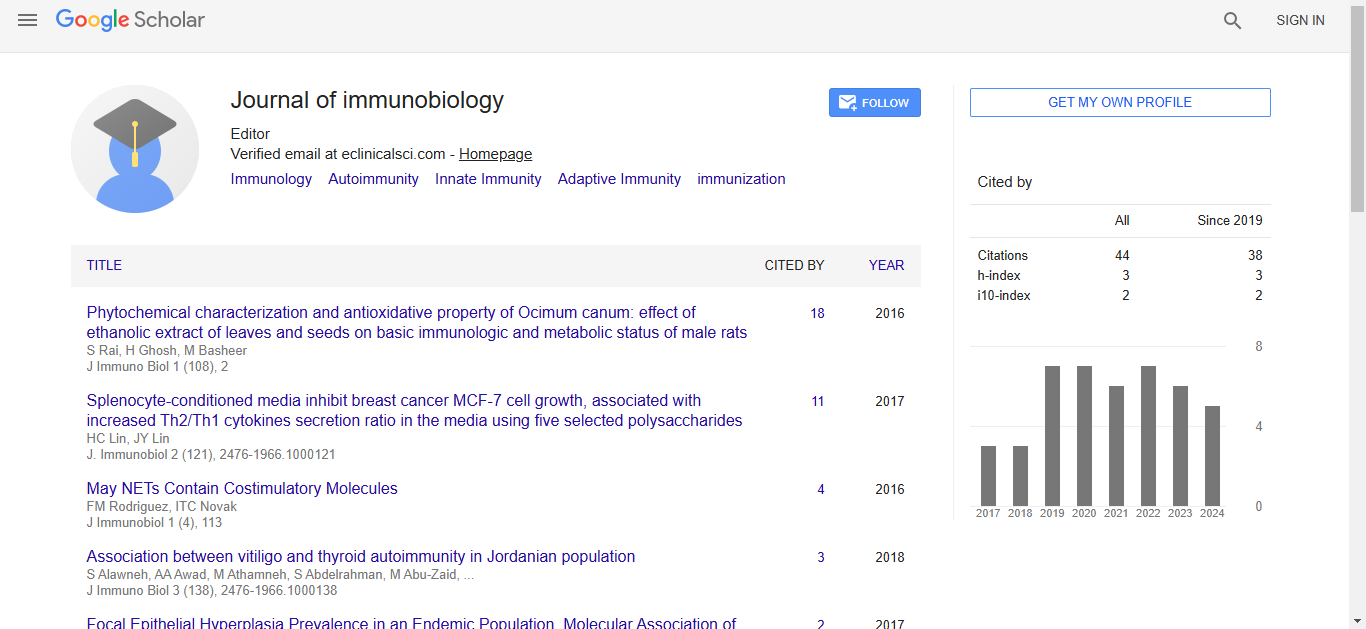
Journal of Immunobiology received 34 citations as per Google Scholar report