Opinion - (2025) Volume 14, Issue 5
Received: 01-Sep-2025, Manuscript No. jamk-25-177317;
Editor assigned: 03-Sep-2025, Pre QC No. P-177317;
Reviewed: 17-Sep-2025, QC No. Q-177317;
Revised: 22-Sep-2025, Manuscript No. R-177317;
Published:
29-Sep-2025
, DOI: 10.37421/2168-9601.2025.14.576
Citation: Petrova, Natalia. ”Global Marketing: Navigating Digital, Geopolitical, and Ethical Shifts.” J Account Mark 14 (2025):576.
Copyright: © 2025 Petrova N. This is an open-access article distributed under the terms of the Creative Commons Attribution License, which permits unrestricted use, distribution and reproduction in any medium, provided the original author and source are credited.
The contemporary global marketplace is undergoing profound transformations, largely driven by advancements in digital technologies. This shift necessitates a re-evaluation of established international marketing strategies to ensure sustained firm performance. Companies are increasingly leveraging digital tools to navigate complex global dynamics, aiming to enhance efficiency and reach. Understanding the specific strategic adaptations required in this digitally interconnected environment is crucial for academic research and practical application alike [1].
The aftermath of the recent global pandemic has further accelerated the need for adaptive marketing approaches, presenting both unprecedented challenges and novel opportunities. In this evolving landscape, digitalization and sustainability have emerged as pivotal themes, guiding businesses in their efforts to address new market demands and foster resilience across borders. The interplay of these factors defines the strategic imperatives for global marketers in the current era [2].
Artificial Intelligence (AI) stands as a transformative force within global marketing, offering substantial opportunities for enhancing targeting precision and delivering highly personalized consumer experiences. However, the widespread deployment of AI also introduces significant ethical considerations, particularly when applied across diverse cultural contexts. Striking a balance between technological advancement and ethical governance is paramount for responsible AI integration in marketing practices [3].
Navigating the intricate landscape of global consumer behavior remains a fundamental challenge for marketers operating internationally. The inherent complexity arising from diverse cultural backgrounds, socioeconomic factors, and regional preferences demands sophisticated analytical approaches. Identifying effective strategies to understand and engage varied consumer groups is essential for successful market penetration and sustained growth in an increasingly globalized world [4].
Cross-cultural marketing communication has been significantly reshaped by the digital age, requiring a systematic review of contemporary practices and emerging trends. This area of study highlights the critical importance of understanding cultural nuances to craft effective messages that resonate with global audiences. Digital platforms offer vast opportunities for engagement, yet they also amplify the challenges associated with cultural sensitivity and context [5].
Beyond mere trend, sustainable marketing has solidified its position as a global imperative, closely intertwined with corporate social responsibility (CSR). Businesses face the dual challenge of integrating sustainable practices into their marketing frameworks while simultaneously addressing the unique complexities and expectations across different national and regional markets. The pursuit of sustainability is not just ethical, but increasingly a driver of competitive advantage [6].
Technological innovation plays a direct and significant role in determining international marketing success. A multi-country examination reveals a clear correlation between the effective adoption of new technologies and improved marketing performance within the dynamic and often challenging global market environment. Firms that strategically invest in and integrate advanced technologies gain a distinct advantage in reaching and serving international customers [7].
For small and medium-sized enterprises (SMEs), entering emerging global markets presents a unique set of strategic considerations. These businesses frequently encounter specific obstacles, such as limited resources and profound cultural barriers. Nevertheless, emerging economies also offer substantial opportunities for strategic growth, necessitating tailored approaches that address both the constraints and the potential inherent in these markets [8].
Digital marketing strategies are increasingly recognized as indispensable for achieving global market expansion. Comprehensive analysis demonstrates how diverse digital tactics, ranging from social media engagement to search engine optimization (SEO), directly influence a firm's capacity to successfully enter and grow in international arenas. Identifying common pitfalls and codifying best practices is crucial for maximizing the impact of digital efforts [9].
Geopolitical risks constitute a significant, often unpredictable, factor influencing global marketing operations. Companies must develop robust frameworks to anticipate, rigorously assess, and flexibly adapt their marketing strategies to mitigate the adverse effects of political instability, international tensions, and trade policy shifts. Proactive management of these risks is fundamental to ensuring business continuity and maintaining a strong market presence worldwide [10].
Ladeira et al. (2023) delve into the profound impact of digital transformation on international marketing strategies, meticulously detailing how companies are adapting to a new global landscape. Their research elucidates specific strategies, such as data-driven decision-making and omnichannel integration, demonstrating how these innovations directly influence firm performance in complex international markets. The article offers practical insights for businesses aiming to optimize their global operations amidst ongoing digitalization [1]. Hameed et al. (2022) provide an in-depth examination of global marketing challenges in the post-pandemic era, emphasizing the indispensable roles of digitalization and sustainability. The paper systematically outlines how businesses can leverage digital platforms for enhanced reach and efficiency, while simultaneously integrating sustainable practices to meet evolving consumer expectations and regulatory requirements. It identifies novel opportunities for growth by addressing these critical market shifts [2]. Dwivedi et al. (2023) explore the transformative potential of Artificial Intelligence in global marketing. Their study highlights significant opportunities, including advanced customer segmentation, hyper-personalization of marketing messages, and predictive analytics for market trends. Concurrently, the authors rigorously address ethical considerations such as data privacy, algorithmic bias, and the impact of AI on cultural sensitivities, advocating for responsible deployment [3]. Iqbal et al. (2020) meticulously dissect the complexities of understanding consumer behavior in a globalized market. The article delineates the formidable challenges associated with cultural differences, varied purchasing power, and diverse regulatory environments. It subsequently identifies key opportunities for marketers to develop more effective, culturally sensitive strategies, stressing the importance of localized insights and adaptable frameworks for engagement [4]. Khan et al. (2023) present a systematic literature review on cross-cultural marketing communication in the digital age. This comprehensive synthesis identifies emerging trends such as influencer marketing and user-generated content, while also critically examining persistent challenges like language barriers and cultural interpretation. The review provides actionable insights for companies seeking to engage global audiences effectively across diverse digital platforms [5]. Belkacem et al. (2023) investigate sustainable marketing within a global context, focusing on the integration of corporate social responsibility (CSR). The paper elaborates on the hurdles businesses encounter, such as varying regulatory landscapes and consumer perceptions of sustainability across different countries. It also highlights the advantages, including enhanced brand reputation and increased consumer loyalty, for companies that successfully embed CSR into their global marketing efforts [6]. Oghazi et al. (2020) conduct a multi-country study to establish the significant link between technological innovation and international marketing success. Their empirical findings illustrate how specific technological adoptions, such as advanced CRM systems, marketing automation, and big data analytics, enable firms to significantly enhance their marketing performance and competitive positioning within complex and competitive global markets [7]. Al-Haddad et al. (2021) analyze global market entry strategies specifically tailored for small and medium-sized enterprises (SMEs) in emerging economies. The paper meticulously details challenges such as limited financial capital, lack of international experience, and navigating unfamiliar regulatory frameworks. Crucially, it also identifies unique opportunities for strategic growth, emphasizing niche market identification and leveraging digital tools for scalable entry [8]. Al-Mashhadani et al. (2023) provide a thorough analysis of how various digital marketing strategies influence global market expansion. Their study assesses the effectiveness of tactics like social media marketing, content marketing, search engine optimization (SEO), and email campaigns. It pinpoints common pitfalls, such as failing to localize content, and delineates best practices for firms aiming to achieve successful penetration and sustainable growth in international markets [9]. Ghauri et al. (2021) address the critical issue of navigating geopolitical risks in global marketing strategies. The paper outlines a comprehensive framework for companies to anticipate potential political instabilities, rigorously assess their impact on supply chains and market access, and adapt marketing approaches accordingly. Strategies include diversification of markets, contingency planning, and diplomatic engagement, all aimed at ensuring business continuity and maintaining robust market presence despite international tensions [10].
The provided research collectively underscores the dynamic evolution of global marketing, heavily influenced by digital transformation, technological innovation, and geopolitical shifts. Key themes include the profound impact of digitalization on international marketing strategies and firm performance, alongside the critical roles of sustainability and Artificial Intelligence in addressing contemporary market challenges and opportunities. Understanding complex global consumer behavior, adapting cross-cultural communication in the digital age, and integrating corporate social responsibility are identified as essential for success. Specific studies highlight strategies for small and medium-sized enterprises entering emerging markets and the necessity of mitigating geopolitical risks. Overall, the literature emphasizes proactive adaptation, strategic leveraging of technology, and ethical considerations for businesses operating in an interconnected and often volatile global environment. The synthesis reveals that successful global marketing in the modern era requires a multifaceted approach, combining technological prowess with cultural intelligence and resilience against external shocks.
None
None
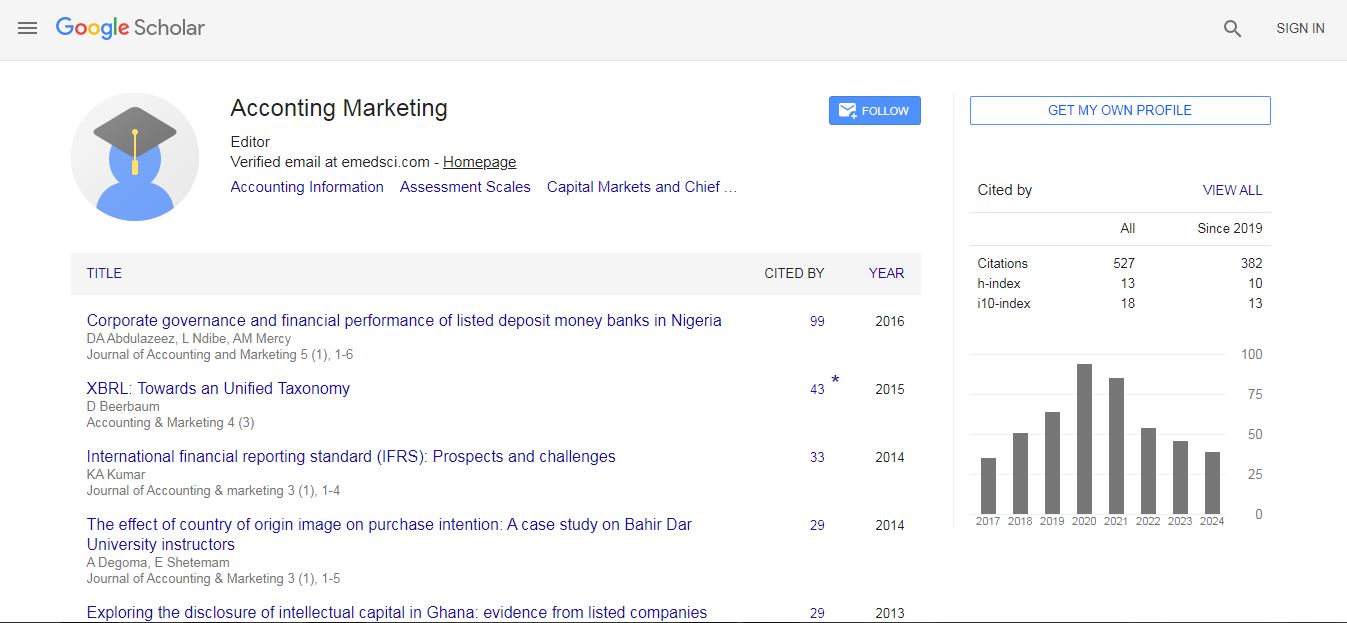
Accounting & Marketing received 487 citations as per Google Scholar report