Commentary - (2025) Volume 14, Issue 3
Received: 01-May-2025, Manuscript No. jamk-25-177275;;
Editor assigned: 03-May-2025, Pre QC No. P-177275;
Reviewed: 17-May-2025, QC No. Q-177275;
Revised: 24-May-2025, Manuscript No. R-177275;
Published:
31-May-2025
, DOI: 10.37421/2168-9601.2025.14.553
Citation: Wilson, Andrew. ”Financial Reporting Quality: Driving Growth and Value.” J Account Mark 14 (2025):553.
Copyright: © 2025 Wilson A. This is an open-access article distributed under the terms of the Creative Commons Attribution License, which permits unrestricted use, distribution and reproduction in any medium, provided the original author and source are credited.
The foundational importance of high-quality financial reporting in enhancing corporate investment efficiency has been consistently demonstrated. Reliable financial information empowers managerial teams to make judicious capital allocation decisions, directly fostering improved resource utilization and heightened operational efficiency. This critical function transcends mere regulatory compliance, positioning accurate financial reporting as a pivotal catalyst for sustainable business expansion and strategic development [1].
Robust corporate governance structures are indispensable for elevating the quality of financial reporting. Independent and actively engaged boards of directors play a crucial oversight role in financial disclosures, significantly mitigating the potential for earnings management. This ensures that reported financial figures offer greater reliability to all stakeholders, confirming that effective governance directly translates into more credible financial statements [2].
Transparent and accurate environmental, social, and governance (ESG) reporting is increasingly recognized not merely as a superficial commitment but as a tangible driver of superior financial performance. Studies indicate that dependable ESG disclosures cultivate enhanced stakeholder confidence, which can positively impact a company's financial bottom line. This underscores the growing significance of precise non-financial metric reporting, making it as crucial as traditional financial statements for comprehensive business success [3].
The effectiveness of audit committees is paramount to achieving high-quality financial reporting. A well-functioning audit committee, operating in conjunction with proficient auditors, substantially bolsters the reliability and trustworthiness of an organization's financial statements. This emphasizes that robust internal and external oversight mechanisms are fundamental in preventing misstatements and upholding reporting accuracy [4].
Digitalization profoundly impacts financial reporting, particularly within the banking sector. The strategic adoption of digital technologies has been shown to markedly improve reporting accuracy and streamline audit processes. This integration of advanced tools significantly reduces the potential for human error, facilitating the generation of quicker and more dependable financial data, which is essential for informed decision-making in complex industries [5].
Accurate financial reporting plays a crucial role in significantly augmenting firm value, primarily by cultivating strong investor confidence. When investors possess trust in reported financial figures, they are more inclined to commit capital, leading to a reduction in the cost of equity and an enhancement of market perceptions. This establishes reliability in financial statements as a direct pathway to achieving a stronger market position [6].
The implementation of International Financial Reporting Standards (IFRS) is widely regarded as a key mechanism for improving the quality of financial reporting. Research from regions like Tunisia supports this perspective, illustrating how IFRS adoption can reduce accrual-based earnings management, thereby leading to more accurate financial statements. This highlights how global accounting standards aim to instill consistency and reliability in financial data across diverse economies [7].
Data analytics is transforming internal controls and, consequently, financial reporting. The strategic application of data analytics markedly strengthens internal control systems, enabling them to be more proactive in identifying anomalies and potential irregularities. This advancement directly contributes to the generation of higher quality and more accurate financial reports, enhancing the overall reliability of financial information for decision-makers [8].
Managerial incentives can exert considerable influence on financial reporting quality, occasionally leading to practices such as earnings management. However, research suggests that a company's ownership structure can mediate these effects. Specifically, a judiciously distributed or concentrated ownership, coupled with appropriate oversight, can effectively counteract managerial inclinations to manipulate financial figures, thereby fostering more accurate reporting [9].
Artificial intelligence (AI) and big data are poised to revolutionize financial reporting and auditing processes. These advanced technologies are anticipated to substantially enhance the accuracy and efficiency of financial disclosures through process automation and improved anomaly detection capabilities. The future of precise financial reporting is therefore intrinsically linked to the proactive adoption and integration of these sophisticated technological advancements [10].
High-quality financial reporting is a critical determinant of corporate investment efficiency, as studies consistently reveal. When firms provide reliable financial information, managers are better equipped to make optimal decisions regarding capital allocation, which subsequently translates into superior resource management and enhanced operational effectiveness. This underscores that robust reporting extends beyond regulatory mandates, serving as a primary catalyst for intelligent business expansion [1]. Effective corporate governance mechanisms are directly correlated with an elevated standard of financial reporting quality. Research indicates that independent and actively engaged boards play an essential role in overseeing financial disclosures, thereby diminishing the propensity for earnings management. This proactive oversight ensures that financial statements are more credible for stakeholders, confirming a direct link between strong governance and trustworthy financial information [2]. Evidence suggests that transparent and accurate ESG disclosure significantly contributes to a firm's financial performance, particularly in emerging markets. Such reliable non-financial reporting fosters stakeholder confidence, which can lead to positive impacts on a company's profitability. This highlights the evolving importance of precise reporting on environmental, social, and governance factors as a critical component of overall business success [3]. The pivotal role of effective audit committees in ensuring financial reporting quality cannot be overstated. When an audit committee functions optimally, collaborating closely with high-quality auditors, it substantially bolsters the credibility and accuracy of a company's financial statements. This reinforces the necessity of robust internal and external oversight frameworks for preventing inaccuracies and ensuring the integrity of financial data [4]. Digital transformation profoundly influences financial reporting, especially within the banking sector. The adoption of digital technologies has been found to markedly improve the accuracy of reporting and the efficiency of audit procedures. By leveraging advanced tools, organizations can minimize human errors and accelerate the production of reliable financial data, which is vital for strategic decision-making in a highly regulated industry [5]. Reliable financial reporting is instrumental in enhancing firm value by cultivating investor trust. When investors perceive financial statements as trustworthy, they are more inclined to provide capital, which in turn lowers the cost of equity and improves market valuation. This demonstrates that consistent accuracy in financial reporting serves as a direct pathway to a more robust market standing for firms [6]. The implementation of International Financial Reporting Standards (IFRS) is consistently associated with improvements in reporting quality. Studies, including specific evidence from Tunisia, illustrate that IFRS adoption can effectively reduce accrual-based earnings management, leading to more precise financial statements. This confirms the global objective of IFRS to foster greater consistency and reliability in financial disclosures worldwide [7]. Data analytics plays a transformative role in reinforcing internal control systems, thereby enhancing financial reporting quality. The strategic application of data analytics allows for more proactive identification of anomalies and potential risks within financial processes. This integration directly leads to the production of higher quality and more accurate financial reports, significantly improving the overall dependability of financial information [8]. Managerial incentives, while often influencing financial reporting quality, are mediated by a firm's ownership structure. Research indicates that specific ownership configurations, whether widely distributed or highly concentrated, can, with proper oversight, effectively counteract management's potential desire to manipulate financial figures. This mechanism promotes greater accuracy and integrity in reported financial data [9]. Artificial intelligence and big data are emerging as transformative forces in financial reporting and auditing. These technologies are anticipated to substantially improve the accuracy and efficiency of financial disclosures by automating complex processes and enhancing the detection of irregularities. This signifies that the future landscape of accurate financial reporting is increasingly dependent on the strategic adoption of advanced technological solutions [10].
This collection of studies underscores the multifaceted nature and profound impact of financial reporting quality on various organizational outcomes. High-quality financial reporting is consistently linked to improved investment efficiency, enhanced firm value through bolstered investor confidence, and superior financial performance, including from transparent ESG disclosures. Key determinants of reporting quality include robust corporate governance frameworks, effective audit committees, and the global adoption of standards like IFRS. Furthermore, technological advancements such as digitalization, data analytics, artificial intelligence, and big data are increasingly pivotal in enhancing the accuracy and efficiency of financial reporting and audit processes. While managerial incentives can pose challenges to reporting integrity, appropriate ownership structures can mediate these effects, promoting more reliable disclosures. Collectively, the research emphasizes that accurate and reliable financial information is not merely a compliance issue but a fundamental driver of strategic decision-making, operational efficiency, and sustainable business growth across diverse sectors.
None
None
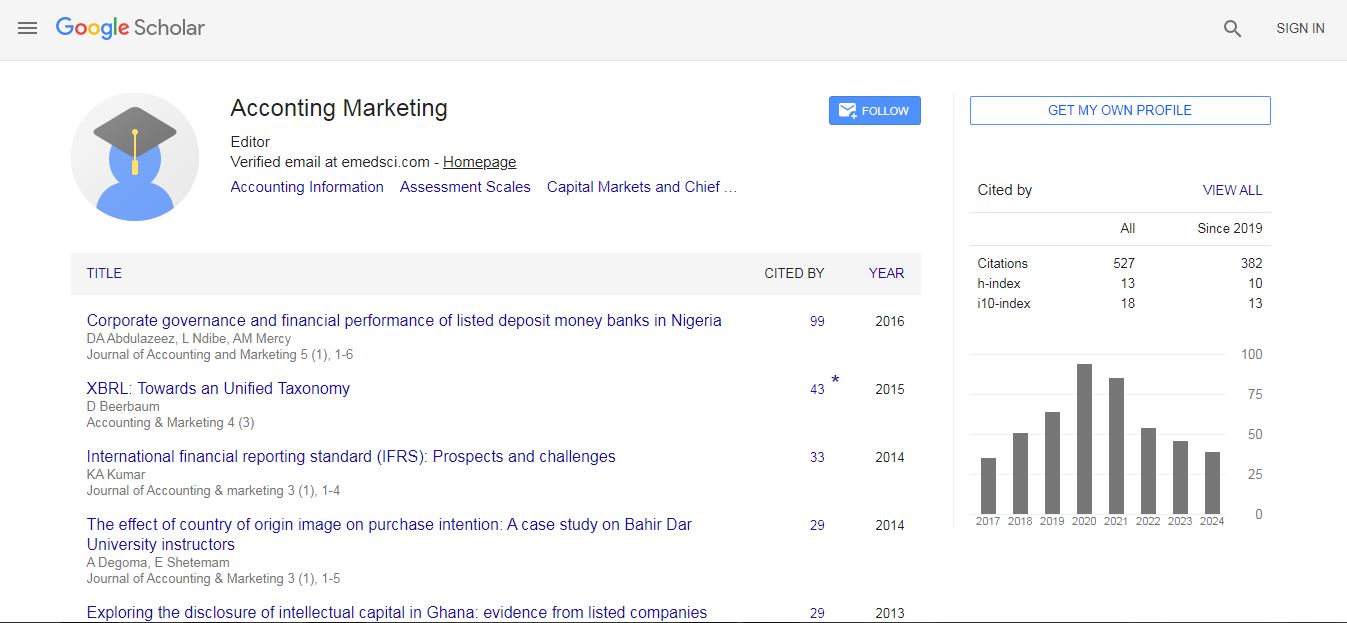
Accounting & Marketing received 487 citations as per Google Scholar report