Brief Report - (2025) Volume 15, Issue 5
Received: 01-Sep-2025, Manuscript No. Jsmds-25-175809;
Editor assigned: 03-Sep-2025, Pre QC No. P-175809;
Reviewed: 17-Sep-2025, QC No. Q-175809;
Revised: 22-Sep-2025, Manuscript No. R-175809;
Published:
29-Sep-2025
, DOI: 10.37421/2161-0673.2025.15.446
Citation: Giordani, Matteo. ”Exercise: Health, Performance, and Disease Prevention.” J Sports Med Doping Stud 15 (2025):446.
Copyright: © 2025 Giordani M. This is an open-access article distributed under the terms of the Creative Commons Attribution License, which permits unrestricted use,
distribution and reproduction in any medium, provided the original author and source are credited.
This article explores the intricate ways skeletal muscle adapts to exercise and nutritional interventions, discussing critical mechanisms like protein synthesis, mitochondrial biogenesis, and fiber type shifting. It emphasizes how these adaptations are crucial not just for athletic performance but also for managing and preventing various metabolic diseases, highlighting the potential for targeted interventions[1].
This review delves into the complex relationship between physical activity and the immune system, explaining how exercise can both enhance and temporarily suppress immune responses. It covers the implications for host defense against infections, inflammation, and chronic diseases, suggesting optimized exercise strategies for maintaining immune health across different populations, thereby influencing overall resilience[2].
This article provides a current perspective on the critical role of cardiorespiratory fitness in preventing cardiovascular disease. It summarizes the physiological mechanisms by which regular exercise improves cardiac function, endothelial health, and metabolic profiles, reinforcing the importance of fitness assessment and promotion in clinical practice for risk reduction and improved patient outcomes[3].
This paper examines how exercise induces metabolic remodeling within skeletal muscle, impacting energy substrate utilization and overall metabolic health. It discusses the molecular pathways involved in enhancing mitochondrial capacity and insulin sensitivity, emphasizing how these adaptations contribute to the prevention and management of metabolic disorders like Type 2 Diabetes, showcasing the profound impact of physical activity[4].
This narrative review explores the profound effects of physical exercise on brain health and neuroplasticity. It highlights mechanisms such as increased neurogenesis, enhanced synaptic plasticity, and improved cerebral blood flow, suggesting that regular physical activity can mitigate cognitive decline and offer therapeutic benefits for neurological conditions, supporting mental well-being across the lifespan[5].
This article provides a comprehensive overview of how aging impacts physiological systems and how exercise physiology adapts to address these changes. It discusses sarcopenia, reduced cardiorespiratory function, and impaired metabolic health in older adults, emphasizing exercise as a potent intervention to maintain functional independence and improve quality of life, extending healthy years[6].
This systematic review and meta-analysis synthesizes current evidence on the physiological adaptations to High-Intensity Interval Training (HIIT) in healthy adults. It confirms that HIIT effectively improves cardiorespiratory fitness, muscular endurance, and metabolic parameters, often in shorter durations than traditional continuous exercise, making it an efficient training modality for various populations[7].
This article explores the fundamental mechanisms by which exercise serves as a potent preventative and therapeutic strategy for a wide array of chronic diseases. It discusses how physical activity impacts inflammation, oxidative stress, immune function, and cellular metabolism, providing insights into its broad protective effects against conditions like cancer, diabetes, and cardiovascular disease, making it a cornerstone of preventive medicine[8].
This review presents current perspectives in environmental exercise physiology, bridging laboratory research with real-world applications. It focuses on how human physiological responses to exercise are modified by extreme environmental conditions, such as heat, cold, and altitude, and discusses strategies for optimizing performance and safety in these challenging settings, vital for athletes and professionals alike[9].
This paper highlights recent advancements in molecular exercise physiology, focusing on the intricate signaling pathways and gene expression changes that underpin exercise adaptations. It covers topics like miRNA regulation, epigenetic modifications, and the role of various intracellular sensors, offering a deeper understanding of how exercise influences cellular processes and overall health, paving the way for personalized interventions[10].
Physical activity stands as a powerful tool in both preventing and managing a broad spectrum of chronic diseases, a principle deeply rooted in its fundamental physiological impacts [8]. Regular engagement in exercise significantly improves cardiorespiratory fitness, which is critically linked to a reduced risk of cardiovascular disease through enhanced cardiac function and improved endothelial health [3]. Beyond cardiac benefits, exercise profoundly influences the immune system, mediating complex responses that can both bolster host defense against infections and effectively modulate inflammation, thereby supporting a robust immune response [2]. The protective effects extend to various metabolic pathways, where exercise plays a crucial role in maintaining overall metabolic health and preventing conditions like Type 2 Diabetes, largely by improving glucose regulation [4, 8]. The underlying mechanisms involve a notable reduction in systemic inflammation, a decrease in detrimental oxidative stress, and significantly enhanced cellular metabolism, demonstrating exercise's comprehensive and profound biological influence across multiple bodily systems [8]. This broad protective capacity, observed across diverse populations, underscores the immense importance of physical activity as a cornerstone of public health strategies and clinical therapeutic practice.
Skeletal muscle exhibits remarkable plasticity, undergoing significant and intricate adaptations in response to both consistent exercise and strategic nutritional interventions [1]. These adaptations are multifaceted, involving crucial changes at the cellular level, such as increased protein synthesis, enhanced mitochondrial biogenesis, and dynamic fiber type shifting, all of which collectively improve muscular function and overall metabolic efficiency [1]. Notably, exercise induces substantial metabolic remodeling within skeletal muscle, directly affecting how the body effectively utilizes various energy substrates, shifting towards more efficient fuel consumption [4]. This profound remodeling includes not only improving mitochondrial capacity, a key factor in cellular energy production, but also significantly enhancing insulin sensitivity, which is vital for optimal glucose uptake and regulation throughout the body [4]. Such muscular and metabolic improvements are not only essential for achieving peak athletic performance but are equally critical in the effective prevention and diligent management of various metabolic disorders, reinforcing the muscle's role as a metabolic regulator [1, 4]. These compelling insights highlight the muscle as a dynamic organ, central to maintaining systemic health and resilience against disease.
The benefits of sustained physical exercise extend significantly to brain health and neuroplasticity, offering promising avenues for not only mitigating age-related cognitive decline but also providing substantial therapeutic support for a range of neurological conditions [5]. Physical activity is known to promote increased neurogenesis, the creation of new brain cells, enhance synaptic plasticity, which improves communication between neurons, and improve cerebral blood flow, all contributing to a healthier, more adaptable, and resilient brain structure [5]. Furthermore, the field of exercise physiology is acutely relevant to addressing the complex physiological challenges posed by human aging, as it provides potent and accessible interventions to counteract age-related physiological decline [6]. Older adults frequently experience conditions such as sarcopenia, a debilitating reduction in muscle mass and strength, alongside diminished cardiorespiratory function and impaired metabolic health. Regular, appropriately designed exercise programs have been shown to be invaluable in preserving functional independence, improving balance, and significantly enhancing the quality of life in this vulnerable population, effectively slowing down or even partially reversing some detrimental aspects of physiological aging [6].
Modern exercise science also delves into highly specialized training modalities and the intricate influences of environmental factors. High-Intensity Interval Training (HIIT), for instance, has rapidly gained recognition as an exceptionally efficient training method that significantly improves cardiorespiratory fitness, muscular endurance, and various metabolic parameters in healthy adults [7]. Importantly, these benefits are often achieved in shorter cumulative durations compared to traditional continuous exercise, making HIIT a time-efficient option for diverse populations [7]. Furthermore, research extensively explores how human physiological responses to exercise are profoundly modified by extreme environmental conditions, such as intense heat, severe cold, and high altitude [9]. This fascinating field of environmental exercise physiology offers critical insights for optimizing athletic performance and ensuring safety in such challenging settings, which is vital for athletes, military personnel, and outdoor professionals alike [9]. On an even deeper level, molecular exercise physiology meticulously uncovers the intricate signaling pathways and precise gene expression changes that robustly underpin all exercise adaptations [10]. This cutting-edge research includes understanding miRNA regulation, epigenetic modifications, and the crucial role of various intracellular sensors, thereby offering a sophisticated and detailed view of how exercise profoundly impacts cellular processes and overall health, paving the way for highly personalized and effective exercise prescriptions in the future [10].
Exercise physiology is a dynamic field that illuminates the profound impact of physical activity on human health and performance. It explores how skeletal muscle adapts through protein synthesis and mitochondrial biogenesis, crucial for athletic prowess and preventing metabolic diseases [1]. The discipline also clarifies the complex interplay between exercise and the immune system, showing how physical activity can both enhance and modulate immune responses, impacting defense against infections and chronic inflammation [2]. Cardiorespiratory fitness emerges as a vital factor in cardiovascular disease prevention, with regular exercise improving cardiac function and metabolic profiles [3]. Beyond systemic benefits, exercise induces significant metabolic remodeling in skeletal muscle, enhancing insulin sensitivity and mitochondrial capacity, which is key for managing metabolic disorders like Type 2 Diabetes [4]. The brain also sees substantial benefits, with exercise promoting neurogenesis, synaptic plasticity, and improved blood flow, thereby supporting cognitive health and offering therapeutic potential for neurological conditions [5]. Furthermore, exercise is a potent intervention against age-related decline, helping older adults maintain functional independence and improve quality of life by addressing sarcopenia and reduced cardiorespiratory function [6]. Specific training modalities, such as High-Intensity Interval Training (HIIT), have proven effective in improving fitness and metabolic parameters efficiently [7]. The overarching view is that exercise acts as a fundamental preventative and therapeutic strategy for numerous chronic diseases, impacting inflammation, oxidative stress, and cellular metabolism [8]. Research also extends to environmental exercise physiology, understanding adaptations to extreme conditions [9], and molecular exercise physiology, delving into gene expression and signaling pathways that underpin these wide-ranging health benefits [10].
None
None
Indexed at, Google Scholar, Crossref
Indexed at, Google Scholar, Crossref
Indexed at, Google Scholar, Crossref
Indexed at, Google Scholar, Crossref
Indexed at, Google Scholar, Crossref
Indexed at, Google Scholar, Crossref
Indexed at, Google Scholar, Crossref
Indexed at, Google Scholar, Crossref
Indexed at, Google Scholar, Crossref
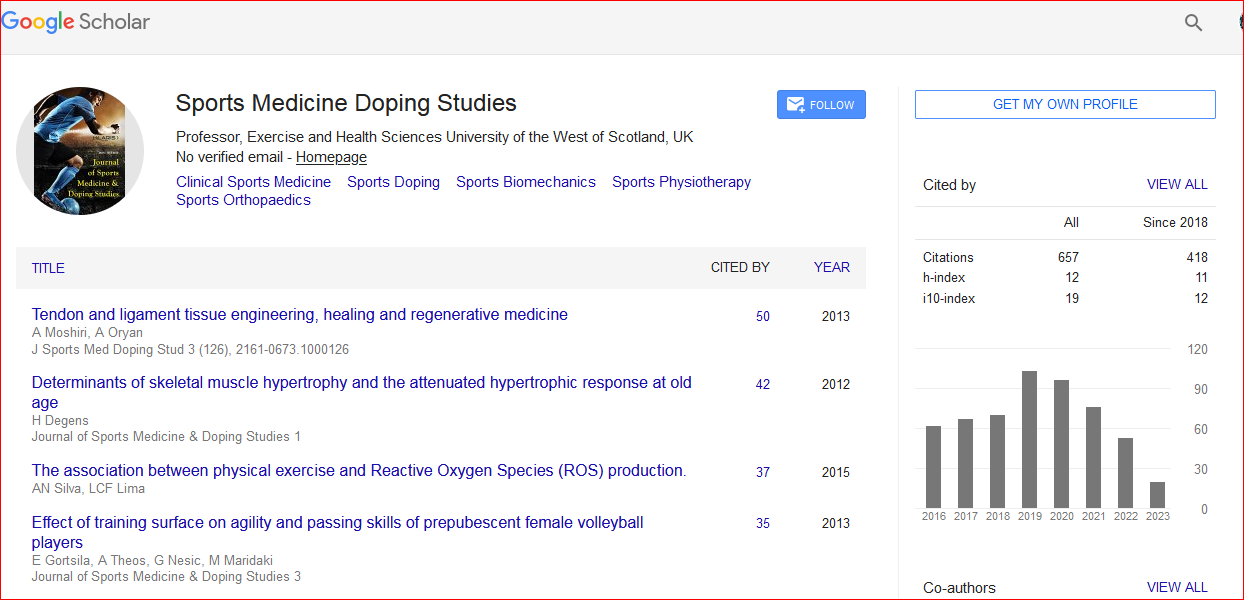
Journal of Sports Medicine & Doping Studies received 1022 citations as per Google Scholar report