Opinion - (2025) Volume 14, Issue 6
Received: 01-Nov-2025, Manuscript No. jamk-25-177331;
Editor assigned: 03-Nov-2025, Pre QC No. P-177331;
Reviewed: 17-Nov-2025, QC No. Q-177331;
Revised: 24-Nov-2025, Manuscript No. R-177331;
Published:
29-Nov-2025
, DOI: 10.37421/2168-9601.2025.14.587
Citation: Johnson, Robert. ”Evolving Digital Marketing: AI, Metaverse, and Beyond.” J Account Mark 14 (2025):587.
Copyright: © 2025 Johnson R. This is an open-access article distributed under the terms of the Creative Commons Attribution License, which permits unrestricted use, distribution and reproduction in any medium, provided the original author and source are credited.
The pervasive integration of artificial intelligence (AI) into digital marketing represents a transformative shift in how businesses approach consumer engagement and strategic outreach. AI technologies are increasingly leveraged to refine crucial marketing functions, including the optimization of personalization strategies, the development of sophisticated predictive analytics, and the automation of content generation processes. This systematic integration enables organizations to achieve unparalleled precision in targeting specific consumer segments and to deliver experiences that are highly relevant and compelling. Ultimately, AI fundamentally alters the dynamic of brand-consumer connections, fostering more impactful and efficient marketing outcomes [1].
Influencer marketing has undergone rapid evolution, necessitating a thorough understanding of its current state and future research trajectories. Key areas of focus include how influencers shape consumer behavior, the dynamics of brand authenticity, and the importance of transparent disclosure practices in an increasingly digital landscape. This review underscores that as digital platforms continue to expand, comprehending the intricacies of influencer engagement becomes crucial for the formulation of effective digital strategies [2].
Personalization stands as a critical element in digital marketing, with systematic reviews highlighting its substantial benefits and inherent challenges. Tailoring content and experiences is crucial for driving customer engagement and fostering loyalty. The main idea here is that effective personalization moves beyond basic segmentation, utilizing advanced data analytics to create unique customer journeys that are highly resonant with individual consumer needs and preferences [3].
The metaverse introduces a novel frontier for marketing, presenting both unprecedented opportunities and significant challenges for brands operating within virtual environments. This includes exploring new advertising formats and creating immersive customer experiences. The implications for businesses involve an urgent need to adapt their strategies for engagement in these emergent digital spaces, embracing the unique characteristics of virtual interactions [4].
The intersection of digital marketing and sustainable consumption reveals dual potentials: promoting eco-friendly products and behaviors while navigating complex ethical dilemmas. Digital marketers must therefore consider both the environmental footprint of their campaigns and how to genuinely support sustainable consumer choices, ensuring their efforts contribute positively to ecological goals [5].
A conceptual framework illustrates the interconnectedness of digital transformation, big data analytics, and artificial intelligence in reshaping marketing paradigms. It argues that these intertwined technologies drive profound organizational changes in how businesses understand and engage with customers. This signifies a fundamental shift towards data-driven strategies aimed at achieving improved efficiency and securing a robust competitive advantage [6].
Mobile marketing characteristics significantly influence purchase intention within e-commerce, as explored through moderated mediation models. Critical drivers of consumer decisions on mobile platforms include an intuitive user experience, inherent convenience, and established trust, which are paramount in the rapidly expanding mobile commerce ecosystem. Understanding these elements is essential for optimizing mobile marketing effectiveness [7].
Blockchain technology offers transformative potential for marketing by enhancing transparency, trust, and data security in digital transactions and loyalty programs. This emerging technology is poised to redefine customer relationships and bolster supply chain integrity, promising new paradigms for secure and verifiable interactions across various marketing applications [8].
Conversational AI, encompassing technologies such as chatbots and voice assistants, is profoundly altering digital marketing practices. Its applications range from elevating customer service standards to delivering personalized recommendations at scale. This allows brands to offer more immediate and human-like interactions, thereby improving customer engagement and operational efficiency across digital touchpoints [9].
Phygital marketing introduces a conceptual framework for seamlessly integrating physical and digital customer experiences. By bridging online and offline touchpoints, this approach creates richer and more unified customer journeys. The core message is that future marketing success depends on offering hybrid experiences that meet evolving consumer expectations and preferences in a convergent marketplace [10].
This systematic review comprehensively analyzes the integration of artificial intelligence (AI) into digital marketing. It elaborates on how AI tools revolutionize marketing facets such as enhanced personalization, sophisticated predictive analytics, and efficient automated content creation. The core implication is that businesses can achieve superior targeting precision and deliver more pertinent customer experiences, fundamentally altering how brands interact with consumers [1]. The review on influencer marketing meticulously outlines its rapid evolution, current state, and vital future research directions. It examines the mechanisms through which influencers impact consumer behavior, the cultivation of brand authenticity, and the imperative for ethical disclosure practices. Understanding these dynamics is crucial for developing effective digital strategies amidst the continuous growth of digital platforms [2]. A systematic review of personalization in digital marketing underscores its significant advantages and inherent challenges. It details how the strategic tailoring of content and experiences directly fosters greater engagement and customer loyalty. The paper emphasizes moving beyond rudimentary segmentation, advocating for the deployment of advanced data analytics to craft unique and highly individualized customer journeys [3]. Exploring the metaverse as a new marketing frontier, this article identifies both the extensive opportunities and formidable challenges for brands within virtual worlds. It discusses the emergence of novel advertising forms and the creation of immersive customer experiences. Businesses are therefore urged to swiftly adapt their marketing strategies to effectively engage audiences in these rapidly evolving digital environments [4]. This review critically examines the nexus between digital marketing and sustainable consumption. It highlights the potential of digital channels to advocate for eco-friendly products and behaviors, concurrently exposing inherent ethical dilemmas. Digital marketers are thus tasked with evaluating the environmental impact of their campaigns and genuinely supporting sustainable consumer choices [5]. A conceptual framework establishes the profound interconnections among digital transformation, big data analytics, and artificial intelligence within the marketing domain. It posits that these technologies are inextricably linked, driving fundamental changes in how organizations perceive and interact with their customer base. This necessitates a strategic pivot towards data-driven approaches to enhance operational efficiency and secure competitive advantage [6]. The study investigates the influence of mobile marketing characteristics on purchase intention in e-commerce, utilizing a moderated mediation model to uncover critical drivers. It reveals that user experience, convenience, and trust are paramount in guiding consumer decisions on mobile platforms, underscoring their significance in the burgeoning mobile commerce landscape [7]. This systematic literature review assesses the application of blockchain technology in marketing contexts. It elucidates how blockchain can significantly bolster transparency, trust, and data security in digital transactions and loyalty programs. The authors propose that this technology holds considerable promise for redefining customer relationships and enhancing the integrity of supply chains [8]. The review concerning conversational AI, encompassing chatbots and voice assistants, maps its diverse applications in digital marketing. From elevating customer service to providing personalized recommendations, conversational AI enables brands to deliver immediate and human-like interactions at scale, thereby improving both customer engagement and operational efficiency [9]. A conceptual framework for â??phygitalâ?? marketing is introduced, advocating for the seamless integration of physical and digital experiences. The premise is that combining online and offline touchpoints cultivates richer, more cohesive customer journeys. This approach is positioned as essential for future marketing success, meeting modern consumer expectations for hybrid experiences [10].
The provided collection of articles comprehensively explores various contemporary and emerging facets of digital marketing. Key themes include the transformative impact of artificial intelligence on personalization, predictive analytics, and content creation, alongside the rapid evolution and strategic importance of influencer marketing. Discussions also highlight the imperative for advanced data analytics in achieving effective personalization and the new frontiers presented by metaverse marketing. The ethical considerations in digital marketing related to sustainable consumption are also addressed, emphasizing the dual role of digital channels in promoting eco-friendly practices. Further insights are provided on the integrated roles of digital transformation, big data, and AI in data-driven strategies. The importance of mobile marketing characteristics like user experience, convenience, and trust in e-commerce is examined, alongside the potential of blockchain technology to enhance transparency and security in customer relationships. Lastly, the review covers the growing influence of conversational AI in customer engagement and the strategic integration of physical and digital experiences through phygital marketing to create seamless customer journeys. These insights collectively underscore the dynamic and evolving nature of digital marketing practices.
None
None
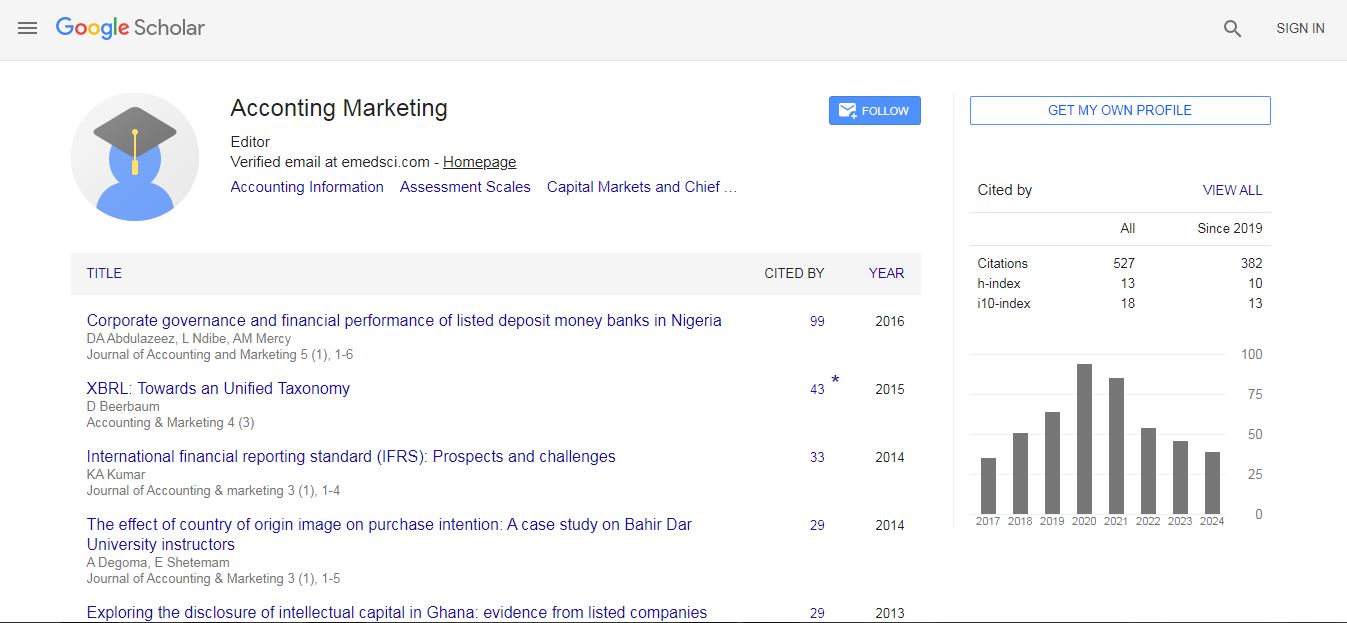
Accounting & Marketing received 487 citations as per Google Scholar report