Commentary - (2025) Volume 14, Issue 4
Received: 02-Jul-2025, Manuscript No. jamk-25-177290;
Editor assigned: 04-Jul-2025, Pre QC No. P-177290;
Reviewed: 18-Jul-2025, QC No. Q-177290;
Revised: 23-Jul-2025, Manuscript No. R-177290;
Published:
30-Jul-2025
, DOI: 10.37421/2168-9601.2025.14.563
Citation: Anderson, James. ”Ethics: Foundation for Financial Reporting and Sustainability.” J Account Mark 14 (2025):563.
Copyright: © 2025 Anderson J. This is an open-access article distributed under the terms of the Creative Commons Attribution License, which permits unrestricted use, distribution and reproduction in any medium, provided the original author and source are credited.
This article explores how moral intensity influences accountants' willingness to blow the whistle on unethical practices. It highlights that perceived organizational support acts as a mediator, meaning if accountants feel their organization supports them, they are more likely to report issues. The study also points out that a strong ethical climate within the workplace can further strengthen this intention, emphasizing the importance of a supportive environment for ethical behavior [1].
This paper investigates the connection between corporate social responsibility (CSR), robust corporate governance practices, and the integrity of financial reporting in Egypt. The findings suggest that companies with stronger CSR commitments and effective governance structures tend to produce higher quality financial reports. This really means that ethical conduct beyond just financial rules can significantly improve how trustworthy a company's financial statements are [2].
This research explores how ethical leadership influences the quality of audits. It argues that auditor independence plays a crucial mediating role, meaning ethical leaders foster an environment where auditors can act more independently. Moreover, strong corporate governance practices enhance this relationship, making the link between ethical leadership and audit quality even more pronounced. This highlights that ethical leadership is not just about good vibes; it directly impacts the reliability of financial oversight [3].
This study examines how personal religiosity and ethical values shape the quality of financial reporting, drawing insights from Bangladesh. The findings indicate that deeply held religious beliefs and strong ethical values among individuals contribute to more transparent and accurate financial disclosures. What this really means is that individual moral compasses can significantly influence corporate financial integrity, suggesting a cultural dimension to ethical accounting practices [4].
This paper investigates the link between ethical leadership and a company's commitment to responsible financial reporting and broader sustainability goals. It suggests that leaders who prioritize ethics can drive organizations toward greater transparency in financial disclosures and more sustainable business practices. Here is the thing: ethical leadership is not just about avoiding wrongdoing; it actively fosters positive outcomes in both financial integrity and long-term organizational viability [5].
This study examines how a strong ethical culture and effective internal control systems within the Indonesian banking sector contribute to preventing financial statement fraud. It finds that these two elements are crucial in mitigating fraudulent activities. The implication here is that fostering an environment where ethical behavior is the norm, coupled with robust internal checks and balances, is key to maintaining the integrity of financial reporting [6].
This research investigates how accounting students in Jordan perceive ethical dilemmas in financial reporting. It reveals insights into their moral reasoning and the factors that shape their views on ethical issues they might encounter in their future careers. What this means for educators and practitioners is the need for stronger ethics education to equip future accountants with the necessary moral framework to navigate complex reporting challenges [7].
This study explores the influence of whistleblowing systems on the quality of financial reporting specifically within public sector organizations. It suggests that effective whistleblowing mechanisms significantly enhance the reliability and transparency of financial statements. Here is the thing: by providing channels for reporting misconduct, these systems act as a critical deterrent against unethical practices, ultimately leading to more accurate financial disclosures [8].
This paper examines the combined effects of strong corporate governance and ethical leadership on the quality of financial reporting in Egypt. The research indicates that both factors are crucial for ensuring accurate and transparent financial disclosures. Let us break it down: when leaders prioritize ethical behavior and governance structures are robust, companies are more likely to produce financial reports that stakeholders can trust, reducing the likelihood of ethical breaches [9].
This study investigates the interplay between ethical climate, employee commitment, and job satisfaction within the accounting profession. It reveals that a strong ethical climate significantly contributes to higher organizational commitment and job satisfaction among accounting professionals. What this implies is that fostering an ethical environment is not just about compliance, but also about creating a workplace where accountants feel valued and engaged, which indirectly supports integrity in financial reporting [10].
The study by Rahayu, Wijaya, and Ghozali (2023) delves into the nuanced relationship between an accountant's moral intensity and their inclination to engage in whistleblowing. They establish that organizational support is a pivotal mediator, directly affecting whether an individual feels empowered enough to report ethical violations. The research further posits that a pervasive ethical climate within the firm can amplify these intentions, making a supportive cultural backdrop indispensable for promoting ethical conduct [1]. El-Sayed, Tarek, and Abdel-Moneim (2023) contribute to the understanding of financial reporting quality by examining the roles of corporate social responsibility and robust corporate governance in Egypt. Their empirical evidence highlights a clear positive correlation, indicating that organizations committed to broader societal welfare and strong oversight structures inherently produce more reliable financial statements. This suggests a foundational link between ethical business practices and financial transparency [2]. Al Amosh, Al Amosh, and Tawalbeh (2022) explore how ethical leadership fundamentally shapes the audit process. Their work identifies auditor independence as a critical mediating factor, suggesting that ethical leaders create conditions conducive to unbiased audit judgments. Furthermore, the presence of strong corporate governance structures is found to strengthen this positive influence, demonstrating that integrated ethical frameworks are vital for superior audit quality [3]. Uddin, Ullah, and Islam (2022) provide cultural insights from Bangladesh, revealing the profound impact of personal religiosity and ethical values on financial reporting quality. Their findings suggest that individual moral compasses are not merely theoretical constructs but translate into tangible improvements in financial transparency and accuracy. This underscores the importance of individual ethical development in the broader context of corporate integrity [4]. Al-Haddad, Al-Khateeb, and Al-Thuneibat (2021) extend the discussion on ethical leadership by connecting it to both responsible financial reporting and sustainability initiatives. They argue that ethical leaders are instrumental in fostering transparency in financial disclosures and guiding organizations toward more sustainable operational practices. Their research illustrates that ethical leadership is a proactive force for positive organizational outcomes, beyond just compliance [5]. Pangaribuan, Saragih, and Sitorus (2020) investigate the critical role of ethical culture and internal control systems in preventing financial statement fraud within the Indonesian banking sector. Their study confirms that a strong ethical environment combined with robust internal checks and balances significantly reduces the incidence of fraudulent activities. This emphasizes the dual importance of both soft (culture) and hard (systems) controls in maintaining financial integrity [6]. Al-Hadrawi, Al-Jabari, and Al-Akra (2019) examine the ethical perceptions of accounting students in Jordan, shedding light on how future professionals conceptualize ethical dilemmas in financial reporting. Their findings offer crucial insights for educators, indicating a need for more intensive ethics education to better prepare these students for the complex moral challenges they will inevitably face in their careers [7]. Sumiati, Priyadi, and Widyastuti (2023) focus on the impact of whistleblowing systems on financial reporting quality within public sector organizations. Their research demonstrates that well-implemented whistleblowing mechanisms act as a powerful deterrent to misconduct, thereby significantly enhancing the reliability and transparency of financial statements. This highlights whistleblowing as an essential tool for public accountability [8]. El-Sayed, El-Kasrawy, and Tarek (2022) offer further empirical evidence from Egypt regarding the combined influence of corporate governance and ethical leadership on financial reporting quality. Their study reinforces the idea that an synergy between strong governance structures and ethically driven leadership creates an environment where accurate and transparent financial disclosures are more likely, effectively reducing the potential for ethical breaches [9]. Al-Malkawi, Al-Omari, and Al-Qatawneh (2021) explore the broader benefits of an ethical climate within the accounting profession, linking it to enhanced employee commitment and job satisfaction. Their research suggests that fostering an ethical environment not only promotes compliance but also cultivates a more engaged and satisfied workforce, indirectly bolstering the integrity of financial reporting through improved morale and dedication [10].
The collected research consistently highlights the paramount importance of ethics in various facets of financial reporting and organizational conduct. Studies reveal that individual moral frameworks, whether stemming from moral intensity, personal religiosity, or general ethical values, significantly influence actions such as whistleblowing and the quality of financial disclosures. Furthermore, organizational factors play a crucial role, with strong ethical climates, ethical leadership, and robust corporate governance practices repeatedly shown to enhance financial reporting quality, deter fraud, and promote transparency. The presence of effective internal control systems and whistleblowing mechanisms also acts as a safeguard against unethical practices. Collectively, these studies underscore that an ethical foundation, encompassing individual integrity, supportive organizational cultures, and sound governance structures, is indispensable for fostering trustworthy financial reporting and achieving broader organizational sustainability.
None
None
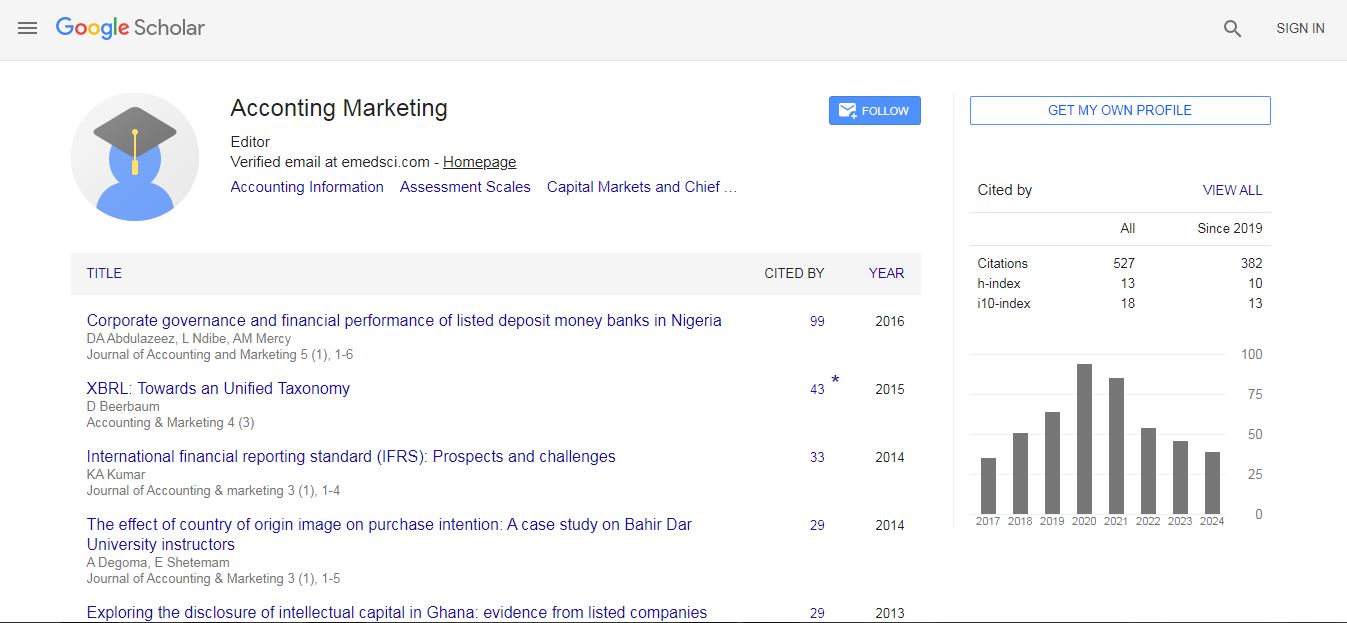
Accounting & Marketing received 487 citations as per Google Scholar report