Perspective - (2025) Volume 14, Issue 5
Received: 01-Sep-2025, Manuscript No. jamk-25-177321;
Editor assigned: 03-Sep-2025, Pre QC No. P-177321;
Reviewed: 17-Sep-2025, QC No. Q-177321;
Revised: 22-Sep-2025, Manuscript No. R-177321;
Published:
29-Sep-2025
, DOI: 10.37421/2168-9601.2025.14.578
Citation: Kowalska, Anna. ”Dynamic Email: Personalization and Data-Driven Success.” J Account Mark 14 (2025):578.
Copyright: © 2025 Kowalska A. This is an open-access article distributed under the terms of the Creative Commons Attribution License, which permits unrestricted use, distribution and reproduction in any medium, provided the original author and source are credited.
The effectiveness of email marketing campaigns is significantly enhanced by the strategic application of content personalization. This approach actively tailors communications to individual preferences, fostering a deeper sense of connection among recipients and directly influencing their intent to purchase. Understanding distinct customer preferences for more relevant communication is paramount to achieving these objectives [1].
The integration of gamified elements into email marketing represents a potent strategy for elevating customer interaction. Such interactive components, which may include quizzes or mini-games embedded within emails, demonstrably increase customer engagement and contribute to higher conversion rates by making the digital interaction more dynamic and enjoyable [2].
The multifaceted nature of email marketing effectiveness is profoundly influenced by the content of the message, the credibility of the sender, and the precision of delivery timing. Research indicates that a clear, pertinent message originating from a reputable sender, when disseminated at an opportune moment, significantly amplifies the efficacy of email campaigns. The temporal dimension, in particular, often holds greater weight than commonly assumed [3].
Automated email sequences, specifically those triggered by distinct customer behaviors, serve as instrumental tools in fostering sustained customer relationships. These 'behavioral emails', automatically dispatched in response to specific user actions or expressed interests, are shown to substantially enhance customer loyalty and stimulate increased purchase frequency, ensuring relevance without demanding continuous manual intervention [4].
Customer engagement in email marketing is not solely a function of objective personalization, but critically depends on the recipient's subjective perception of such efforts. The subjective experience of receiving a personalized email, rather than merely the objective act of personalization, profoundly impacts engagement levels. This perceived personalization emerges as a critical determinant, significantly influencing customer interaction and overall campaign effectiveness [5].
A data-centric methodology in email marketing, which involves detailed audience segmentation and content optimization, is crucial for augmenting customer lifetime value. This systematic methodology involves leveraging consumer data to accurately segment target audiences and meticulously refine content delivery, thereby optimizing what specific customer groups receive and leading to a significant increase in their long-term value [6].
The design of an email's subject line, particularly through personalization, plays a pivotal role in capturing recipient attention and driving subsequent interaction. Experimental evidence confirms that subject lines customized with the recipient's name or references to specific individual details markedly improve both email open rates and subsequent click-through rates. This seemingly minor adjustment acts as a powerful catalyst for engagement [7].
Advanced analytical techniques, such as machine learning, are increasingly vital for discerning the key determinants of email marketing success and for guiding strategic decision-making. By employing machine learning algorithms, it is possible to precisely identify the key elements that contribute to campaign success, enabling marketers to forecast outcomes and implement data-backed strategies instead of relying on conjecture [8].
Foundational to successful email marketing is the cultivation of trust with the consumer and the consistent delivery of perceived value within message content. When consumers perceive a sender as trustworthy and recognize inherent value within the email's content, their propensity for engagement and conversion significantly increases. These elements form the bedrock of any successful digital communication strategy [9].
Empirical investigations consistently demonstrate that the precise timing of email dispatch constitutes a critical leverage point for maximizing customer engagement and conversion rates. Empirical findings underscore that merely optimizing the precise moment an email is dispatched can yield substantial gains in customer engagement and conversion. This emphasizes that strategic timing, aligned with audience behavior, offers a distinct competitive advantage [10].
Recent scholarship underscores that tailoring email content to individual customer preferences is a critical determinant for enhancing engagement. This practice leads to customers feeling more connected, directly correlating with an increased intent to purchase. Therefore, understanding and addressing customer preferences through relevant communication stands as a cornerstone of effective marketing strategies [1]. The incorporation of gamified features within email marketing campaigns has demonstrated a substantial capacity to elevate customer interaction metrics. Specifically, interactive elements such as quizzes or embedded mini-games within emails are shown to significantly uplift customer engagement and drive higher conversion rates, thereby transforming the user experience into something more dynamic and enjoyable [2]. An exhaustive examination of email marketing efficacy reveals that a confluence of factors, including message characteristics, sender credibility, and temporal delivery, are paramount. This includes emphasizing that a clear, pertinent message, delivered by a trusted entity at an optimally selected time, can dramatically boost the overall effectiveness of email marketing efforts. The precise timing of message delivery, in particular, often surpasses expectations regarding its impact [3]. The deployment of automated email sequences, contingent upon specific customer actions or behavioral triggers, represents an advanced strategy for nurturing customer relationships. Such 'behavioral emails' are meticulously designed to respond to individual customer journeys, and studies indicate their efficacy in significantly boosting customer loyalty and fostering more frequent purchasing habits without requiring manual, continuous oversight [4]. Beyond mere technical personalization, the subjective perception of tailored communication significantly influences customer engagement in digital marketing contexts. This perception acts as a crucial intervening factor, demonstrably enhancing the degree to which customers interact with email campaigns and profoundly influencing the overall efficacy of these marketing endeavors, highlighting the psychological aspect of engagement [5]. A sophisticated, data-driven methodology for email marketing involves granular segmentation of audiences and iterative content optimization. This strategic approach involves leveraging comprehensive data analytics to categorize customers into specific groups and subsequently fine-tuning the content they receive, which has been shown to significantly enhance the long-term value derived from each customer relationship [6]. Experimental studies confirm that the judicious application of personalization within email subject lines is a powerful lever for improving initial engagement metrics. By directly addressing the recipient or incorporating specific, personalized references, such subject lines are remarkably effective in capturing attention, leading to a demonstrable increase in both open rates and the subsequent click-through rates for the email content [7]. Modern research employs machine learning paradigms to systematically identify and prioritize factors that contribute to the success of email marketing initiatives. These methods enable marketers to move beyond speculative approaches, allowing for the precise identification of influential factors and the prediction of optimal strategies, thereby facilitating data-backed decisions that drive superior marketing outcomes [8]. Fundamental to achieving robust email marketing outcomes is the establishment of sender trustworthiness and the clear articulation of value proposition to recipients. Online consumers are considerably more inclined to engage with and convert from emails when they possess confidence in the sender and perceive substantive utility within the message itself, establishing trust and value as critical pillars for campaign success [9]. Rigorous empirical analyses consistently highlight the strategic importance of optimizing email send times as a direct mechanism to amplify engagement and conversion. This demonstrates that the precise timing of message delivery, when carefully aligned with the behavioral patterns of the target audience, offers a significant strategic advantage for marketers seeking to enhance engagement and conversion metrics effectively [10].
The landscape of email marketing effectiveness is profoundly shaped by several interconnected strategies. Personalization, both actual and perceived, consistently emerges as a critical driver of customer engagement and purchase intent. Tailoring message content, subject lines, and even the overall brand communication fosters a sense of connection and relevance for the recipient. Beyond static content, integrating interactive elements, such as gamification, has been shown to significantly uplift engagement and conversion rates by making the experience more dynamic. The strategic deployment of automated, behavior-triggered emails also plays a vital role in cultivating customer loyalty and encouraging repeat purchases, demonstrating the power of timely and relevant outreach. Furthermore, foundational aspects like sender reputation, message content clarity, and especially the precise timing of email delivery, are instrumental in influencing customer decision-making. Marketers leveraging data-driven approaches, including audience segmentation and content optimization, can enhance customer lifetime value. Modern techniques, such as machine learning, are increasingly employed to predict success factors and refine strategies. Ultimately, building trust and consistently delivering perceived value within email communications are fundamental to securing sustained consumer engagement and driving conversions.
None
None
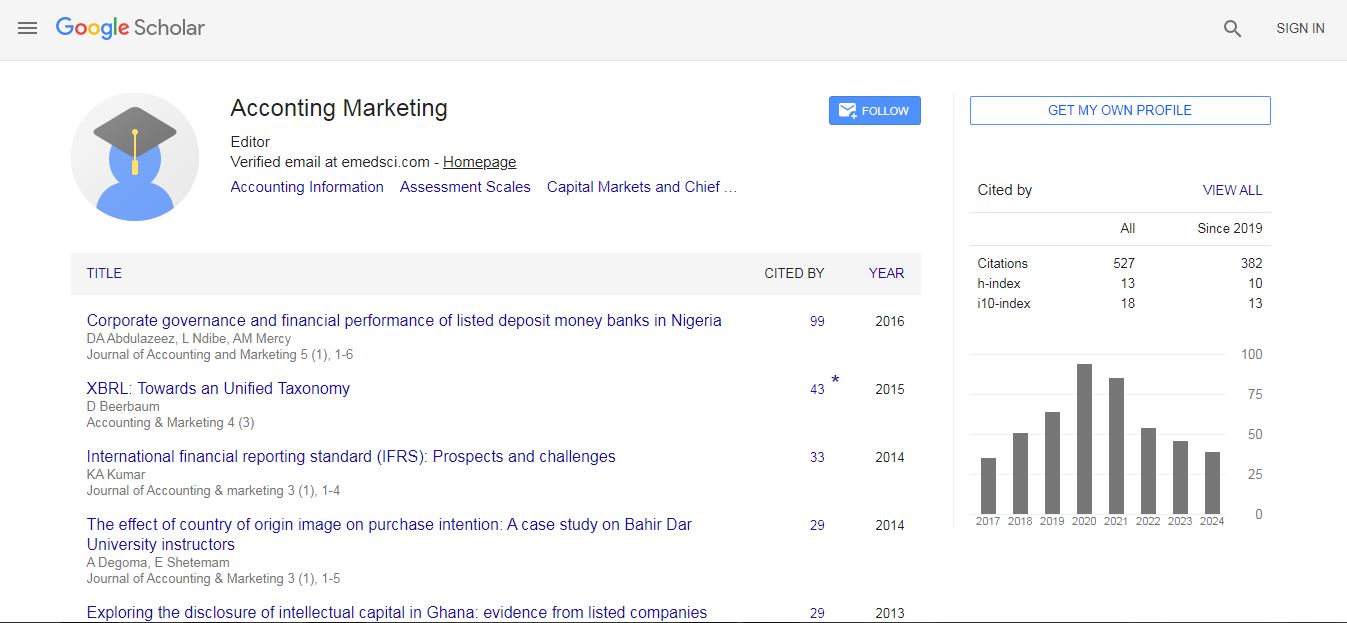
Accounting & Marketing received 487 citations as per Google Scholar report