Perspective - (2025) Volume 14, Issue 3
Received: 01-May-2025, Manuscript No. jamk-25-177282;
Editor assigned: 03-May-2025, Pre QC No. P-177282;
Reviewed: 17-May-2025, QC No. Q-177282;
Revised: 24-May-2025, Manuscript No. R-177282;
Published:
31-May-2025
, DOI: 10.37421/2168-9601.2025.14.558
Citation: Verma, Sanjay. ”Digital Accounting: Transformation, Reporting and Future Education.” J Account Mark 14 (2025):558.
Copyright: © 2025 Verma S. This is an open-access article distributed under the terms of the Creative Commons Attribution License, which permits unrestricted use, distribution and reproduction in any medium, provided the original author and source are credited.
Digital transformation is profoundly reshaping accounting information systems, particularly for smaller businesses. This evolution affects both financial and management accounting functions, which are significantly adapting to new technologies. Consequently, organizations must strategically adjust their accounting processes to maintain relevance and efficiency within the contemporary digital landscape, ensuring sustained operational effectiveness [1].
Integrated reporting critically influences the quality of management commentary disclosures. By adopting a more holistic reporting framework that effectively blends financial and non-financial information, organizations can significantly enhance transparency and decision-usefulness for all stakeholders. This approach creates a more connected narrative, bridging the gap between purely financial outcomes and the broader business context [2].
The role of Big Data Analytics in accounting is comprehensively revolutionizing the field. Both financial and management accounting practices are being transformed by the capacity to process vast amounts of data, leading to significantly more informed decision-making and remarkably enhanced predictive capabilities. Big Data is thus becoming an indispensable component for effective modern accounting operations [3].
Accounting information, encompassing both financial and managerial aspects, is undeniably crucial for decision-making within small and medium-sized enterprises. Access to relevant and timely accounting data directly impacts managerial effectiveness and informs strategic choices. For SMEs, therefore, establishing robust accounting practices is fundamentally key to making sound and sustainable business decisions [4].
Strategic management accounting adoption significantly impacts organizational performance in SMEs. Studies indicate that when businesses strategically leverage management accounting tools, they consistently achieve improved operational and financial outcomes. This demonstrates that management accounting extends beyond mere reporting; it acts as a crucial strategic driver for sustainable growth and efficiency [5].
Artificial intelligence is fundamentally shaping the future of accounting. AI's potential extends to transforming both financial reporting and management accounting processes, from automating routine tasks to delivering advanced analytical capabilities. This signifies that AI is not merely an auxiliary tool but represents a fundamental paradigm shift in how accounting practices will be conducted [6].
The value relevance of accounting information, alongside corporate governance, particularly in emerging markets, warrants close examination. The quality of both financial and management accounting data significantly influences how investors perceive a company's intrinsic value. Thus, robust accounting information is absolutely crucial for attracting and successfully retaining investment in these dynamic and often volatile environments [7].
Performance measurement systems in the public sector are critical and integrate elements from both financial and management accounting to meticulously evaluate efficiency and effectiveness. Robust performance measurement is therefore vital for ensuring accountability and optimizing resource allocation within public organizations, relying heavily on accurate and timely accounting insights for informed governance [8].
Accounting education faces significant challenges in the digital era, as highlighted by accounting professionals. There is a growing demand for new skills, necessitating that traditional financial and management accounting curricula adapt swiftly to technological advancements. This implies that future accountants must cultivate a broader skillset, extending well beyond conventional number-crunching abilities [9].
Environmental accounting's impact on financial performance is an increasingly vital area of study. Integrating environmental data into both financial and management accounting frameworks demonstrably leads to improved organizational outcomes. Businesses are progressively recognizing that environmental stewardship is not merely a cost but a strategic initiative that can positively influence the bottom line [10].
Digital transformation is exerting a profound influence on accounting information systems, particularly within small and medium-sized enterprises. This transformation encompasses both financial and management accounting functions, which are rapidly evolving due to the integration of new technologies. Consequently, organizations must proactively adapt their accounting processes to remain relevant, competitive, and highly efficient in today's increasingly digital business environment [1]. Research demonstrates that integrated reporting plays a pivotal role in enhancing the quality of management commentary disclosures. By adopting a comprehensive reporting framework that seamlessly combines financial and non-financial information, companies can substantially improve transparency and the utility of information for decision-making by various stakeholders. This holistic approach effectively bridges the gap between financial performance metrics and broader strategic business contexts [2]. The continuous evolution of accounting is significantly influenced by Big Data Analytics. This article reveals how the capacity to process immense volumes of data is revolutionizing both financial and management accounting practices, enabling more sophisticated and informed decision-making. Furthermore, it substantially enhances predictive capabilities, making Big Data Analytics an indispensable asset for effective modern accounting [3]. For small and medium-sized enterprises, access to reliable accounting information, encompassing both financial and managerial insights, is fundamentally critical for effective decision-making. The availability of relevant and timely accounting data directly contributes to improved managerial effectiveness and facilitates the formulation of sound strategic choices. Therefore, maintaining robust accounting practices is paramount for the strategic success of SMEs [4]. The strategic adoption of management accounting techniques is empirically linked to enhanced organizational performance in SMEs. This study indicates that enterprises which strategically utilize management accounting tools often experience tangible improvements in both their operational efficiency and financial results. This underscores management accountingâ??s role not just as a reporting mechanism but as a significant strategic driver for growth and overall business efficiency [5]. Artificial intelligence is poised to fundamentally redefine the landscape of accounting. This review emphasizes AI's transformative potential across both financial reporting and management accounting processes, ranging from automating repetitive tasks to providing highly advanced analytical insights. It underscores that AI represents a paradigm shift, fundamentally altering how accounting professionals will operate and contribute [6]. The value relevance of accounting information, in conjunction with robust corporate governance practices, holds particular significance in emerging markets. The quality of both financial and management accounting data is a crucial determinant of how investors perceive and value a company. Consequently, strong, credible accounting information is essential for attracting new capital and ensuring sustained investment in these dynamic economic regions [7]. Performance measurement systems in the public sector are extensively reviewed, highlighting their role in integrating elements from both financial and management accounting. These systems are instrumental in evaluating organizational efficiency and effectiveness. Ultimately, robust performance measurement is indispensable for fostering accountability and guiding optimal resource allocation within public institutions, relying heavily on accurate accounting data [8]. Accounting education faces considerable challenges in the contemporary digital era, a reality well-articulated by accounting professionals. There is an increasing demand for new, specialized skills, which necessitates a significant adaptation of traditional financial and management accounting curricula. This evolution is vital to ensure that future accountants are equipped with a broader, technologically informed skillset beyond conventional calculations [9]. The impact of environmental accounting on financial performance is a growing area of academic interest. This systematic review illustrates how the integration of environmental data into both financial and management accounting frameworks can lead to demonstrably improved organizational outcomes. Businesses are increasingly recognizing that proactive environmental stewardship can positively affect their financial bottom line, rather than solely representing a cost [10].
The provided research collection underscores the transformative evolution of accounting in the digital era, particularly its impact on financial and management accounting functions across various organizational contexts. Digital transformation, Big Data Analytics, and Artificial Intelligence are fundamentally reshaping accounting information systems, enhancing decision-making, and driving efficiency. Integrated reporting emerges as crucial for improved transparency and stakeholder utility by blending financial and non-financial information. For Small and Medium-sized Enterprises (SMEs), robust accounting practices, including strategic management accounting, are vital for managerial effectiveness and organizational performance. Furthermore, the value relevance of accounting information, especially in emerging markets, is tied to corporate governance and investment attraction. The public sector relies on integrated accounting insights for performance measurement and accountability. Finally, accounting education must adapt its curricula to equip future professionals with broader skillsets to navigate these technological advancements and the growing importance of areas like environmental accounting, which positively influences financial outcomes.
None
None
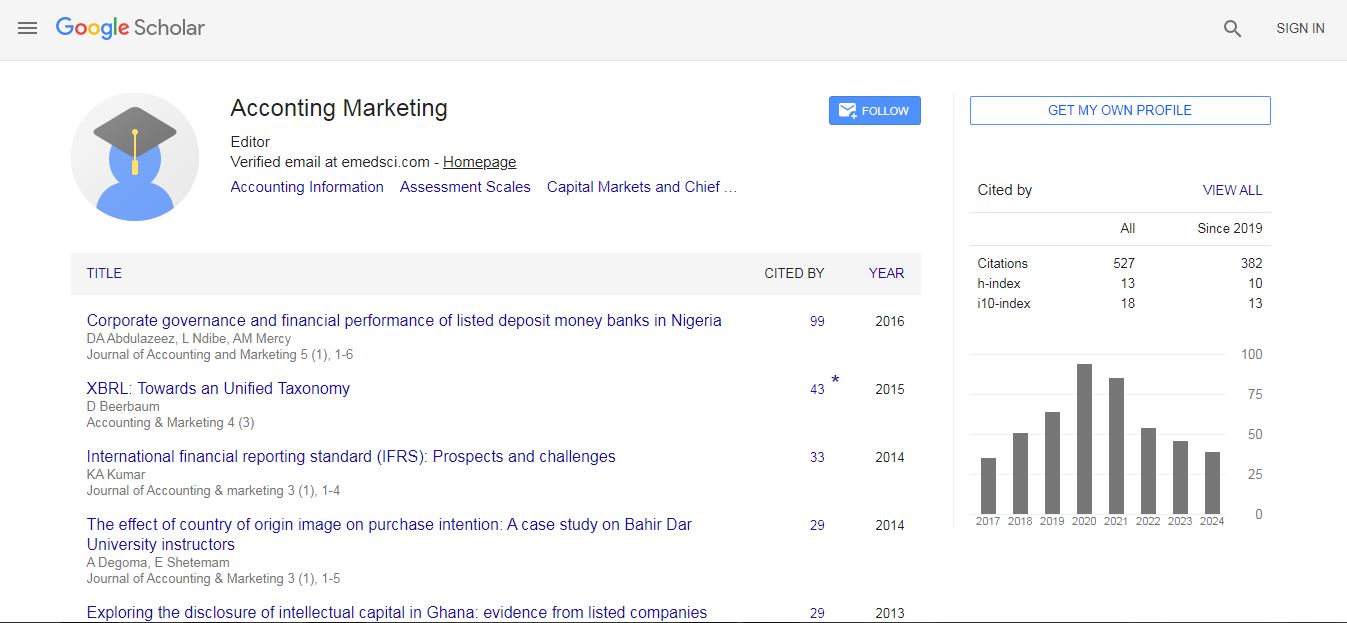
Accounting & Marketing received 487 citations as per Google Scholar report