Perspective - (2025) Volume 14, Issue 2
Received: 01-Mar-2025, Manuscript No. jamk-25-177267;
Editor assigned: 03-Mar-2025, Pre QC No. P-177267;
Reviewed: 17-Mar-2025, QC No. Q-177267;
Revised: 24-Mar-2025, Manuscript No. R-177267;
Published:
31-Mar-2025
, DOI: 10.37421/2168-9601.2025.14.548
Citation: Patel, Arjun. ”Data, AI, and Ethical Marketing Transformation.” J Account Mark 14 (2025):548.
Copyright: © 2025 Patel A. This is an open-access article distributed under the terms of the Creative Commons Attribution License, which permits unrestricted use, distribution and reproduction in any medium, provided the original author and source are credited.
The foundational importance of data analytics capabilities in elevating marketing performance is extensively examined, positing that enhanced analytical prowess directly correlates with superior outcomes. A critical component for this success involves cultivating a robust data-driven culture, which empowers organizations to leverage insights effectively. Furthermore, a profound understanding of the market augments the ability to transform raw data into actionable marketing strategies, thereby significantly contributing to organizational triumph and competitive advantage [1].
The profound impact of artificial intelligence in reshaping marketing landscapes, particularly its role in augmenting customer engagement and influencing purchase intentions, is a significant area of current inquiry. This research emphasizes that the success of AI-powered marketing initiatives hinges critically on customers' perceptions of value derived from these interactions. Concurrently, the development and maintenance of trust between the customer and the AI system are indispensable factors for achieving desired marketing outcomes and fostering long-term customer relationships [2].
Decision-making processes that are fundamentally rooted in data have emerged as a pivotal driver for improving overall firm performance. This strategic approach facilitates organizational growth by enabling companies to make more informed and precise choices across various operational domains. The study highlights that data-driven decision-making actively mediates better performance through two key organizational attributes: enhanced agility, allowing rapid adaptation to market changes, and fostered innovation, leading to the development of novel solutions and offerings [3].
Understanding the comprehensive customer journey remains an imperative for effective marketing, prompting a detailed analytical review of existing practices. This article meticulously synthesizes current methodologies in customer journey analytics, offering a clear framework for practitioners and researchers. Furthermore, it identifies nascent areas within this field that hold substantial promise for future research, indicating how advancements in these domains could significantly bolster marketing effectiveness and strategic customer engagement [4].
The evolution of personalization strategies within the retail sector, particularly under the influence of big data technologies, constitutes a critical area of contemporary investigation. This paper offers a systematic review of the extant literature, synthesizing diverse findings to present a comprehensive overview of the field. Crucially, it delineates a clear and actionable research agenda for future studies, illustrating how data-driven, tailored customer experiences are fundamentally transforming retailer-customer interactions and enhancing engagement [5].
Investigating the intrinsic link between a company's big data capabilities and its capacity for marketing innovation reveals a crucial underlying mechanism. This research emphatically demonstrates that organizations equipped with robust big data capabilities are significantly better positioned to achieve superior marketing innovation performance. The acquisition of pertinent market knowledge, a process greatly facilitated and amplified by advanced big data analytics, serves as the essential mediating factor connecting these capabilities to tangible innovative outputs [6].
Addressing the ethical dimensions inherent in the application of data within marketing practices is a paramount concern in the contemporary digital landscape. This article presents a structured conceptual framework designed to systematically analyze and navigate the complex moral challenges that arise from data-driven marketing. By providing this framework, the study not only offers guidance for responsible practice but also outlines critical areas for future research, ensuring that marketing effectiveness is balanced with ethical accountability [7].
Mastering the effective utilization of predictive analytics within marketing contexts is a key strategic imperative for organizations seeking to optimize their decision-making processes. This paper offers comprehensive guidance on employing Partial Least Squares Structural Equation Modeling (PLS-SEM), a specific and powerful statistical technique, for forecasting marketing outcomes. By providing such practical methodological insights, the research empowers marketers to develop more accurate predictions and implement data-informed strategic initiatives [8].
The concept of customer lifetime value (CLV) is central to sustainable business growth, and its profound connection with data analytics is increasingly recognized. This research offers a comprehensive synthesis of current knowledge regarding how data analytics can be effectively utilized to predict and maximize CLV. By consolidating existing insights, the study establishes a robust theoretical and practical foundation while simultaneously articulating a clear and promising agenda for future investigations into this critical financial and strategic metric [9].
The ongoing transformation within digital marketing, driven predominantly by the pervasive influence of data, represents a significant paradigm shift. This article provides an extensive and current examination of how data is fundamentally reshaping digital marketing strategies and operations. It reviews the prevailing state of digital marketing transformation and meticulously identifies crucial areas where further rigorous research is essential to fully comprehend and harness its multifaceted impacts and implications [10].
Research underscores the direct relationship between advanced data analytics capabilities and improvements in marketing performance. This improvement is fundamentally driven by the development of an organizational culture that prioritizes and systematically utilizes data. Moreover, integrating deep market knowledge ensures that data insights are not merely observed but are strategically applied to formulate potent marketing actions, leading to a measurable increase in overall organizational success and efficacy [1]. This study delineates how artificial intelligence applications within marketing significantly contribute to heightened customer engagement and a greater propensity for purchase. A crucial aspect highlighted is the subjective customer perception of value derived from their interactions with AI systems, which profoundly influences outcomes. Furthermore, the establishment of trust in these AI interactions is presented as an indispensable prerequisite for securing successful marketing initiatives and fostering robust customer relationships [2]. The demonstrable link between data-driven decision-making and enhanced firm performance is thoroughly explored, revealing a causal pathway. The core finding suggests that when organizations base their strategic choices on rigorous data analysis, they unlock substantial improvements in their operational and financial results. This positive effect is further elaborated through the mediating roles of organizational agility, allowing rapid response to market dynamics, and innovation, fostering continuous development and competitive advantage [3]. A comprehensive understanding of the customer journey is vital for strategic marketing, leading to a detailed review of analytical approaches in this domain. This article systematically synthesizes existing practices in customer journey analytics, providing a coherent overview of effective methods and tools. Importantly, it also identifies and outlines promising avenues for future research, indicating how these emerging areas can further refine marketing strategies and optimize customer experiences [4]. This paper scrutinizes the evolving landscape of personalization within the retail industry, with a particular focus on the transformative influence of big data technologies. It offers a systematic review, consolidating a vast body of literature to present a current snapshot of research and practical applications. The study also proposes a forward-looking research agenda, emphasizing how data-powered tailored experiences are fundamentally altering retail engagement models and customer expectations [5]. The intrinsic correlation between a firm's big data capabilities and its capacity to achieve superior marketing innovation performance is critically examined. The research explicitly demonstrates that robust big data infrastructure and analytical expertise directly enhance a company's innovative output in marketing. This relationship is shown to be significantly mediated by the firm's enhanced ability to acquire and process market knowledge, which big data technologies are uniquely positioned to facilitate [6]. Exploring the ethical dimensions surrounding the implementation of data-driven marketing practices is the central theme of this article. It proposes a nuanced conceptual framework designed to help practitioners and scholars systematically identify and address the moral complexities inherent in leveraging consumer data. The framework also serves as a guide for future research, ensuring that ethical considerations are integrated into the development of responsible and effective marketing strategies [7]. Effective deployment of predictive analytics in marketing requires rigorous methodological guidance, which is precisely what this paper provides. It offers a clear, step-by-step guideline for utilizing Partial Least Squares Structural Equation Modeling (PLS-SEM), a sophisticated statistical technique, to forecast various marketing outcomes. This practical guidance empowers marketers to move beyond descriptive analytics, enabling them to make more precise, data-informed strategic decisions and resource allocations [8]. The intricate relationship between customer lifetime value (CLV) and the application of data analytics is the focus of this comprehensive research. The article synthesizes existing knowledge to demonstrate how advanced data analytical techniques are instrumental in predicting and ultimately maximizing CLV. By consolidating these insights, the study lays a strong foundation for both theoretical understanding and practical application, while also charting a clear course for subsequent research endeavors in this vital area [9]. Examining the ongoing digital marketing transformation, particularly how data serves as its primary catalyst, forms the core of this article. It presents a thorough review of the current state of this transformation, highlighting key trends and challenges across various sectors. Furthermore, the research identifies and prioritizes essential areas for future investigation, aiming to deepen the collective understanding of digital marketing's evolving impact and strategic importance [10].
This collection of research highlights the pervasive and transformative impact of data analytics and artificial intelligence across various facets of marketing. It underscores how robust data capabilities, coupled with a data-driven culture and market knowledge, directly enhance marketing performance and facilitate innovation. The importance of data-driven decision-making for overall firm performance, organizational agility, and innovation is also emphasized. Specific applications like customer journey analytics, personalization in retailing, and predictive analytics in marketing are explored, demonstrating their role in improving customer engagement, purchase intention, and customer lifetime value. Furthermore, the ethical implications of data use in marketing are addressed, providing a framework for responsible practices. The comprehensive digital marketing transformation, driven by data, is also reviewed, setting a research agenda for future advancements. Collectively, these studies illustrate the critical role of data in shaping modern marketing strategies and achieving business success, while also pointing to ongoing challenges and future research directions.
None
None
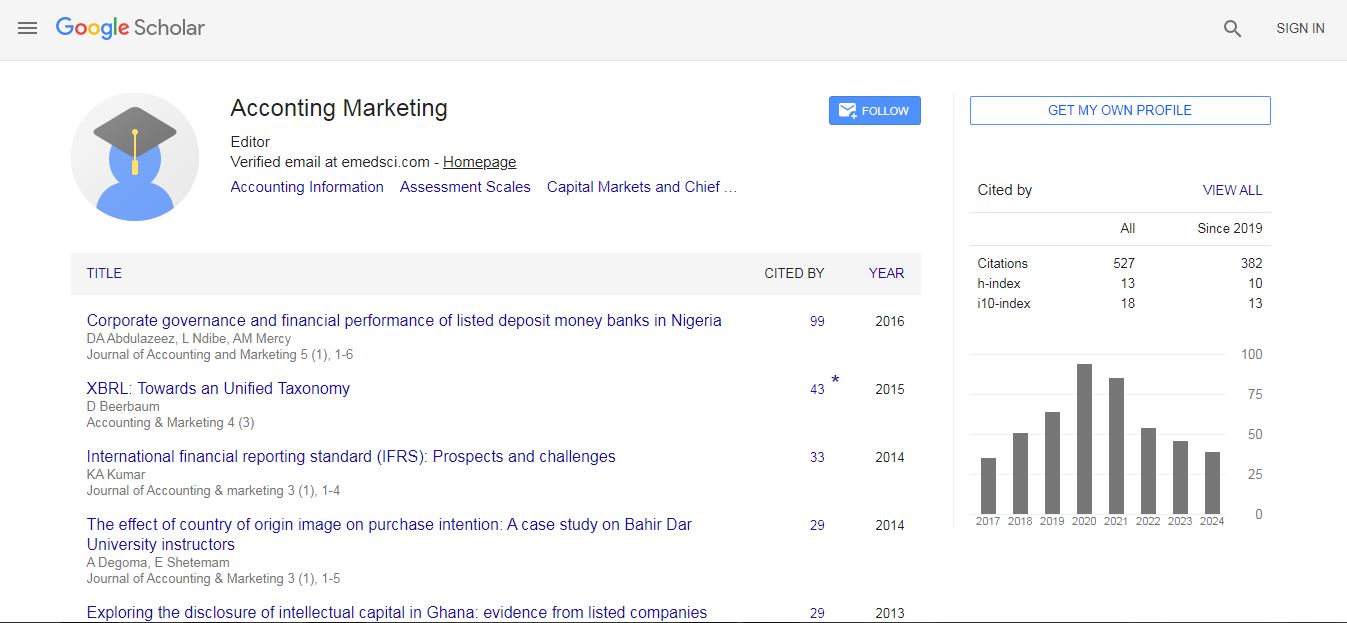
Accounting & Marketing received 487 citations as per Google Scholar report