Opinion - (2025) Volume 14, Issue 3
Received: 01-May-2025, Manuscript No. jamk-25-177280;
Editor assigned: 03-May-2025, Pre QC No. P-177280;
Reviewed: 17-May-2025, QC No. Q-177280;
Revised: 24-May-2025, Manuscript No. R-177280;
Published:
31-May-2025
, DOI: 10.37421/2168-9601.2025.14.557
Citation: Brown, Hannah. ”Critical Factors for Quality Reporting and Fraud Prevention.” J Account Mark 14 (2025):557.
Copyright: © 2025 Brown H. This is an open-access article distributed under the terms of the Creative Commons Attribution License, which permits unrestricted use, distribution and reproduction in any medium, provided the original author and source are credited.
The integrity of financial reporting is fundamentally underpinned by the strength of an organization's internal control systems. Robust controls are instrumental in mitigating the risk of accounting errors, thereby significantly enhancing the reliability and accuracy of financial statements. This reliability is paramount for external stakeholders, including investors and creditors, who rely on such information for critical decision-making processes, ensuring market confidence and operational efficiency [1].
Effective corporate governance structures play a pivotal role in shaping the quality of internal controls within entities. Specifically, the characteristics of audit committees, such as their independence from management and the collective expertise of their members, are powerful determinants. These attributes enable rigorous oversight and strengthen internal monitoring mechanisms, which are crucial for proactively identifying and preventing accounting errors, fostering greater accountability and transparency [2].
The modern auditing landscape has been significantly transformed by the advent of data analytics. This advanced technology substantially improves the effectiveness of audits, particularly in the challenging domain of detecting financial statement fraud. By leveraging sophisticated analytical tools, auditors can uncover complex patterns and anomalies across vast datasets that traditional, manual review processes might inadvertently overlook, thereby elevating the precision and thoroughness of fraud detection efforts [3].
In public sector organizations, the quality and reliability of financial reporting are inextricably linked to the efficacy of their accounting information systems (AIS). A well-designed, meticulously implemented, and fully functional AIS is not merely an operational tool but a critical infrastructure. It serves as the primary mechanism for minimizing accounting errors, ensuring the accuracy of financial records, and supporting transparent resource management within governmental and non-profit entities [4].
The engagement of specialized auditors markedly contributes to an elevated standard of audit quality. This specialization, often reflecting deep industry knowledge and experience, is particularly effective in identifying and reducing instances of earnings management. Auditors possessing sector-specific insights are better equipped to challenge management's accounting judgments and uncover sophisticated misstatements that might otherwise evade detection, thereby enhancing financial reporting integrity [5].
Strong corporate governance practices are consistently associated with superior financial reporting quality. This encompasses a broad spectrum of principles, including the composition and independence of the board of directors, the establishment of ethical guidelines, and robust oversight mechanisms. Collectively, these practices are fundamental in cultivating an environment that actively discourages accounting errors, promotes accountability, and ensures comprehensive transparency in financial disclosures to all stakeholders [6].
The integration of big data analytics into the audit process, when mediated by auditors' professional skepticism, significantly augments audit quality. While technology provides powerful tools for processing and analyzing extensive information, it is the auditor's questioning mindsetâ??a predisposition to critically evaluate evidenceâ??that drives deeper investigation. This synergy helps in uncovering complex misstatements and improving the overall accuracy and reliability of audit conclusions [7].
High-quality financial reporting serves as a crucial determinant of a firm's market value. By providing accurate, transparent, and reliable financial information, companies can build and maintain strong investor confidence. This indirect mechanism effectively incentivizes organizations to implement rigorous internal processes and uphold transparency, as maintaining a positive market perception directly correlates with adhering to best practices in financial disclosure and minimizing reporting errors [8].
The prevention of fraud within organizations is a multifaceted endeavor, critically dependent on a strong corporate culture, robust internal controls, and effective managerial performance. An ethical environment establishes the foundational tone, while well-designed process checks identify and mitigate risks. Competent management ensures oversight and compliance, creating a comprehensive and resilient defense system that collectively safeguards against both deliberate fraud and unintentional accounting errors [9].
A multi-layered strategy involving thorough fraud risk assessment, the implementation of effective internal control systems, and diligent internal audits is paramount for significantly improving fraud detection capabilities. This integrated approach ensures that potential vulnerabilities are systematically identified, preventive measures are in place, and independent reviews continuously monitor operational effectiveness, thereby creating a robust defense against sophisticated financial misstatements and enhancing overall reporting integrity [10].
Empirical evidence underscores that the quality of financial reporting is directly and positively influenced by the robustness of an entity's internal control systems. This relationship implies that well-designed and consistently enforced controls are not merely compliance mechanisms but active safeguards that systematically reduce the likelihood of errors, thereby bolstering the credibility and usefulness of financial statements for critical strategic and operational decisions [1]. The operational effectiveness of internal controls is significantly shaped by the attributes of a company's audit committee. An independent audit committee, composed of members with relevant financial expertise, is better positioned to provide objective oversight of financial reporting processes and internal control efficacy. Such characteristics are instrumental in reinforcing corporate governance and consequently minimizing the occurrence of accounting errors through enhanced monitoring and accountability [2]. In the contemporary audit environment, data analytics has emerged as a powerful tool for elevating audit effectiveness, particularly in uncovering instances of financial statement fraud. The application of advanced analytical techniques allows auditors to process vast quantities of transactional data, identify unusual patterns, and detect anomalies that signal potential misstatements, thereby fundamentally improving the accuracy and depth of audit procedures beyond traditional sampling methods [3]. The reliability of financial reporting, especially within public sector organizations, is critically contingent upon the inherent quality of their accounting information systems (AIS). A high-quality AIS facilitates accurate data capture, secure processing, and consistent reporting of financial transactions. This systemic foundation is indispensable for ensuring the integrity of public funds, minimizing potential accounting discrepancies, and maintaining transparent fiscal operations for public scrutiny [4]. The deployment of auditors with specialized industry knowledge contributes substantially to improved audit quality and a concomitant reduction in earnings management. Specialized auditors possess a deeper understanding of industry-specific risks, complex revenue recognition practices, and unique operational challenges. This insight enables more targeted and effective audit procedures, making it significantly harder for companies to engage in aggressive or fraudulent accounting practices to manipulate earnings [5]. Robust corporate governance practices are fundamental drivers of high-quality financial reporting. This includes effective board oversight, transparent communication, and a strong ethical culture permeating the organization. Such practices establish a framework that promotes managerial accountability, ensures compliance with reporting standards, and actively works to prevent both intentional and unintentional accounting errors, thereby enhancing investor trust and market credibility [6]. The integration of big data analytics into the auditing process can profoundly enhance audit quality, particularly when tempered by a high degree of professional skepticism from auditors. Analytics provides the capacity to analyze extensive datasets for potential irregularities, but it is the auditor's questioning mind that interprets these findings, challenges management assertions, and seeks corroborating evidence, leading to more profound and accurate detection of misstatements [7]. A direct correlation exists between the quality of a firm's financial reporting and its overall market valuation. Reliable and transparent financial statements reduce information asymmetry, fostering greater investor confidence and a lower cost of capital. This dynamic creates a powerful incentive for companies to prioritize accurate reporting, which indirectly reinforces rigorous internal controls and ethical accounting practices to sustain a positive perception and enhance firm value [8]. Effective fraud prevention is a composite outcome of a strong ethical corporate culture, meticulously designed and operated internal controls, and competent managerial performance. An organizational culture that values integrity discourages illicit activities, while sound internal controls act as deterrents and detection mechanisms. Coupled with diligent management, these elements form an integrated defense system, significantly reducing the opportunities and incidences of fraud and related errors [9]. Enhanced fraud detection is a direct consequence of a comprehensive approach that combines thorough fraud risk assessment, robust internal control systems, and active internal audit functions. This synergistic model ensures that risks are identified proactively, controls are implemented to mitigate them, and continuous monitoring provides assurance. Such a multi-faceted strategy is crucial for identifying and deterring sophisticated financial misstatements before they escalate [10].
The synthesis of recent research underscores several critical factors influencing financial reporting quality and fraud prevention. Strong internal control systems are foundational, directly improving reporting accuracy and reliability, while effective audit committee characteristics, such as independence and expertise, bolster these controls. The adoption of advanced technologies like data analytics significantly enhances audit effectiveness in detecting financial statement fraud by identifying complex patterns and anomalies. Quality accounting information systems are indispensable, especially in the public sector, for minimizing errors and ensuring accurate records. Specialized auditors further refine audit quality, adeptly uncovering earnings management due to their deep industry knowledge. Robust corporate governance practices, encompassing ethical oversight and well-structured boards, are crucial for preventing errors and ensuring transparency. The interplay of big data analytics and auditors' professional skepticism improves audit quality by facilitating deeper investigation. High financial reporting quality ultimately builds investor confidence and increases firm value, creating incentives for rigorous processes. Finally, a multi-pronged defense combining strong corporate culture, robust internal controls, effective managerial performance, fraud risk assessment, and diligent internal audits is essential for both preventing and detecting financial misstatements.
None
None
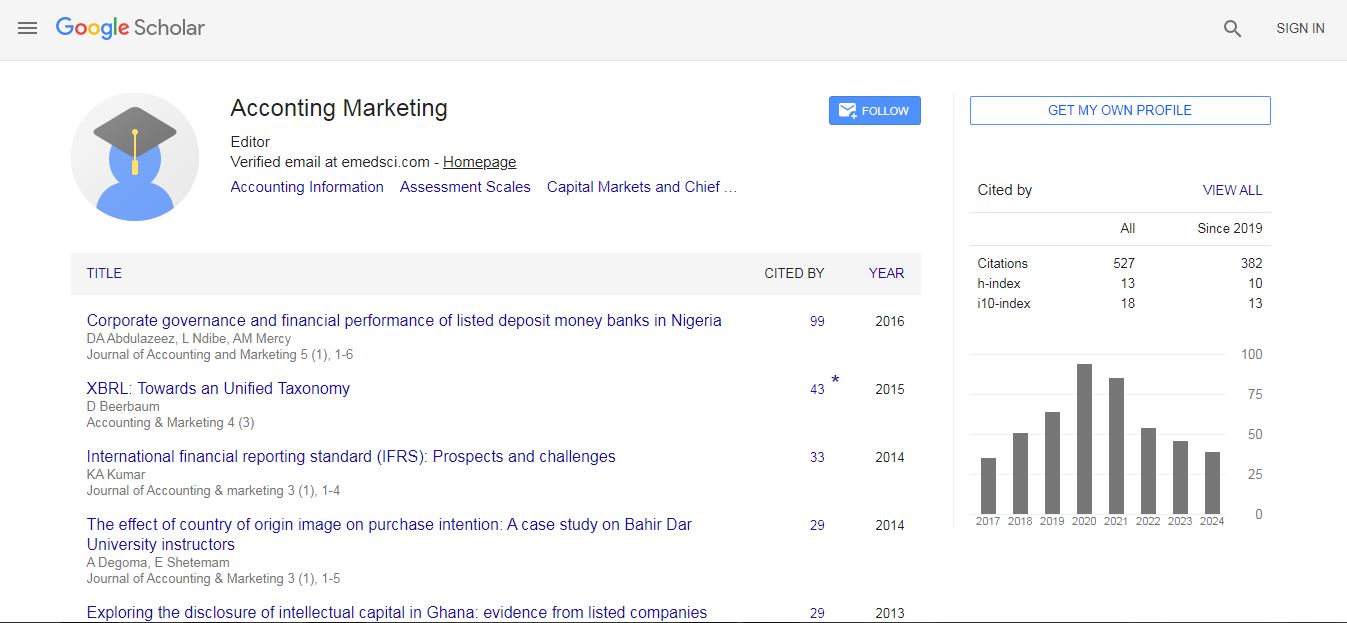
Accounting & Marketing received 487 citations as per Google Scholar report