Perspective - (127) Volume 14, Issue 6
Received: 01-Nov-2025, Manuscript No. jamk-25-177333;
Editor assigned: 03-Nov-2025, Pre QC No. P-177333;
Reviewed: 17-Nov-2025, QC No. Q-177333;
Revised: 22-Apr-2025, Manuscript No. R-177333;
Published:
29-Nov-2025
, DOI: 10.37421/2168-9601.2025.14.589
Citation: Herrera, Juan. ”Content Marketing and Customer Engagement: Drivers and Outcomes.” J Account Mark 14 (2025):589.
Copyright: © 2025 Herrera J. This is an open-access article distributed under the terms of the Creative Commons Attribution License, which permits unrestricted use, distribution and reproduction in any medium, provided the original author and source are credited.
Content marketing plays a pivotal role in shaping customer engagement, with perceived value and brand trust acting as crucial mediating factors. By delivering high-quality, valuable content, brands can cultivate trust, which subsequently enhances customer interaction and connection. This foundational understanding underscores the strategic imperative of crafting content that genuinely resonates with the target audience [1].
The dynamics of social media content profoundly influence customer engagement, particularly within the nascent sharing economy. Empirical studies, such as those focusing on Airbnb, reveal that platform-specific, engaging content is instrumental in fostering robust customer interaction, thereby building community and trust essential for shared service models. These insights are invaluable for platforms seeking to optimize user participation through social media strategies [2].
Marketing communication strategies, especially social media posts by luxury brands, are instrumental in driving consumer engagement. Content analysis has identified specific characteristics of brand-generated content that effectively capture consumer attention and stimulate interaction. Visually appealing and narrative-rich content consistently proves to be highly effective in engaging high-end consumers, demonstrating the importance of aesthetic and storytelling in luxury branding [3].
Customer engagement serves as a critical mediator in determining the overall efficacy of content marketing initiatives. Research indicates that content marketing strategies achieve greater impact when they successfully cultivate engagement, establishing a vital link between content creation and desired marketing outcomes such as customer loyalty and increased sales. This perspective offers a structured approach for refining content strategies to maximize their effectiveness [4].
In the digital era, the interplay between social media content and brand authenticity is paramount for fostering customer engagement. Authentic brand messaging, consistently delivered through pertinent content on social platforms, is essential for forging genuine connections and achieving elevated levels of customer interaction. This understanding provides actionable guidance for brands aiming to bolster their digital presence and nurture enduring customer relationships [5].
The authenticity of user-generated content (UGC) significantly influences customer engagement within social media environments. Consumers are more inclined to engage with brands when they perceive UGC as genuine and trustworthy. This highlights the strategic advantage of encouraging and leveraging authentic user contributions to stimulate interaction and cultivate a vibrant brand community, showcasing the power of consumer advocacy [6].
Online brand communities and content marketing exert a combined influence on customer loyalty, with customer engagement acting as a crucial intermediary. Studies have shown that content marketing efforts within active brand communities substantially boost customer engagement, which in turn translates into heightened loyalty. This symbiotic relationship emphasizes the importance of integrating community building with strategic content delivery for long-term customer retention [7].
The combined effect of content quality and brand trust is a significant determinant of customer engagement in social media marketing. High-quality content, when paired with established brand trust, leads to considerably enhanced customer interaction and participation. Marketers are thus advised to prioritize both the informational value and the credibility of their content to foster deeper engagement and build lasting consumer relationships [8].
Interactive content marketing profoundly impacts customer engagement, particularly through the cultivation of psychological ownership. When interactive content instills a sense of personal stake among consumers, their engagement levels demonstrably increase. This suggests that designing content experiences that allow users to feel a personal connection or involvement with the brand can be exceptionally effective in driving participation and loyalty [9].
Various dimensions of content marketing hold significant sway over brand equity and customer engagement within the tourism industry. Specific content attributes, such as their informational value and entertainment quotient, are pivotal in constructing robust brand equity and fostering stronger customer engagement. These findings furnish practical insights for tourism marketers seeking to optimize their content strategies for competitive advantage [10].
A central theme in marketing research concerns how content marketing fosters customer engagement. One study meticulously dissects this relationship, revealing that perceived value and brand trust operate as vital mediators. The authors demonstrate that when content is skillfully crafted and offers substantial perceived value, it naturally cultivates brand trust, which then directly amplifies customer engagement. This emphasizes the fundamental need for content to be valuable and relevant to consumers to build profound connections [1]. Within the burgeoning sharing economy, understanding customer engagement is crucial. Research specifically examining Airbnb illustrates how targeted social media content profoundly affects user interaction. This work highlights that content designed to be highly engaging and platform-specific is indispensable for building a sense of community and establishing trust in these unique service models. The implications are significant for platforms aiming to elevate user participation and expand their reach [2]. The efficacy of marketing communication, particularly social media posts by luxury brands, in stimulating consumer engagement has been rigorously analyzed. Through systematic content analysis, researchers have pinpointed distinct characteristics of brand-generated content that are most effective in capturing attention and encouraging interaction among consumers. The findings consistently show that content rich in visual appeal and compelling narratives is especially potent for engaging discerning high-end consumers [3]. A critical investigation into content marketing effectiveness underscores the mediating role of customer engagement. This research concludes that the success of content marketing strategies is contingent upon their ability to effectively foster customer engagement. Engagement is posited as the essential bridge connecting content creation with desired commercial outcomes, such as enhanced loyalty and increased sales, thereby offering a foundational framework for strategic optimization [4]. Engaging customers in the contemporary digital landscape necessitates a keen understanding of social media content and brand authenticity. A key study illuminates how authentic brand messaging, disseminated through consistent and relevant content across various social platforms, is fundamental to establishing genuine connections and nurturing elevated levels of customer engagement. These insights provide a roadmap for brands aspiring to strengthen their digital footprint and cultivate enduring relationships [5]. The influence of user-generated content (UGC) authenticity on customer engagement in social media environments is a significant area of inquiry. This research demonstrates that consumers are substantially more likely to engage with brands when they perceive UGC as both genuine and credible. This finding highlights the strategic imperative of cultivating and encouraging authentic user contributions as a powerful mechanism to drive interaction and solidify brand community [6]. The synergistic relationship between online brand communities and content marketing in driving customer loyalty, mediated by engagement, has been thoroughly explored. A specific study reveals that content marketing efforts integrated within active brand communities significantly amplify customer engagement, which subsequently translates into greater customer loyalty. This emphasizes the dual importance of community cultivation and strategic content delivery for sustainable brand success [7]. In social media marketing, the combined impact of content quality and brand trust on customer engagement is a critical factor. Research indicates that the presence of high-quality content, when complemented by established brand trust, leads to a significant increase in customer interaction and active participation. This suggests that marketers must strategically prioritize both the intrinsic value and the perceived trustworthiness of their content to foster deeper engagement [8]. Interactive content marketing's ability to enhance customer engagement, particularly through the lens of psychological ownership, has been rigorously investigated. This work illustrates that when interactive content successfully engenders a sense of personal connection or ownership among consumers, their engagement levels experience a notable surge. This implies that designing content that allows users to feel a personal stake can be remarkably effective in eliciting higher engagement [9]. The impact of various dimensions of content marketing on both brand equity and customer engagement within the competitive tourism industry has been systematically analyzed. The study identifies specific content attributes, such as their informational richness and entertainment value, as key contributors to strengthening brand equity and fostering more robust customer engagement, offering invaluable practical guidance for tourism marketers [10].
This compilation of research comprehensively examines the multifaceted relationship between content marketing and customer engagement across various digital contexts. Key findings consistently underscore the importance of content quality, perceived value, brand trust, and authenticity as critical drivers of engagement. Studies highlight that engaging content, whether brand-generated, user-generated, or interactive, builds trust and fosters connections. Social media platforms, the sharing economy, and online brand communities are identified as crucial environments where strategic content delivery can significantly enhance interaction, loyalty, and brand equity. The mediating role of customer engagement is a recurring theme, demonstrating its essential function in translating content marketing efforts into desired business outcomes like loyalty and sales. Visually appealing and narrative-rich content is particularly effective for certain demographics, while interactive content fosters psychological ownership. Overall, effective content marketing is characterized by its ability to offer value, build trust, and encourage active participation, ultimately leading to stronger customer relationships and commercial success.
None
None
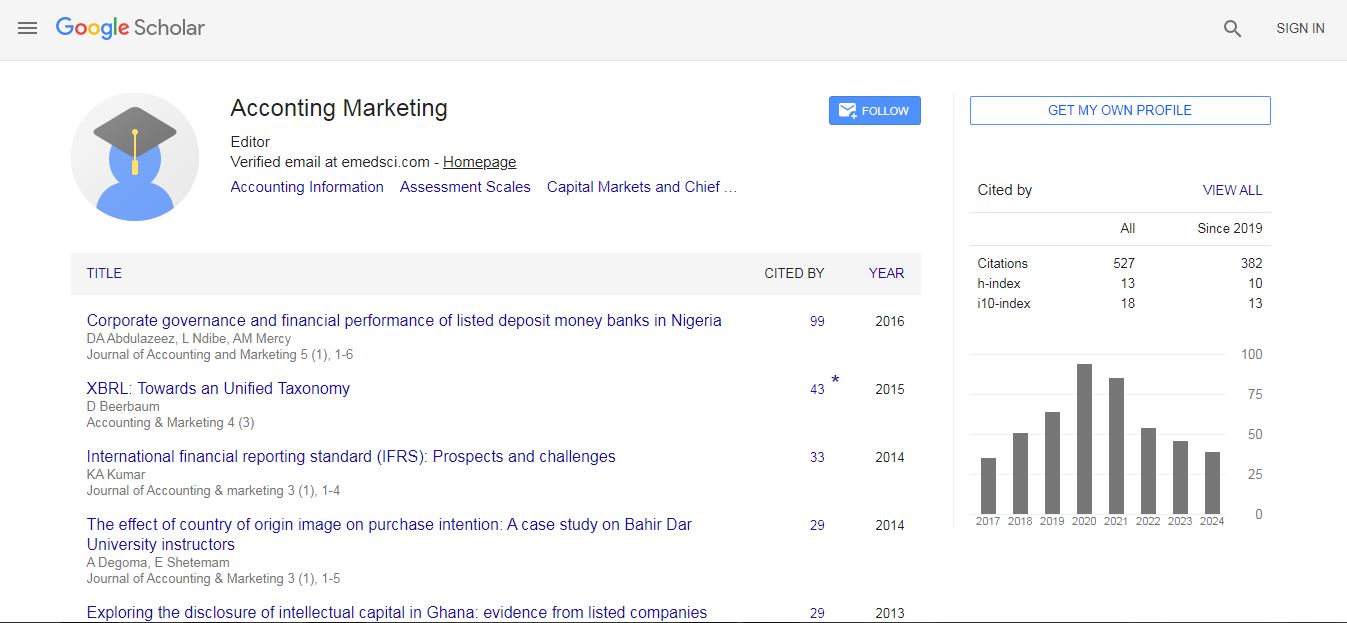
Accounting & Marketing received 487 citations as per Google Scholar report