Opinion - (2025) Volume 14, Issue 6
Received: 01-Nov-2025, Manuscript No. jamk-25-177330;
Editor assigned: 03-Nov-2025, Pre QC No. P-177330;
Reviewed: 17-Nov-2025, QC No. Q-177330;
Revised: 24-Nov-2025, Manuscript No. R-177330;
Published:
29-Nov-2025
, DOI: 10.37421/2168-9601.2025.14.586
Citation: Almeida, Beatriz. ”Consumer Decisions: Tech, Ethics, and Psychology.” J Account Mark 14 (2025):586.
Copyright: © 2025 Almeida B. This is an open-access article distributed under the terms of the Creative Commons Attribution License, which permits unrestricted use, distribution and reproduction in any medium, provided the original author and source are credited.
The landscape of consumer behavior has been profoundly reshaped by digital transformation, a phenomenon systematically reviewed in recent literature. This shift encompasses various aspects of consumer decision-making, from initial information search to post-purchase evaluations. Businesses are compelled to adapt to this evolving environment, as technological advancements fundamentally alter how consumers interact with products and services, creating new challenges and opportunities for market engagement and strategic planning [1].
A significant area of contemporary focus is sustainable consumer behavior, driven by a growing awareness of environmental and social issues. Research delves into the intricate factors influencing purchasing decisions for eco-friendly products, highlighting the roles of ethical concerns, perceived value, and brand trust. Understanding the complex interplay of these elements is crucial for promoting conscious consumption and fostering a more responsible marketplace [2].
The digital realm's impact extends to the influence of online reviews on consumer purchase intention, particularly through their emotional valence and arousal. Studies demonstrate that the emotional content embedded within these reviews significantly shapes consumer attitudes, subsequently driving or deterring buying decisions. Such insights are invaluable for e-commerce platforms aiming to optimize their review systems and enhance consumer engagement [3].
Artificial intelligence (AI) has emerged as a transformative force within the retail sector, revolutionizing consumer behavior and brand engagement. AI-powered tools personalize shopping experiences, analyze preferences, and influence buying decisions through sophisticated algorithms. This integration of AI is not merely an enhancement but a fundamental alteration of the retail landscape, pushing businesses to innovate their customer interaction strategies [4].
Social media influencers have cultivated a powerful role in shaping consumer purchase intentions, largely contingent on their perceived characteristics. Research indicates that attributes such as credibility and attractiveness, mediated by the perceived value of the product or service, significantly impact consumers' willingness to buy. This underscores the strategic importance of influencer marketing in crafting consumer perceptions and stimulating demand [5].
Gamification, the application of game-design elements and game principles in non-game contexts, represents another innovative approach to influencing consumer behavior. Systematic reviews explore its underlying mechanisms and effects, illustrating how incorporating game-like elements can substantially boost consumer engagement. This strategy effectively impacts purchasing decisions across diverse contexts, from loyalty programs to marketing campaigns [6].
Long-term consumer relationships and repeat buying decisions are critically dependent on a combination of factors, including service quality, customer satisfaction, and perceived value. Studies consistently show that these elements collectively enhance customer loyalty and foster repurchase intention. For businesses, prioritizing these aspects is essential for cultivating a loyal customer base and ensuring sustained market presence [7].
Online impulse buying remains a fascinating and complex phenomenon within e-commerce, warranting comprehensive understanding. Meta-analyses synthesize findings on its key antecedents and moderators, offering insights into what precisely triggers spontaneous purchases in digital environments. Such knowledge is indispensable for retailers seeking to develop effective strategies to either encourage or manage impulsive consumer actions [8].
The concept of brand authenticity plays a crucial role in influencing consumer trust and purchase intention. Research demonstrates that consumers highly value genuine brands, and this perception significantly impacts their buying decisions. Furthermore, the impact of brand authenticity can vary across different product categories, suggesting a nuanced relationship that marketers must carefully consider [9].
Neuromarketing represents an advanced frontier in understanding consumer behavior, leveraging brain science methods to explore unconscious decision-making processes. Systematic reviews trace its historical development and project future directions, offering deeper insights into the subconscious factors that drive purchasing behavior. This interdisciplinary field promises to revolutionize marketing strategies by tapping into the hidden motivations of consumers [10].
The systematic review by Gupta et al. (2024) meticulously maps the profound influence of digital transformation on contemporary consumer behavior. It identifies critical themes such as the alteration of information search strategies, the evolution of purchasing channels, and the post-purchase evaluation landscape. The study comprehensively illustrates how technological advancements compel businesses to re-strategize their approaches to engage with an increasingly digital-savvy consumer base, emphasizing the dynamic shift from traditional to digitally mediated interactions [1]. Wang et al. (2023) investigated the underlying drivers of sustainable consumer behavior, providing a detailed examination of factors that compel consumers towards eco-friendly choices. Their research specifically highlighted the significant roles played by ethical concerns regarding product origin and impact, the perceived value derived from sustainable options, and the trust consumers place in brands advocating environmental responsibility. This study elucidates the intricate psychological and market-driven elements that converge to foster conscious consumption patterns [2]. Zhao et al. (2022) conducted an insightful study on how online reviews sway consumer purchase intention, introducing a novel perspective centered on emotional valence and arousal. Their findings unequivocally demonstrated that the subjective emotional content embedded within customer reviews exerts a powerful influence on consumer attitudes, subsequently dictating their buying decisions. This research provides actionable intelligence for e-commerce platforms seeking to leverage the emotional dynamics of user-generated content effectively [3]. Ramachandran et al. (2024) explored the transformative capabilities of artificial intelligence within the retail industry, specifically analyzing its dual impact on consumer behavior and brand engagement. The paper illuminated how AI-driven personalization, recommendation engines, and predictive analytics contribute to shaping consumer preferences and influencing purchasing paths. Their work underscores AI's pivotal role in redesigning the customer journey and enhancing brand-consumer interactions across the retail landscape [4]. The research by Kwon et al. (2023) provided a nuanced understanding of social media influencers' efficacy in driving consumer purchase intentions. This study particularly focused on how influencer characteristics, such as their perceived credibility and physical attractiveness, modulate consumer responses. Crucially, the authors identified perceived value as a key mediating factor, emphasizing that an influencer's attributes only translate into purchase intent when the consumer also perceives value in the promoted offering [5]. Costa et al. (2023) presented a systematic review on the pervasive influence of gamification on consumer behavior. Their synthesis of existing literature meticulously identified various mechanisms through which game-like elements, such as points, badges, and leaderboards, are employed to boost engagement and subsequently impact purchasing decisions. The review offers a comprehensive overview of how these strategic integrations can motivate consumer participation and alter consumption patterns across diverse applications [6]. Nurlaila et al. (2022) meticulously examined the synergistic relationship between service quality, customer satisfaction, and perceived value in cultivating customer loyalty and encouraging repurchase intention. Their investigation revealed that when customers perceive high service quality and derive satisfactory experiences, coupled with a strong sense of value, their propensity for long-term loyalty and repeat purchases significantly increases. This research reinforces the strategic imperative for businesses to prioritize holistic customer experience management [7]. Li et al. (2021) conducted a meta-analysis to comprehensively understand the intricate phenomenon of online impulse buying. Their work synthesized findings from numerous studies, identifying critical antecedents such as situational factors, individual traits, and product characteristics, alongside various moderators that either amplify or mitigate impulsive purchasing behavior in e-commerce environments. This analysis offers invaluable guidance for retailers to strategically manage or capitalize on spontaneous consumer decisions [8]. Lee et al. (2021) investigated the significant role of brand authenticity in fostering consumer trust and driving purchase intention. Their research articulated that consumers are increasingly drawn to brands perceived as genuine and transparent, and this perception directly influences their willingness to engage in transactions. A crucial finding was the moderating effect of product type, suggesting that authenticity's impact varies depending on the nature of the goods or services offered [9]. Strobach et al. (2020) offered a comprehensive systematic review of neuromarketing, charting its evolution, current applications, and prospective future directions. This study highlighted how advanced neuroscientific techniques are employed to unveil the unconscious cognitive and emotional processes that underpin consumer decision-making, providing insights beyond traditional market research. The review underscores neuromarketing's potential to deepen our understanding of buying behavior and inform more effective marketing strategies [10].
The collective body of research explores the multifaceted nature of consumer behavior in an increasingly complex marketplace. Digital transformation and advanced technologies like artificial intelligence are fundamentally reshaping how consumers interact with brands and make purchase decisions, from initial information gathering to post-purchase evaluation. Influencers on social media and gamified experiences also play significant roles in boosting engagement and driving purchasing intent through perceived value and interactive elements. Beyond technological influences, core drivers such as ethical concerns, brand authenticity, service quality, customer satisfaction, and the emotional content of online reviews are crucial in shaping consumer trust, loyalty, and sustainable choices. The studies also delve into specific phenomena like online impulse buying and the deeper, often unconscious, processes revealed by neuromarketing, offering comprehensive insights into both conscious and subconscious decision-making. This extensive research highlights the imperative for businesses to adopt holistic strategies that integrate technological advancements with a profound understanding of consumer psychology and values to thrive in dynamic market conditions.
None
None
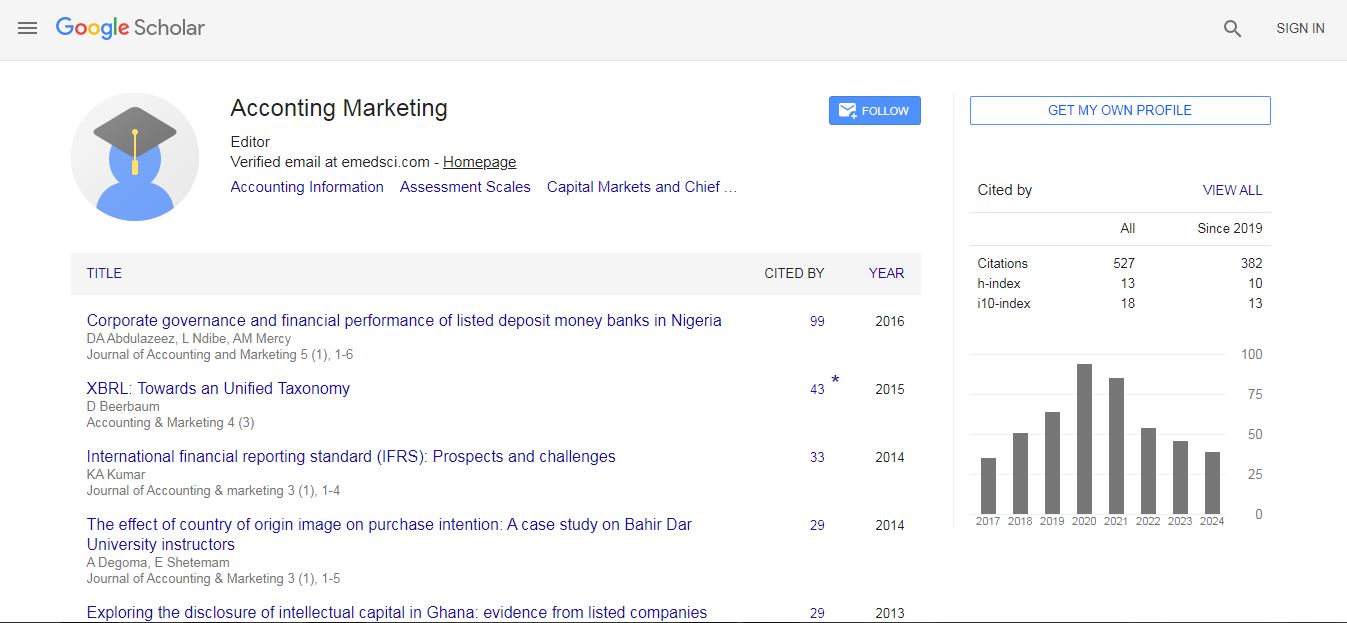
Accounting & Marketing received 487 citations as per Google Scholar report