Perspective - (2025) Volume 14, Issue 6
Received: 01-Nov-2025, Manuscript No. jamk-25-177332;
Editor assigned: 03-Nov-2025, Pre QC No. P-177332;
Reviewed: 17-Nov-2025, QC No. Q-177332;
Revised: 24-Nov-2025, Manuscript No. R-177332;
Published:
29-Nov-2025
, DOI: 10.37421/2168-9601.2025.14.588
Citation: Fatima, Noor. ”Branding Strategies for Competitive Advantage.” J Account Mark 14 (2025):588.
Copyright: © 2025 Fatima N. This is an open-access article distributed under the terms of the Creative Commons Attribution License, which permits unrestricted use, distribution and reproduction in any medium, provided the original author and source are credited.
The contemporary business landscape is characterized by intense competition, necessitating robust strategies for achieving and sustaining competitive advantage. A core element in this pursuit is branding, which encompasses diverse approaches to differentiate offerings, engage stakeholders, and build enduring market positions. The academic literature increasingly emphasizes the multifaceted nature of branding and its strategic implications across various sectors and contexts. This collection of studies collectively illuminates how distinct branding paradigms contribute to a firm's or individual's competitive edge. The concept of brand co-creation, where consumers actively participate in the development process, has emerged as a significant driver of competitive advantage. This collaborative approach not only strengthens brand loyalty but also fosters a deeper connection between the brand and its consumers, ultimately providing a unique market differentiation. Marketers are thus encouraged to integrate collaborative strategies to build more resilient brands [1].
Digital branding has become an indispensable component of modern marketing, particularly within the dynamic retail sector. Effective digital strategies are shown to significantly enhance brand equity, thereby equipping retailers with a crucial competitive edge in an increasingly saturated market. Leveraging digital platforms strategically offers clear pathways for retailers to augment their brand value and market standing [2].
Furthermore, the cultivation of sustainable competitive advantage through brand equity is critically influenced by corporate social responsibility (CSR) and active customer engagement. Strong CSR initiatives, when synergized with robust customer involvement, demonstrably amplify brand value, ensuring a lasting advantage. This integration of sustainability into branding strategies provides a vital framework for long-term market success [3].
Employer branding plays a pivotal role in an organization's attractiveness and its ability to secure a competitive advantage in the labor market. A compelling employer brand is instrumental not only in attracting high-caliber talent but also in establishing a distinctive strategic position. Human resource professionals can leverage these insights to construct a powerful workplace identity, thereby gaining an edge in talent acquisition [4].
The strategic use of brand storytelling serves as a potent mechanism for driving consumer engagement and securing a competitive advantage. Perceived authenticity and established brand trust act as crucial mediators in this process. By developing engaging narratives, brands can cultivate profound consumer connections, fostering loyalty and cementing a unique market presence through effective communication strategies [5].
Within the banking sector, internal branding significantly impacts employee brand equity and the organization's overall competitive advantage. By aligning employees with core brand values, internal branding elevates their perception of the brand, which, in turn, fortifies the organizationâ??s competitive standing. This highlights the intrinsic value of cultivating a cohesive brand identity from within [6].
Personal branding, particularly through strategic engagement with social media and self-promotion, is increasingly vital for career success and individual competitive advantage. The judicious use of digital platforms for personal brand development can markedly enhance a professional's standing and trajectory. This offers practical guidance for individuals navigating the complexities of the modern professional landscape [7].
Brand extension strategies are shown to profoundly influence firm performance, with innovation capability mediating the achievement of competitive advantage. Successful brand extensions, particularly when underpinned by strong innovative capacities, significantly augment a company's market position and financial outcomes. This emphasizes the strategic importance of innovation in brand management and expansion efforts [8].
In the highly competitive smartphone industry, various dimensions of brand equity are crucial for establishing a competitive advantage. Strong brand awareness, perceived quality, brand associations, and unwavering brand loyalty collectively enhance a company's market position. These findings provide critical strategic implications for technology firms aiming to cultivate enduring and influential brands [9].
Finally, destination branding is a key factor in achieving competitive advantage within the tourism sector. The mediating roles of destination image and visitor satisfaction are paramount in this process. A compelling brand image, combined with high levels of visitor satisfaction, significantly boosts a destination's appeal and market standing, offering invaluable strategic insights for tourism marketers seeking to enhance their competitive edge [10].
The provided research corpus offers a comprehensive exploration into various facets of branding and its pivotal role in achieving and sustaining competitive advantage across diverse industries and contexts. Each study contributes a unique perspective, dissecting specific mechanisms through which brand-related activities translate into market superiority and improved performance. These investigations collectively underscore the strategic imperative of holistic brand management in today's dynamic global economy. Specifically, one investigation details how brand co-creation, involving consumers in the brand development process, can directly lead to competitive advantage. The study posits that enhanced brand loyalty, a direct outcome of consumer participation, mediates this relationship, thereby strengthening market position. Marketers are presented with actionable strategies to leverage collaborative consumer involvement for superior brand performance and differentiation [1]. Another key study examines the pronounced impact of digital branding on brand equity and, consequently, competitive advantage within the retail industry. It illustrates how effectively executed digital branding campaigns augment a brand's intrinsic value, affording retailers a significant advantage in fiercely contested markets. The research provides valuable guidance for retailers seeking to optimize their digital presence for strategic gains [2]. Further contributing to this understanding, research elucidates the role of brand equity in fostering sustainable competitive advantage, with particular emphasis on corporate social responsibility (CSR) and customer engagement. The argument is made that integrating robust CSR initiatives with active customer participation not only boosts brand value but also ensures a durable market edge. This work provides a framework for embedding sustainability within core branding strategies [3]. The influence of employer branding on an organization's overall attractiveness and its competitive standing is also thoroughly explored. This research demonstrates that a powerful employer brand is crucial for attracting top-tier talent and for establishing a unique strategic position within the labor market. Human resource professionals can utilize these findings to craft compelling workplace identities that draw desirable candidates and differentiate their organization [4]. Moreover, the literature highlights brand storytelling as a powerful tool for driving consumer engagement and generating competitive advantage. This process is mediated by perceived authenticity and brand trust, both essential for cultivating deep consumer connections. Through skillfully constructed narratives, brands can foster loyalty and achieve a distinct market identity, providing insights into effective communication practices [5]. Within the banking sector, the impact of internal branding on employee brand equity and competitive advantage receives specific attention. This study confirms that strong internal branding significantly improves employees' perception of their brand, which in turn strengthens the organization's competitive posture. The findings underscore the critical importance of internal alignment with brand values for external market success [6]. Beyond organizational branding, personal branding is analyzed for its contribution to career success and individual competitive advantage. The research focuses on the strategic deployment of social media and self-promotion, revealing how digital platforms can be leveraged to enhance professional standing and trajectory. This offers practical advice for individuals navigating career advancement in the contemporary professional landscape [7]. The strategic implications of brand extension on firm performance are also examined, with innovation capability identified as a crucial mediator for achieving competitive advantage. Successful brand extensions, particularly when supported by strong innovation, demonstrably improve a company's market position and financial results. This provides valuable insights for strategic brand portfolio management [8]. A detailed analysis of the smartphone industry reveals how various dimensions of brand equity contribute to competitive advantage. Key factors such as brand awareness, perceived quality, brand associations, and brand loyalty are shown to collectively enhance a company's market position. This research offers specific strategic guidance for technology firms striving to build and maintain powerful, enduring brands [9]. Lastly, the tourism sector benefits from an investigation into destination branding and its role in competitive advantage. This study highlights the critical mediating roles of destination image and visitor satisfaction. It concludes that a strong brand image coupled with high visitor satisfaction significantly enhances a destination's appeal and market standing, providing actionable insights for tourism marketers to gain a competitive edge [10].
The presented research collectively explores the multifaceted relationship between various branding strategies and the attainment of competitive advantage across different industries and contexts. Key themes emerge, emphasizing the significance of consumer involvement, digital presence, and internal alignment in building strong brands. Studies demonstrate that brand co-creation enhances loyalty and competitive edge, while effective digital branding boosts brand equity in retail. Sustainable competitive advantage is linked to brand equity, corporate social responsibility, and customer engagement. Employer branding attracts talent and provides strategic differentiation, and authentic brand storytelling fosters consumer trust and loyalty. Internal branding in the banking sector improves employee perception and organizational competitiveness. Personal branding, particularly through social media, supports individual career success. Furthermore, successful brand extensions, underpinned by innovation, enhance firm performance. In the smartphone industry, brand equity dimensions like awareness and perceived quality are vital. Finally, destination branding in tourism relies on strong image and visitor satisfaction for market standing. These studies provide comprehensive insights into how strategic branding, whether corporate, employer, personal, or destination-focused, is essential for securing a distinct and lasting market advantage.
None
None
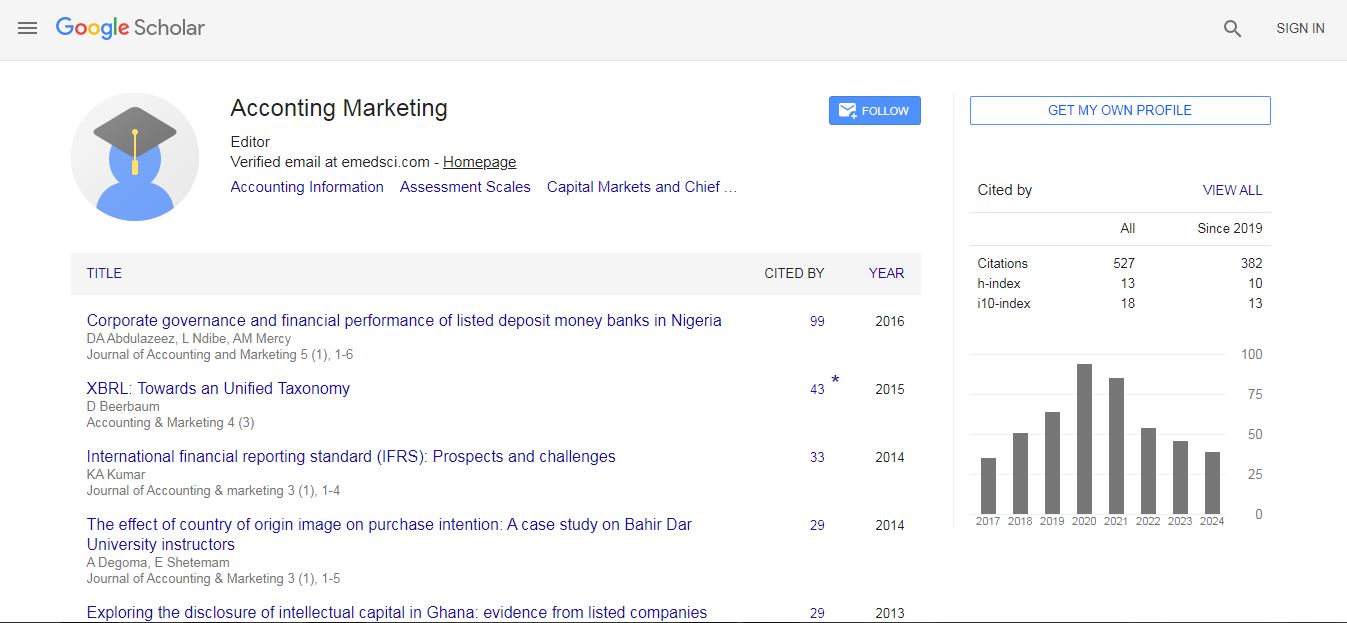
Accounting & Marketing received 487 citations as per Google Scholar report