Opinion - (2025) Volume 10, Issue 3
Received: 01-Sep-2025, Manuscript No. jib-25-175276;
Editor assigned: 03-Sep-2025, Pre QC No. P-175276;
Reviewed: 17-Sep-2025, QC No. Q-175276;
Revised: 22-Sep-2025, Manuscript No. R-175276;
Published:
29-Sep-2025
, DOI: 10.37421/2476-1966.2025.10.284
Citation: Montero, Diego. ”Autoimmunity: Triggers, Cells, Personalized Therapies.” J Immuno Biol 10 (2025):284.
Copyright: © 2025 Montero D. This is an open-access article distributed under the terms of the Creative Commons Attribution License, which permits unrestricted use, distribution and reproduction in any medium, provided the original author and source are credited.
Autoimmunity, at its core, involves a breakdown in the body's ability to distinguish self from non-self, leading to immune responses that attack healthy tissues. Recent understanding highlights a complex interplay of genetic predispositions, environmental triggers, and dysregulated immune pathways, including specific roles of T and B cells [1].
Understanding how the immune system loses its tolerance to self-antigens is central to unraveling autoimmunity. This process, known as the breakdown of self-tolerance, can occur through various mechanisms, including defects in central and peripheral tolerance, aberrant antigen presentation, or dysregulation of regulatory T cells. A series of checkpoints, designed to prevent autoimmunity, fail, allowing self-reactive immune cells to escape and mount an attack against the body's own tissues [2].
Genetics undeniably play a significant role in an individual's susceptibility to autoimmune diseases, ranging from single-gene disorders to complex polygenic risks. Advances in genomic sequencing and association studies are continuously uncovering novel genetic loci and pathways involved. Identifying these genetic predispositions helps in predicting risk, stratifying patients for clinical trials, and developing targeted therapies that account for a person's unique genetic blueprint [3].
While genetics lay the groundwork, environmental factors are critical triggers in the development of autoimmune diseases. These can include infections, diet, toxins, and lifestyle choices, which interact with genetic susceptibility to initiate or exacerbate disease. Our daily exposures and habits significantly influence our immune system's behavior, emphasizing the potential for preventative strategies and the need for a holistic view of autoimmune disease etiology [4].
The gut microbiome's influence on systemic immunity and autoimmunity is a rapidly expanding area of research. Dysbiosis, an imbalance in the gut microbial community, can alter immune cell differentiation, barrier function, and metabolite production, directly impacting autoimmune processes. A healthy gut environment is crucial for maintaining immune tolerance, and interventions targeting the microbiome, like prebiotics, probiotics, or fecal microbiota transplantation, are being explored as potential therapeutic avenues [5].
T cells are central orchestrators of autoimmune responses, with specific subsets like Th1, Th17, and cytotoxic T cells driving tissue damage. Recent studies continue to refine our understanding of their activation, differentiation, and effector functions within various autoimmune conditions. By dissecting the intricate roles of different T cell populations and their communication networks, we can identify precise targets for therapeutic modulation and restore immune balance [6].
B cells play a crucial, multifaceted role in autoimmune diseases, extending beyond antibody production to include antigen presentation, cytokine secretion, and the formation of ectopic lymphoid structures. Recent research has shed light on their complex contributions to disease pathogenesis. Understanding these diverse functions opens up new avenues for therapeutic intervention, highlighting B cells not just as targets for depletion, but as sophisticated regulators of immune responses [7].
The field of autoimmune disease treatment is rapidly shifting towards precision medicine. This approach focuses on tailoring therapies based on an individual's specific genetic makeup, disease phenotype, and immunological profile. Instead of broad immunosuppression, the goal is to target specific pathways or cell types implicated in a patient's particular disease, offering more effective treatment with fewer side effects. This personalized strategy is showing significant promise, moving us closer to truly individualized care [8].
Immunotherapies for autoimmune diseases are continuously evolving, moving beyond broad immunosuppressants to more specific, targeted agents. These include biologics that block specific cytokines or cell surface receptors, as well as cell-based therapies. The goal is to precisely modulate the aberrant immune responses responsible for disease while preserving protective immunity, leading to better efficacy and reduced side effects compared to older treatments. This refined approach is a game-changer for many patients [9].
Biomarkers are essential tools in the management of autoimmune diseases, aiding in early diagnosis, predicting disease progression, monitoring treatment response, and identifying patient subsets. Advances in genomics, proteomics, and metabolomics are leading to the discovery of novel biomarkers with greater specificity and sensitivity. Better biomarkers allow for more personalized medicine, enabling clinicians to make informed decisions and intervene earlier, ultimately improving patient outcomes [10].
Autoimmunity, at its core, involves a breakdown in the body's ability to distinguish self from non-self, leading to immune responses that attack healthy tissues [1]. This complex condition arises from an interplay of genetic predispositions, environmental triggers, and dysregulated immune pathways, including specific roles of T and B cells [1]. Understanding how the immune system loses its tolerance to self-antigens is central to unraveling autoimmunity [3]. This process, the breakdown of self-tolerance, can occur through various mechanisms like defects in central and peripheral tolerance, aberrant antigen presentation, or dysregulation of regulatory T cells [3]. A series of checkpoints designed to prevent autoimmunity fail, allowing self-reactive immune cells to escape and attack the body's own tissues [3].
Genetics undeniably play a significant role in an individual's susceptibility to autoimmune diseases, encompassing both single-gene disorders and complex polygenic risks [6]. Advances in genomic sequencing are continuously uncovering novel genetic loci and pathways involved, helping in risk prediction and targeted therapy development [6]. While genetics lay the groundwork, environmental factors are critical triggers in disease development [7]. These include infections, diet, toxins, and lifestyle choices, which interact with genetic susceptibility to initiate or exacerbate disease [7]. Our daily exposures significantly influence immune system behavior, emphasizing the potential for preventative strategies [7].
T cells are central orchestrators of autoimmune responses, with specific subsets like Th1, Th17, and cytotoxic T cells driving tissue damage [5]. Dissecting their intricate roles and communication networks helps identify precise targets for therapeutic modulation [5]. B cells also play a crucial, multifaceted role beyond antibody production, including antigen presentation, cytokine secretion, and forming ectopic lymphoid structures [4]. Understanding these diverse functions opens new avenues for therapeutic intervention, recognizing B cells as sophisticated immune regulators [4]. The gut microbiome's influence on systemic immunity and autoimmunity is a rapidly expanding area of research [8]. Dysbiosis, an imbalance in the gut microbial community, can alter immune cell differentiation, barrier function, and metabolite production, directly impacting autoimmune processes [8]. A healthy gut environment is crucial for maintaining immune tolerance, and microbiome-targeting interventions are being explored as therapeutic avenues [8].
The field of autoimmune disease treatment is rapidly shifting towards precision medicine [2]. This approach tailors therapies based on an individual's specific genetic makeup, disease phenotype, and immunological profile, targeting specific pathways or cell types for more effective treatment with fewer side effects [2]. Immunotherapies are continuously evolving, moving beyond broad immunosuppressants to more specific, targeted agents like biologics that block cytokines or cell surface receptors, as well as cell-based therapies [9]. The goal is to modulate aberrant immune responses while preserving protective immunity, leading to better efficacy [9]. Biomarkers are essential tools for managing autoimmune diseases, aiding in early diagnosis, predicting progression, monitoring treatment response, and identifying patient subsets [10]. Advances in genomics, proteomics, and metabolomics are discovering novel biomarkers, enabling more personalized medicine and earlier intervention for improved patient outcomes [10].
Autoimmunity fundamentally involves the immune system attacking healthy tissues, a complex interplay of genetic predispositions, environmental triggers, and dysregulated immune pathways, including roles for T and B cells. Understanding the breakdown of self-tolerance, where checkpoints fail, is central. Genetics significantly influence susceptibility, from single-gene disorders to complex polygenic risks. Environmental factors like infections, diet, and toxins are critical triggers, interacting with genetic vulnerability to initiate or exacerbate disease. The gut microbiome's influence is also significant; dysbiosis can impact immune cell differentiation and barrier function. T cells orchestrate autoimmune responses, with specific subsets driving tissue damage, while B cells play multifaceted roles beyond antibody production, involving antigen presentation and cytokine secretion. The treatment landscape is shifting towards precision medicine, tailoring therapies based on an individual's genetic and immunological profile, moving away from broad immunosuppression. Emerging immunotherapies use targeted agents, like biologics, to modulate aberrant immune responses. Biomarkers are essential for early diagnosis, predicting progression, monitoring treatment, and facilitating personalized medicine by enabling informed clinical decisions.
None
None
Anne D, Betty D, Marianne W. "The evolving landscape of pathogenic mechanisms in autoimmunity.".Nat Immunol 24 (2023):200-209.
Indexed at, Google Scholar, Crossref
Paolo P, Marco G, Kévin T. "Precision medicine in autoimmune diseases: a rapidly evolving reality.".J Autoimmun 130 (2022):102837.
Indexed at, Google Scholar, Crossref
Koji O, James BH, John JO. "Mechanisms of Breakdown of Self-Tolerance.".Immunity 54 (2021):1098-1111.
Indexed at, Google Scholar, Crossref
Vinh TC, C. B, Nicolas B. "B Cells and Autoimmunity: The Knowns, Unknowns, and Potential Therapeutics.".Annu Rev Immunol 38 (2020):191-213.
Indexed at, Google Scholar, Crossref
Peter KG, Tomas O, Lars R. "T Cell Responses in Autoimmune Diseases.".J Immunol 207 (2021):947-956.
Indexed at, Google Scholar, Crossref
Yuen-Ling L, Christopher JL, John BH. "Genetics of Autoimmune Disease: From Single Gene Disorders to Polygenic Risk.".Trends Mol Med 29 (2023):885-900.
Indexed at, Google Scholar, Crossref
Li W, Yaqing W, Chunxiao X. "Environmental factors in autoimmune diseases: a comprehensive review.".J Autoimmun 129 (2022):102805.
Indexed at, Google Scholar, Crossref
Kinza K, Vivek V, Anil KS. "The Gut Microbiome and Autoimmunity: An Overview of the Current Landscape.".World J Gastroenterol 27 (2021):3267-3286.
Indexed at, Google Scholar, Crossref
Lin S, Ran W, Ming L. "Emerging Immunotherapies for Autoimmune Diseases: A Scoping Review.".Front Immunol 14 (2023):1215104.
Indexed at, Google Scholar, Crossref
Juan-Manuel A, Sergio R, Karen P. "Biomarkers for autoimmune diseases: state of the art.".Biomarkers in Medicine 16 (2022):1-13.
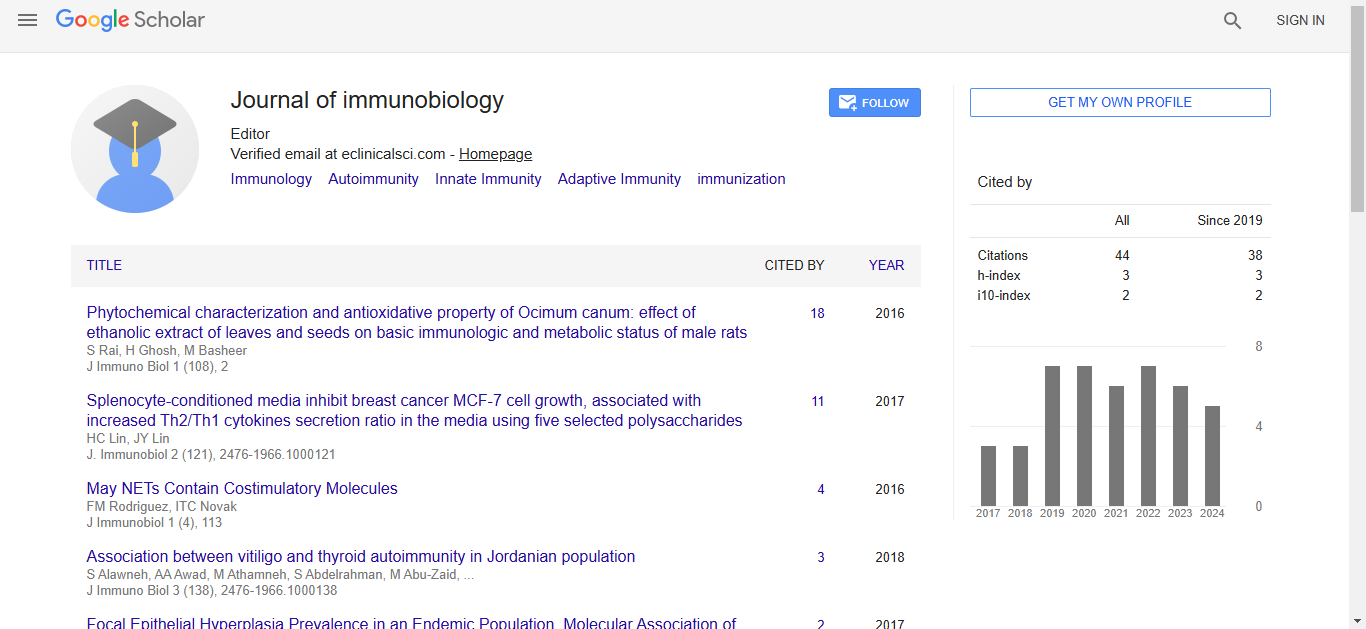
Journal of Immunobiology received 34 citations as per Google Scholar report