Opinion - (127) Volume 15, Issue 4
Received: 01-Dec-2025, Manuscript No. jttr-25-175453;
Editor assigned: 03-Dec-2025, Pre QC No. P-175453;
Reviewed: 17-Dec-2025, QC No. Q-175453;
Revised: 22-Dec-2025, Manuscript No. R-175453;
Published:
29-Dec-2025
, DOI: 10.37421/2161-0991.2025.15.317
Citation: Park, Sung-Min. ”Allo-HSCT: Progress, Personalization and Persistent Challenges.” J Transplant Technol Res 15 (2025):317.
Copyright: © 2025 Park S. This is an open-access article distributed under the terms of the Creative Commons Attribution License, which permits unrestricted use, distribution and reproduction in any medium, provided the original author and source are credited.
Allogeneic stem cell transplantation (Allo-HSCT) represents a cornerstone therapy for various hematologic malignancies, particularly acute myeloid leukemia (AML). Recent research has focused on refining these transplantation strategies, introducing advancements in critical areas such as patient selection, the tailoring of conditioning regimens, and optimizing post-transplant supportive care. The overarching goal of these evolving developments is to significantly improve patient outcomes and concurrently mitigate the incidence of complications, moving towards a highly personalized approach to treatment that considers individual patient profiles and disease characteristics [1].
Despite its therapeutic potential, Allo-HSCT is frequently complicated by graft-versus-host disease (GVHD), a severe immunological reaction. This condition arises from the donor's immune cells recognizing the recipient's tissues as foreign. A deeper understanding of GVHD's intricate pathophysiology, which meticulously outlines the precise roles of donor T-cells and recipient tissues, is continuously evolving. This enhanced understanding is crucial for the development of innovative therapeutic strategies specifically designed to both prevent and effectively treat the diverse clinical manifestations of GVHD, encompassing both acute and chronic forms [2].
The status of minimal residual disease (MRD) prior to allogeneic transplantation holds increasing significance, especially for patients battling acute myeloid leukemia (AML) and acute lymphoblastic leukemia (ALL). Assessing MRD kinetics and employing advanced detection methods have become indispensable tools for robust risk stratification and for accurately predicting post-transplant outcomes. This information critically informs clinical decision-making, allowing for more precise management and intervention strategies [3].
Myeloablative conditioning regimens are fundamental components of Allo-HSCT for acute myeloid leukemia, designed to eliminate residual cancer cells and prepare the bone marrow for engraftment. Current research meticulously evaluates the efficacy and toxicity profiles of various conditioning approaches. Clinicians consistently strive to strike a delicate balance between achieving comprehensive disease eradication and ensuring the utmost patient safety, thereby optimizing overall transplant success and reducing treatment-related morbidity [4].
A common and serious challenge following allogeneic hematopoietic cell transplantation is the occurrence of infectious complications. These can range widely, involving bacterial, viral, fungal, and parasitic pathogens. Understanding the prevalent pathogens and identifying risk factors are paramount. Evolving strategies for both the prevention and treatment of these infections are being developed, underscoring the vital importance of vigilant surveillance and timely, aggressive intervention to safeguard patient health [5].
Haploidentical stem cell transplantation offers a crucial alternative for patients who lack a fully matched sibling or unrelated donor, expanding access to potentially life-saving treatment. Significant advancements in this field, particularly in donor selection protocols, optimized conditioning regimens, and the strategic use of post-transplant cyclophosphamide, have dramatically improved outcomes. These innovations have broadened the applicability of haploidentical transplantation, making it a more viable and effective option for a wider patient population [6].
Preventing and treating disease relapse remains a critical objective in acute myeloid leukemia patients who have undergone allogeneic hematopoietic cell transplantation. Current strategies involve a multi-faceted approach, incorporating pre-emptive immunotherapy, highly targeted therapies, and donor lymphocyte infusions. These interventions are specifically employed for meticulous monitoring and early intervention, all with the aim of significantly enhancing long-term disease-free survival rates for these patients [7].
The quality of life and patient-reported outcomes post-allogeneic hematopoietic stem cell transplantation are increasingly recognized as essential metrics for successful treatment. Survivors often face a multitude of long-term physical, psychological, and social challenges. This highlights an urgent need for comprehensive post-transplant care strategies that are specifically designed to support their holistic well-being and facilitate better reintegration into daily life [8].
Chronic graft-versus-host disease (cGVHD) stands as a complex and challenging long-term complication following allogeneic transplantation, significantly impacting survivors. Recent research provides evolving insights into its nuanced pathophysiology, refined diagnostic criteria, and a broad spectrum of therapeutic approaches. These include both established treatments and promising novel agents, all continuously evaluated to improve overall patient outcomes and mitigate the long-term impact of cGVHD [9].
Beyond malignant diseases, allogeneic hematopoietic cell transplantation is increasingly recognized for its expanding role in treating a variety of non-malignant hematologic disorders. This includes conditions such as severe aplastic anemia, thalassemia, and sickle cell disease. Research is continuously assessing the efficacy and addressing the unique challenges of transplantation for these specific conditions, with advancements making it a more viable and potentially curative option for a growing number of patients [10].
Allogeneic hematopoietic stem cell transplantation (Allo-HSCT) stands as a critical therapeutic modality, particularly for patients with acute myeloid leukemia (AML) [1]. Progress in this field involves refining patient selection criteria, optimizing conditioning regimens, and enhancing post-transplant supportive care. These advancements aim to improve overall outcomes and reduce complications by adopting a more personalized approach to treatment [1]. Myeloablative conditioning regimens, essential for eliminating disease and preparing the recipient, are carefully evaluated for their efficacy and toxicity. Clinicians continuously balance the need for robust disease eradication with patient safety to achieve optimal transplant success [4].
A significant and persistent challenge in Allo-HSCT is graft-versus-host disease (GVHD), a complex complication arising from the interaction between donor T-cells and recipient tissues [2]. Understanding its intricate pathophysiology is vital for developing effective therapeutic strategies. Efforts are directed towards both preventing and treating acute and chronic forms of GVHD, a major determinant of long-term success [2]. Specifically, chronic GVHD (cGVHD) represents a complex, long-term complication after transplantation. Ongoing research into its pathophysiology, diagnostic criteria, and a broad spectrum of therapeutic options, including both established and novel agents, seeks to improve patient outcomes in this challenging area [9].
Other critical considerations after Allo-HSCT include managing infectious complications and preventing disease relapse. Patients are susceptible to a myriad of infections from bacterial, viral, fungal, and parasitic pathogens. Proactive surveillance, identification of risk factors, and evolving prevention and treatment strategies are crucial for early intervention [5]. For AML patients, preventing and treating relapse is paramount. Strategies encompass pre-emptive immunotherapy, targeted therapies, and donor lymphocyte infusions, all focused on early monitoring and intervention to enhance long-term disease-free survival [7]. Furthermore, the pre-transplant minimal residual disease (MRD) status and its kinetics are increasingly important for risk stratification and predicting post-transplant outcomes in both AML and acute lymphoblastic leukemia (ALL), guiding clinical decisions [3].
The landscape of Allo-HSCT has expanded to include haploidentical transplantation, a crucial option for patients lacking a fully matched donor [6]. Advances in donor selection, conditioning regimens, and the use of post-transplant cyclophosphamide have significantly improved outcomes, broadening its applicability. Beyond immediate clinical success, the long-term quality of life (QoL) and patient-reported outcomes (PROs) after Allo-HSCT are critical. Survivors often face physical, psychological, and social challenges, highlighting the necessity for comprehensive post-transplant care strategies to support their overall well-being [8].
Finally, the utility of allogeneic hematopoietic cell transplantation extends beyond malignant diseases to encompass non-malignant hematologic disorders. It offers a viable curative option for conditions such as severe aplastic anemia, thalassemia, and sickle cell disease. Ongoing research assesses the efficacy and addresses the unique challenges associated with transplantation for these diverse non-malignant conditions, making this therapy accessible and effective for a broader patient population [10].
Allogeneic hematopoietic stem cell transplantation (Allo-HSCT) is a vital treatment, especially for acute myeloid leukemia (AML), with continuous advancements in patient selection, conditioning regimens, and supportive care aimed at improving outcomes and reducing complications through a personalized approach. Graft-versus-host disease (GVHD), a significant complication, involves complex pathophysiology driven by donor T-cells and recipient tissues, prompting ongoing development of therapeutic strategies for both acute and chronic forms. Minimal residual disease (MRD) status pre-transplant is increasingly crucial for risk stratification and predicting outcomes in AML and acute lymphoblastic leukemia (ALL), guiding clinical decisions. Myeloablative conditioning regimens are carefully balanced for efficacy and toxicity in AML, ensuring disease eradication while prioritizing patient safety. Post-transplant, infectious complications remain a major concern, requiring proactive surveillance and early intervention against bacterial, viral, fungal, and parasitic pathogens. Haploidentical stem cell transplantation has emerged as a viable option for patients without matched donors, with improved outcomes due to advancements in donor selection, conditioning, and post-transplant cyclophosphamide. Strategies to prevent and treat relapse in AML after Allo-HSCT include pre-emptive immunotherapy, targeted therapies, and donor lymphocyte infusions. The long-term quality of life and patient-reported outcomes for Allo-HSCT survivors underscore the need for comprehensive post-transplant care addressing physical, psychological, and social challenges. Chronic GVHD, a complex long-term issue, is seeing new insights into its pathophysiology, diagnostic criteria, and diverse therapeutic approaches. Beyond malignancies, Allo-HSCT is expanding its role in treating non-malignant hematologic disorders like severe aplastic anemia, thalassemia, and sickle cell disease, offering curative potential to more patients.
None
None
Ute B, Sebastian S, Michael D. "Allogeneic Stem Cell Transplantation for Acute Myeloid Leukemia: Recent Advances in Strategies and Supportive Care".Hemasphere 7 (2023):e861.
Indexed at, Google Scholar, Crossref
Robert Z, Naoi P, Frank J. "Graft-versus-host disease in allogeneic stem cell transplantation: recent insights into pathophysiology and therapeutic approaches".Leukemia 37 (2023):2369-2384.
Indexed at, Google Scholar, Crossref
Christopher SH, Michael RL, Kevin MO. "Pre-transplant MRD status and kinetics for predicting outcomes of allogeneic transplantation in AML and ALL".Blood Adv 5 (2021):2494-2503.
Indexed at, Google Scholar, Crossref
Florent M, Myriam L, Mohamad M. "Myeloablative conditioning for allogeneic hematopoietic stem cell transplantation for acute myeloid leukemia: state of the art".Haematologica 105 (2020):1786-1798.
Indexed at, Google Scholar, Crossref
David Z, Ali A, Zaher R. "Infectious Complications After Allogeneic Hematopoietic Cell Transplantation".Cancer J 28 (2022):254-266.
Indexed at, Google Scholar, Crossref
Asad B, Mei-Jie Z, Mukta A. "Haploidentical Stem Cell Transplantation: Current State and Future Directions".Front Immunol 13 (2022):854955.
Indexed at, Google Scholar, Crossref
Roberto S, Antonella P, Michele B. "Strategies to prevent and treat relapse after allogeneic hematopoietic cell transplantation for acute myeloid leukemia".J Hematol Oncol 13 (2020):79.
Indexed at, Google Scholar, Crossref
Satoru K, Takaaki M, Atsuko M. "Quality of Life and Patient-Reported Outcomes After Allogeneic Hematopoietic Stem Cell Transplantation".Front Oncol 12 (2022):839733.
Indexed at, Google Scholar, Crossref
Geoff RH, Takanori T, Ashley CH. "Chronic graft-versus-host disease: recent updates on pathophysiology and management".Blood 137 (2021):2717-2729.
Indexed at, Google Scholar, Crossref
Peter JS, Michael HA, Evelien TK. "Allogeneic hematopoietic cell transplantation in patients with non-malignant hematologic disorders: A review".Bone Marrow Transplant 56 (2021):2867-2878.
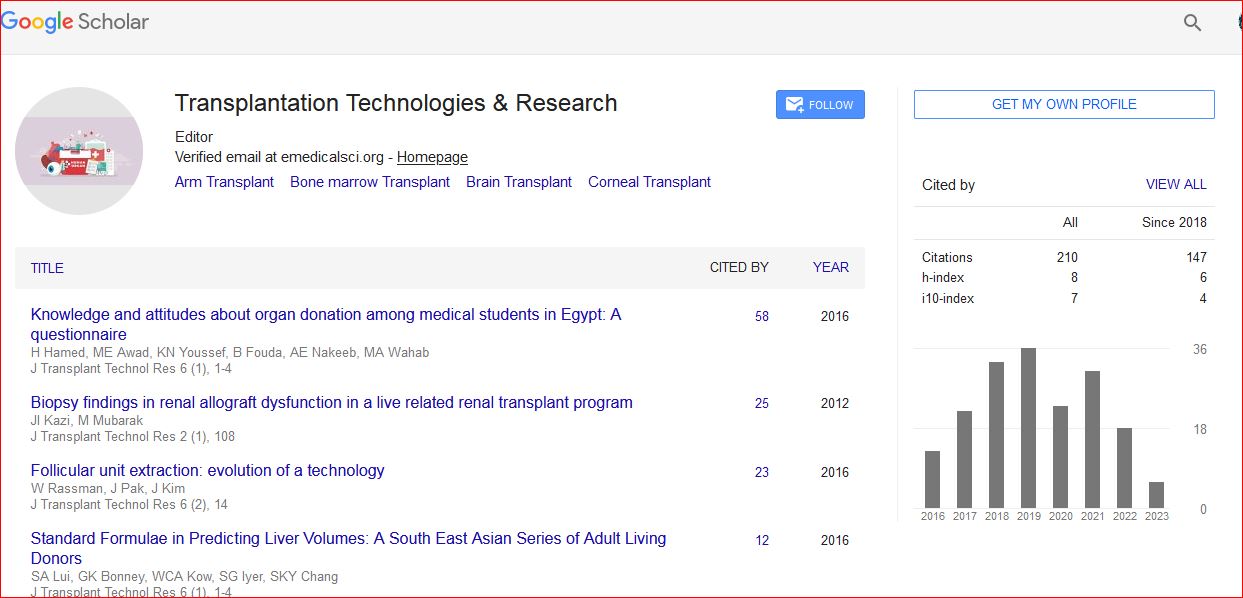
Transplantation Technologies & Research received 223 citations as per Google Scholar report