Brief Report - (2025) Volume 14, Issue 5
Received: 01-Sep-2025, Manuscript No. jamk-25-177314;;
Editor assigned: 03-Sep-2025, Pre QC No. P-177314;;
Reviewed: 17-Sep-2025, QC No. Q-177314;;
Revised: 22-Sep-2025, Manuscript No. R-177314;;
Published:
29-Sep-2025
, DOI: 10.37421/2168-9601.2025.14.574
Citation: Zhang, Wei. ”AI in Marketing: Frameworks, Transformation, and Future Prospects.” J Account Mark 14 (2025):574.
Copyright: © 2025 Zhang W. This is an open-access article distributed under the terms of the Creative Commons Attribution License, which permits unrestricted use, distribution and reproduction in any medium, provided the original author and source are credited.
The pervasive influence of artificial intelligence on modern marketing is explored in a comprehensive study, systematically reviewing existing literature to establish a foundational framework. It subsequently outlines a clear agenda for future research, thereby enhancing understanding of AIâ??s current role in marketing and pinpointing crucial areas for ongoing scholarly focus [1].
An integrated review maps the current state of artificial intelligence in marketing, synthesizing various insights and proposing practical directions for future studies. This endeavor aims to provide researchers and practitioners with a consolidated view of AI's critical role in marketing and the anticipated trajectory of the field's development [2].
Moving beyond mere automation, this article explores how AI fundamentally transforms marketing strategies, rather than simply enhancing efficiency. It delves into how AI redefines business approaches to marketing efforts, emphasizing AIâ??s emergence as a strategic lever for comprehensive change, not just a tactical tool [3].
Through a detailed bibliometric analysis, this study meticulously maps the intellectual structure of artificial intelligence in marketing. It uncovers key trends, identifies influential works, and points out significant gaps requiring further research. This analysis clarifies how AI marketing research has evolved and highlights areas that remain underexplored [4].
A clear overview of AIâ??s current applications and future prospects in marketing is presented, detailing how AI is being utilized today and anticipating future innovations. This paper offers a comprehensive snapshot of contemporary practices and a forward-looking forecast for the evolution of AI technologies in the marketing domain [5].
This paper focuses on Customer Relationship Management, conducting a systematic review of AI integration within CRM processes. It highlights the current research status and outlines important questions for future studies. The core finding is how AI profoundly influences not only marketing but also the management of crucial customer relationships [6].
Providing a balanced perspective, a systematic review explores both the positive contributions and potential drawbacks of AI in marketing. It addresses not only AI's capabilities but also the ethical considerations and challenges it introduces. Understanding these dual aspects is vital for the responsible deployment of these powerful technologies [7].
This paper offers a systematic review of AI in marketing, establishing a robust conceptual framework that explains AIâ??s impact on marketing activities. It also highlights promising avenues for future research, providing a clear structure for understanding AIâ??s role and guiding further knowledge development in the field [8].
An integrative review examines how AI is fundamentally changing sales and marketing processes, synthesizing current knowledge and proposing a future research agenda. This offers a holistic view of AIâ??s transformative effect, demonstrating that AI reshapes entire operational workflows, not just individual tasks [9].
This study empirically investigates AI's specific impact on customer satisfaction and brand loyalty within marketing contexts. It provides insights into how AI applications influence key customer outcomes, helping to understand whether AI tools strengthen customer relationships and brand affinity effectively [10].
A comprehensive paper scrutinizes how artificial intelligence is shaping contemporary marketing, undertaking a systematic review of extant literature. This work aims to construct a solid theoretical framework and propose an explicit agenda for future scholarly investigation. Its core utility lies in clarifying AI's present influence and identifying areas for concentrated research [1]. An integrated review critically maps the current landscape of artificial intelligenceâ??s application in marketing. This compilation draws from various insights, subsequently offering actionable directives for forthcoming studies. The central premise is to equip both researchers and industry with a consolidated understanding of AI's impact and its future trajectory [2]. This article delves into the profound metamorphosis artificial intelligence instigates within marketing strategies, moving significantly beyond mere automation. It explores how AI fundamentally reconfigures the strategic approaches businesses adopt, positioning AI as an essential strategic catalyst rather than a simple operational enhancement tool [3]. Utilizing a detailed bibliometric analysis, this research meticulously charts the intellectual architecture of artificial intelligence in marketing. It reveals critical trends, highlights seminal contributions, and precisely delineates existing gaps that demand further scholarly inquiry. This helps to discern patterns in the evolution of AI marketing research [4]. A salient paper offers a clear exposition of artificial intelligence's current deployments within marketing and projects its future evolutionary path. It systematically outlines prevailing AI applications and forecasts prospective technological developments. This dual focus provides an immediate situational assessment and a visionary outlook on AI's anticipated role [5]. Specifically addressing Customer Relationship Management, this study conducts a systematic review of AI integration within CRM processes. It illuminates the present state of research and articulates crucial questions for future academic pursuits. The central implication underscores how AI is not merely altering marketing but also deeply transforming customer relationship management [6]. Offering a balanced perspective, a systematic literature review examines both the advantageous aspects and inherent challenges presented by artificial intelligence in marketing. This critical assessment weighs AIâ??s positive contributions against potential drawbacks and ethical considerations. Understanding both sides of this technological coin is imperative for informed deployment [7]. This paper provides a systematic review of AI in marketing, culminating in a robust conceptual framework that explicates AIâ??s diverse impacts on marketing activities. It concurrently identifies and outlines promising avenues for future research, offering a structured approach for advancing knowledge and practice within the academic field [8]. An integrative review comprehensively details how artificial intelligence is fundamentally reshaping both sales and marketing processes, extending beyond task-level enhancements. It synthesizes current academic insights and proposes a detailed agenda for future research, providing a holistic perspective on AIâ??s transformative effects across entire operational workflows [9]. An empirical study investigates the direct influence of artificial intelligence on key customer outcomes, specifically focusing on satisfaction and brand loyalty in marketing contexts. This research provides tangible data on how AI applications modify these crucial metrics, shedding light on their efficacy in strengthening customer relationships and brand affinity [10].
This collection of research comprehensively explores the multifaceted role of artificial intelligence in marketing. It systematically reviews existing literature to build robust frameworks, maps the intellectual structure of the field through bibliometric analysis, and identifies critical areas for future research. Several contributions highlight AI's capacity to fundamentally transform marketing strategies, moving beyond simple automation to reshape entire operational workflows in sales and customer relationship management. The current applications and future prospects of AI in marketing are detailed, alongside a balanced examination of its benefits, challenges, and ethical considerations. Empirical studies further investigate AI's direct impact on key customer outcomes such as satisfaction and brand loyalty. Collectively, these papers provide a consolidated view of AI's pervasive influence, offering both a diagnostic understanding of its current state and a forward-looking agenda for its continued academic and practical development.
None
None
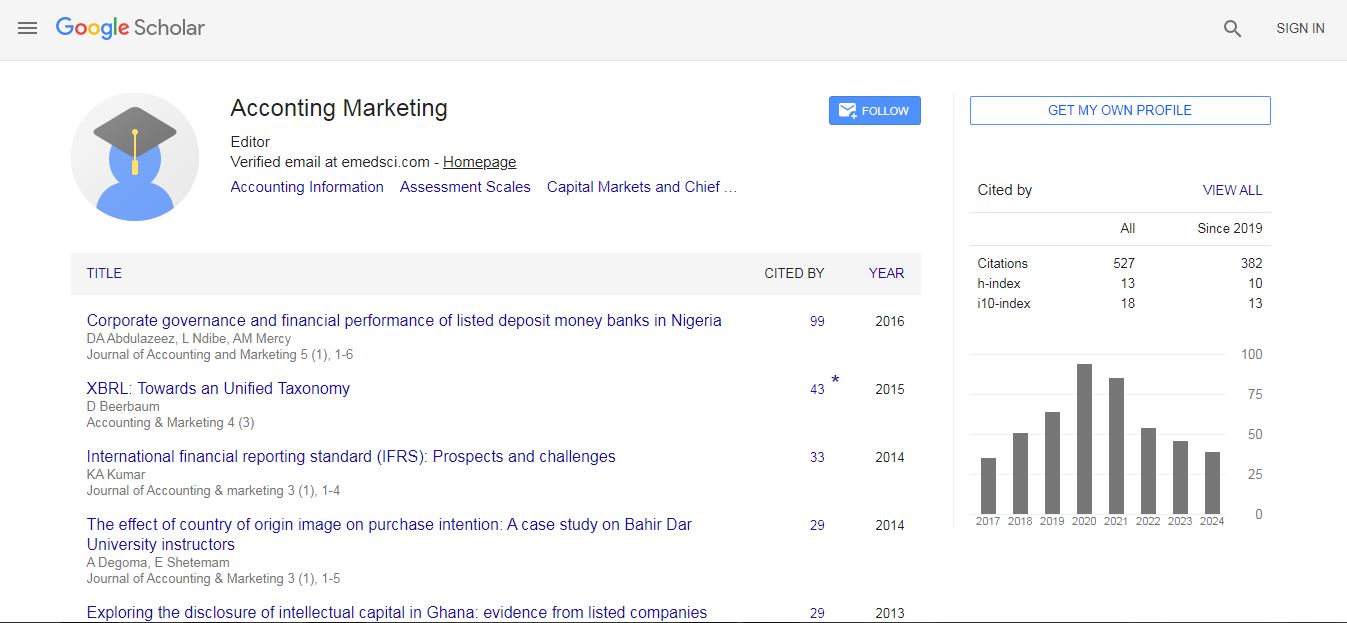
Accounting & Marketing received 487 citations as per Google Scholar report