Opinion - (2025) Volume 14, Issue 3
Received: 01-May-2025, Manuscript No. jamk-25-177279;
Editor assigned: 03-May-2025, Pre QC No. P-177279;
Reviewed: 17-May-2025, QC No. Q-177279;
Revised: 24-May-2025, Manuscript No. R-177279;
Published:
31-May-2025
, DOI: 10.37421/2168-9601.2025.14.556
Citation: Rao, Meenakshi. ”Accounting’s Evolving Role in Strategy and Performance.” J Account Mark 14 (2025):556.
Copyright: © 2025 Rao M. This is an open-access article distributed under the terms of the Creative Commons Attribution License, which permits unrestricted use, distribution and reproduction in any medium, provided the original author and source are credited.
Strategic management accounting practices are pivotal in enhancing firm performance, particularly through their capacity to foster innovation. Effective accounting information serves as a catalyst, guiding strategic decisions that cultivate inventive approaches and ultimately contribute to superior business outcomes [1].
The influence of management control systems on strategic choices and organizational performance is particularly pronounced in environments characterized by uncertainty. Robust accounting controls provide essential information, enabling organizations to make informed and adaptive strategic adjustments even when confronted with unpredictable conditions [2].
Strategic performance measurement systems are instrumental in bridging the gap between strategic formulation and successful implementation, thereby impacting organizational performance. This linkage is significantly mediated by the presence of a shared vision, underscoring accountingâ??s role in cultivating a common understanding of objectives crucial for effective strategic execution [3].
The integration of Big Data analytics with management accounting offers a substantial pathway to achieving sustainable strategic advantage. By applying an accounting perspective to the analysis of extensive datasets, organizations can derive profound insights, empowering strategic decision-makers to make choices that yield lasting benefits [4].
Investigating the relationship between strategic cost management and the attainment of competitive advantage reveals the critical function of sophisticated management accounting practices. Through adeptly managing costs using advanced accounting techniques, firms can solidify and enhance their market position [5].
Sustainability accounting information plays a crucial role in shaping strategic decisions within enterprises, as evidenced by studies in Vietnamese businesses. The incorporation of environmental and social performance data into accounting frameworks equips leaders with the knowledge to make more responsible and strategically sound choices [6].
The design of management accounting systems has a direct bearing on the efficiency with which intellectual capital is utilized. Custom-tailored accounting systems are better equipped to monitor and capitalize on intangible assets, furnishing vital data for strategic initiatives related to both innovation and human capital development [7].
Enterprise risk management (ERM) significantly influences organizational performance, with strategic planning acting as a crucial intermediary in this relationship. A systematic approach to risk accounting enables the development of more resilient strategic plans, leading to an overall improvement in company results [8].
A systematic review of digitalization in management accounting underscores how digital tools are transforming traditional accounting practices and information delivery. This transformation provides a comprehensive framework for understanding how these evolving capabilities bolster strategic decision-making and points towards future research imperatives [9].
The capabilities of Big Data analytics profoundly affect firm performance, with strategic decision-making acting as a vital mediating factor. By effectively harnessing advanced data analytics, which often relies heavily on underlying accounting data, organizations can significantly refine their strategic choices and achieve superior organizational outcomes [10].
Research indicates that firms employing advanced strategic management accounting practices are better positioned to improve their overall performance. This improvement is often facilitated by an enhanced capacity for innovation, demonstrating how well-structured accounting information can directly influence strategic initiatives and lead to better business results [1]. In dynamic and unpredictable operational environments, the efficacy of management control systems becomes paramount for guiding strategic choices and sustaining performance. These systems provide a foundation of reliable accounting controls that deliver indispensable information, enabling leadership to navigate uncertainty with informed and agile strategic adjustments [2]. The efficacy of strategic performance measurement systems in driving strategy implementation and bolstering organizational performance is heavily dependent on a collective shared vision. This highlights the foundational role of accounting in fostering organizational cohesion by ensuring that all stakeholders possess a unified understanding of strategic goals, thereby enabling more effective execution [3]. Integrating Big Data analytics within management accounting frameworks is identified as a potent strategy for cultivating a sustainable competitive advantage. The analytical capacity to process and interpret vast quantities of data through an accounting lens generates deeper, actionable insights, which are crucial for senior decision-makers in formulating long-term strategies [4]. Studies focused on industrial companies reveal a strong link between sophisticated strategic cost management techniques and the achievement of competitive advantage. Effective management accounting practices are crucial in this process, providing the necessary tools to rigorously control costs and thereby allowing firms to carve out a stronger position in the marketplace [5]. The impact of sustainability accounting information on strategic decision-making within businesses, particularly in emerging economies, is increasingly recognized. By systematically incorporating environmental and social metrics into their accounting processes, organizations can guide their leaders towards making more comprehensive and socially responsible strategic choices that reflect broader stakeholder values [6]. Designing management accounting systems with specific organizational needs in mind directly correlates with optimizing the efficiency of intellectual capital. These bespoke systems facilitate a more precise tracking and leveraging of intangible assets, furnishing critical data essential for strategic decisions concerning innovation and the development of human resources [7]. Enterprise risk management (ERM) is a critical determinant of organizational performance, with its influence often mediated by robust strategic planning processes. The systematic identification and accounting for potential risks empower organizations to formulate more resilient and forward-looking strategic plans, which in turn leads to superior overall company outcomes [8]. A comprehensive review of the ongoing digitalization trends in management accounting illuminates the profound shifts occurring in accounting practices and information delivery. This systematic understanding provides a vital framework for comprehending how these technological advancements fundamentally support and reshape strategic decision-making processes, while also outlining promising avenues for future inquiry [9]. Research consistently demonstrates that strong Big Data analytics capabilities significantly impact firm performance, largely by enhancing the quality of strategic decision-making. The ability to effectively analyze complex datasets, intrinsically linked to robust accounting data, empowers organizations to make more astute strategic choices that lead directly to improved organizational results and competitive standing [10].
The provided content extensively examines the multifaceted role of accounting in strategic management and organizational performance. Several studies highlight how strategic management accounting practices, management control systems, and strategic performance measurement systems are instrumental in enhancing firm performance, driving innovation, and facilitating effective strategy implementation, often mediated by factors like shared vision and environmental uncertainty. The integration of modern technologies such as Big Data analytics is shown to provide sustainable strategic advantages, offering deeper insights for decision-makers and improving firm performance through enhanced strategic choices. Furthermore, the importance of strategic cost management for competitive advantage and sustainability accounting for responsible strategic decisions is emphasized. The efficiency of intellectual capital is also linked to management accounting system design, demonstrating its role in leveraging intangible assets. Finally, enterprise risk management is presented as a crucial component for robust strategic planning and overall organizational success, complemented by insights from the digitalization of management accounting. This collection underscores accountingâ??s pervasive and evolving influence on strategic direction and outcomes across various organizational contexts.
None
None
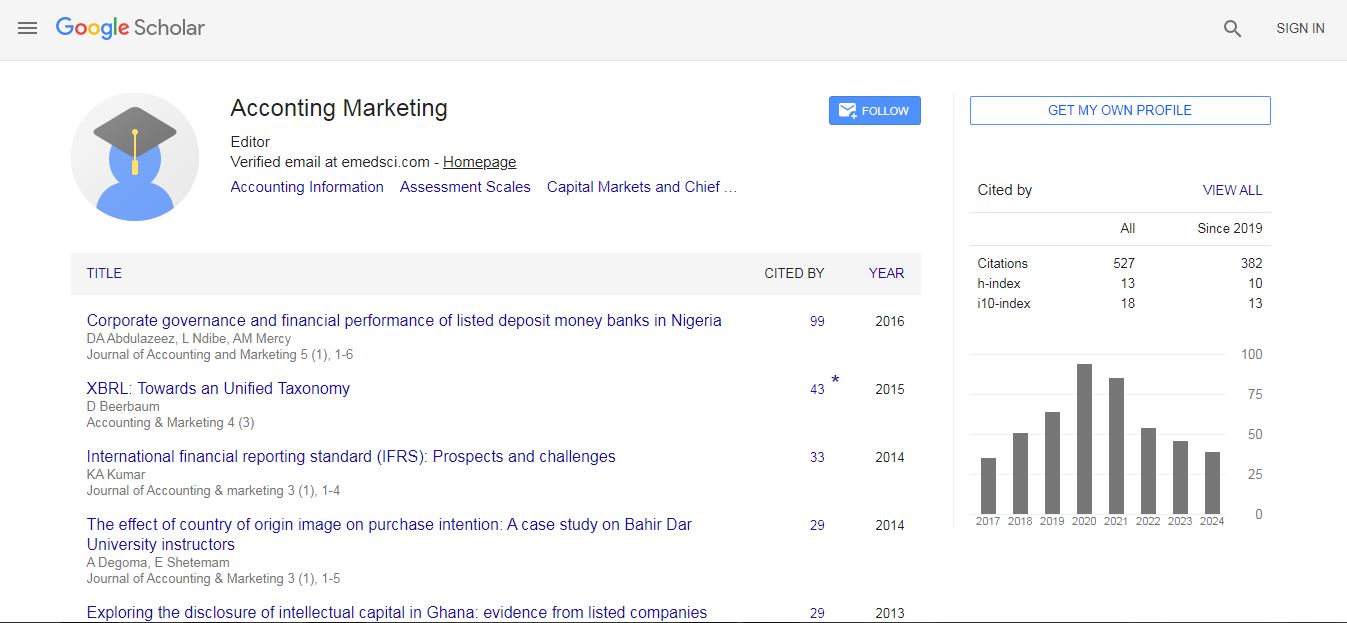
Accounting & Marketing received 487 citations as per Google Scholar report