Short Communication - (2025) Volume 14, Issue 2
Received: 01-Mar-2025, Manuscript No. jamk-25-177272;
Editor assigned: 03-Mar-2025, Pre QC No. P-177272;
Reviewed: 17-Mar-2025, QC No. Q-177272;
Revised: 24-Mar-2025, Manuscript No. R-177272;
Published:
31-Mar-2025
, DOI: 10.37421/2168-9601.2025.14.551
Citation: Malhotra, Rakesh. ”Accounting, Technology, and Sustainability: Shaping Firm Value.” J Account Mark 14 (2025):551.
Copyright: © 2025 Malhotra R. This is an open-access article distributed under the terms of the Creative Commons Attribution License, which permits unrestricted use, distribution and reproduction in any medium, provided the original author and source are credited.
Modern financial accounting data increasingly reflects the profound impact of sustainability performance on firm value. Research in this area delves into how robust environmental, social, and governance practices translate into tangible economic benefits for businesses, establishing a clear and empirically supported link between responsible operations and enhanced financial outcomes [1].
The digital era has ushered in a transformative wave, compelling businesses to innovate their models. Studies utilizing qualitative comparative analysis illuminate the intricate relationship between digital transformation, business model innovation, and a firms financial performance, demonstrating how strategic technological leverage can lead to superior economic results and market positioning [2].
Entrepreneurial orientation plays a pivotal role in fostering the adoption of innovative management accounting practices, particularly within small and medium sized enterprises. Investigations highlight that a proactive and risk taking mindset is crucial for shaping modern accounting functions, enabling these businesses to adapt effectively to dynamic market environments [3].
The adoption of International Financial Reporting Standards IFRS has significant implications for financial reporting quality and overall firm value, especially within emerging markets. Evidence suggests that these global accounting standards enhance business transparency and positively influence investor perception, fostering greater confidence in financial disclosures [4].
The integration of Big Data Analytics in management accounting practices has become a critical area of study, particularly concerning its influence on decision making processes in German companies. This research underscores how advanced data analysis capabilities empower businesses to make more informed, strategic, and data driven choices, optimizing operational efficiency [5].
The interplay between accounting conservatism and corporate social responsibility is a complex yet vital aspect of corporate governance. Research indicates that specific characteristics of an audit committee significantly influence this relationship, providing crucial insights into mechanisms that promote both ethical accounting practices and broader social accountability within organizations [6].
The advent of FinTech has dramatically reshaped the accounting profession, necessitating a comprehensive understanding of its transformative impact. Systematic literature reviews synthesize existing knowledge, outlining the evolving landscape of accounting services, new skill requirements, and the technological adaptations imperative for businesses in this era of financial innovation [7].
Effective management accounting practices are indispensable for facilitating supply chain integration and significantly enhancing organizational performance. Empirical studies demonstrate that robust accounting information and stringent controls are fundamental for optimizing complex business supply networks, leading to improved efficiency and strategic alignment [8].
An innovation strategy profoundly influences financial reporting quality, with accounting information systems playing a crucial mediating role. Research reveals that well designed and efficiently implemented accounting systems are essential for translating innovative efforts into transparent, reliable, and credible financial disclosures, thus bolstering corporate credibility [9].
The value relevance of accounting information for strategic decision making, particularly within the European Union, cannot be overstated. Studies emphasize how accurate and timely accounting data is foundational in informing corporate strategies, thereby guiding business direction and ensuring the achievement of organizational objectives and sustained growth [10].
This article specifically details how sustainability performance, derived from meticulous financial accounting data, directly impacts a firms market value. It meticulously presents evidence on the tangible economic benefits accrued by businesses that implement robust environmental, social, and governance practices, thereby establishing a clear, quantifiable link between responsible operations and superior economic outcomes [1]. The study employs a qualitative comparative analysis QCA methodology to intricately map the connections between digital transformation initiatives, subsequent business model innovation, and the ultimate financial performance of enterprises. It thoroughly examines the mechanisms through which companies strategically leverage emerging technologies to fundamentally redefine their operational models and achieve significant economic uplift [2]. This research delves into the specific mechanisms by which an entrepreneurial orientation drives the integration of innovative management accounting practices within the unique context of small and medium sized enterprises SMEs. It systematically identifies and explains the critical role of proactive strategies and an appetite for risk taking in modernizing accounting functions within dynamic and often resource constrained business environments [3]. The investigation presents empirical findings from various emerging markets concerning the effects of adopting International Financial Reporting Standards IFRS. It rigorously assesses how IFRS implementation influences both the intrinsic quality of financial reporting and the extrinsic valuation of firm value, offering substantial clarity on the broader implications of harmonized global accounting standards for corporate transparency and investor confidence [4]. This research rigorously examines the practical application of Big Data Analytics within the management accounting frameworks of German companies. A primary focus is placed on dissecting its demonstrable influence on enhancing the efficacy of decision making processes, thereby illustrating how sophisticated data analysis capabilities empower businesses to formulate more astute, informed, and strategically advantageous choices [5]. The article provides an in depth exploration of the complex relationship between accounting conservatism and corporate social responsibility CSR. It specifically analyzes how the distinct characteristics and composition of an audit committee serve as a crucial moderating factor in this interaction, yielding vital insights into the corporate governance structures that champion ethical accounting and societal accountability [6]. This systematic literature review meticulously synthesizes a broad spectrum of existing academic work concerning the profound and multifaceted impact of FinTech on the accounting profession. It comprehensively maps the evolving landscape of accounting services, highlights emergent skill requirements, and identifies the necessary technological adaptations that businesses must proactively undertake amidst rapid financial technology innovations [7]. The empirical study meticulously evaluates the indispensable role of advanced management accounting practices in achieving successful supply chain integration and subsequently improving overall organizational performance. It substantiates that precise accounting information, coupled with stringent financial controls, forms the bedrock for optimizing intricate business supply networks, ensuring operational excellence and strategic alignment [8]. This research systematically investigates the direct and indirect pathways through which an innovation strategy impacts the quality of financial reporting, with a particular emphasis on the mediating function of accounting information systems. It robustly demonstrates that highly effective accounting systems are fundamentally instrumental in translating innovation endeavors into transparent, reliable, and credible financial disclosures, thereby reinforcing organizational integrity [9]. This study thoroughly investigates the value relevance of accounting information specifically within the context of strategic decision making for entities operating within the European Union. It profoundly underscores how the provision of accurate, pertinent, and timely accounting data serves as a foundational element for guiding corporate strategies, ensuring the judicious direction of business operations, and ultimately facilitating the achievement of overarching organizational objectives [10].
The contemporary business landscape is significantly shaped by the interplay of technology, governance, and sustainability, all underpinned by robust accounting practices. Research indicates that sustainability performance, as reflected in financial accounting data, directly enhances firm value, demonstrating tangible benefits from strong environmental, social, and governance initiatives. Digital transformation and business model innovation, supported by strategic technology leverage, are crucial for superior financial performance. Innovative management accounting practices, often driven by entrepreneurial orientation, are vital for small and medium sized enterprises. The adoption of International Financial Reporting Standards improves financial reporting quality and firm value, particularly in emerging markets, by increasing transparency. Furthermore, Big Data Analytics in management accounting empowers informed decision making, while accounting conservatism and corporate social responsibility are influenced by audit committee characteristics. The accounting profession is undergoing significant transformation due to FinTech, requiring new skills and technological adaptations. Effective management accounting also facilitates supply chain integration and enhances organizational performance. Finally, innovation strategies and reliable accounting information systems are critical for high quality financial reporting, and the value relevance of accounting data is paramount for strategic decision making, guiding corporate objectives in diverse economic environments like the European Union.
None
None
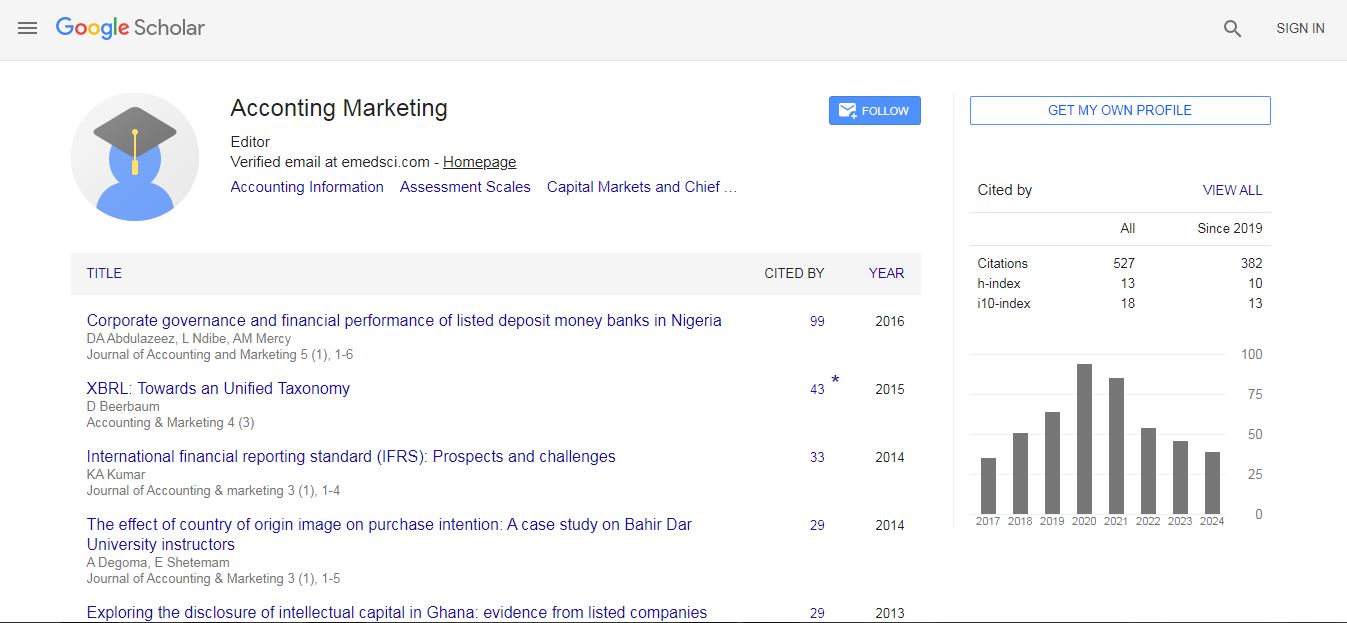
Accounting & Marketing received 487 citations as per Google Scholar report