Short Communication - (2025) Volume 14, Issue 3
Received: 01-May-2025, Manuscript No. jamk-25-177286;
Editor assigned: 03-May-2025, Pre QC No. P-177286;
Reviewed: 17-May-2025, QC No. Q-177286;
Revised: 24-May-2025, Manuscript No. R-177286;
Published:
31-May-2025
, DOI: 10.37421/2168-9601.2025.14.561
Citation: © 2025 Collins R. This is an open-access article distributed under the terms of the Creative Commons Attribution License, which permits unrestricted use, distribution and reproduction in any medium, provided the original author and source are credited.
Copyright: Collins, Rebecca. ”Accounting Standards: Impacting Finance, Compliance, and Future.” J Account Mark 14 (2025):561.
New accounting standards, specifically IFRS 9, have significantly altered financial institutions' risk management practices and their reported financial performance. The estimation of expected credit losses presents considerable challenges, bearing substantial implications for capital adequacy and regulatory compliance. This necessitates the development and implementation of robust internal models alongside a commitment to high-quality data to navigate these complexities effectively [1].
Corporate governance mechanisms are pivotal in ensuring adherence to established accounting standards, especially within the dynamic context of emerging markets. Research consistently demonstrates that a heightened degree of board independence and the proactive effectiveness of audit committees are instrumental in mitigating instances of financial misreporting. These elements collectively serve to bolster the overall credibility and reliability of financial statements for stakeholders [2].
The evolving landscape of environmental, social, and governance (ESG) reporting, underpinned by contemporary accounting standards, profoundly influences investor decision-making processes. Academic discourse suggests that corporations that embrace comprehensive ESG disclosures often experience an improvement in their market valuation and a reduction in their cost of capital, contingent upon the information provided being both credible and readily verifiable by external parties [3].
Revenue recognition under IFRS 15 presents intricate challenges across diverse industry sectors. This research identifies that industries characterized by long-term contracts and complex performance obligations frequently encounter substantial implementation hurdles. Such complexities can lead to varied interpretations of the standard, resulting in material impacts on reported financial figures, underscoring the critical need for specialized training and robust internal controls [4].
The efficacy of audit quality in ensuring steadfast compliance with international accounting standards is a subject of continuous evaluation. Studies emphasize that a combination of robust auditor independence and pertinent, specialized industry knowledge is paramount for the effective detection of non-compliance. These attributes are crucial for enhancing the overall reliability of financial reporting, particularly within complex regulatory frameworks [5].
The burgeoning influence of digital transformation and advanced big data analytics is reshaping the application and enforcement of accounting standards. This perspective posits that technological advancements can significantly augment compliance through process automation and improvements in data accuracy. However, this evolution also introduces novel challenges related to data privacy, cybersecurity, and the imperative for auditors to acquire new skills [6].
Accounting standards play a critical role in fostering comprehensive corporate social responsibility (CSR) reporting. Investigations reveal that the implementation of mandatory CSR disclosure standards generally results in more exhaustive and higher-quality reporting compared to purely voluntary frameworks. This shift promotes enhanced transparency and accountability, crucial for maintaining trust among diverse stakeholder groups [7].
The intricate interplay between political connections, regulatory environments, and firms' compliance with tax accounting standards warrants detailed examination. Findings indicate that politically connected firms may exhibit a reduced propensity for compliance, potentially leveraging their influence. Conversely, robust regulatory oversight demonstrably enhances adherence to standards and actively discourages aggressive tax practices, fostering equity [8].
The adoption of International Financial Reporting Standards (IFRS) has significant implications for the comparability of financial reporting and the overall quality of earnings for multinational corporations. While IFRS aims to establish global comparability, this analysis highlights that variances in national enforcement and interpretative approaches can still lead to notable differences, potentially affecting investor trust and cross-border investment flows [9].
Effective internal control systems, specifically those based on COSO frameworks, are deemed indispensable for ensuring compliance with intricate accounting standards, such as those introduced by Sarbanes-Oxley. This research underscores that a robust internal control environment, particularly within information technology domains, is critical for mitigating the risk of financial statement fraud and bolstering overall organizational integrity [10].
The study describes how new accounting standards, specifically IFRS 9, fundamentally alter financial institutions' risk management practices and their reported financial performance. It outlines the inherent difficulties in accurately estimating expected credit losses and the consequential effects on capital adequacy and regulatory compliance. The research emphasizes the pressing requirement for sophisticated internal models and meticulous data quality to navigate these evolving demands [1]. This research describes the critical function of corporate governance mechanisms in upholding compliance with accounting standards, particularly within emerging markets. It details how enhanced board independence and the proactive engagement of audit committees are key factors that demonstrably reduce instances of financial misreporting, thereby elevating the overall credibility of corporate financial statements for public trust [2]. This article describes the profound influence of environmental, social, and governance (ESG) reporting standards on investor decision-making and firm valuation. It articulates that companies which adopt comprehensive ESG disclosures often benefit from improved market standing and a reduced cost of capital, provided the reported information maintains a high degree of credibility and verifiability for stakeholders [3]. The research describes the complex landscape of revenue recognition under IFRS 15 across various industries. It elucidates that sectors characterized by long-term contracts and intricate performance obligations face considerable challenges during implementation, frequently resulting in diverse interpretations and significant impacts on financial reporting. The study highlights the indispensable role of targeted training and robust internal controls [4]. This study describes an evaluation of audit quality's effectiveness in securing compliance with international accounting standards. It postulates that the combination of strong auditor independence and specialized industry expertise is crucial for identifying non-compliance and enhancing the reliability of financial reporting, especially within the intricate confines of various regulatory environments globally [5]. This paper describes an investigation into the transformative effects of digital transformation and big data analytics on the application and enforcement of accounting standards. It proposes that while technology can bolster compliance through automation and improved data accuracy, it simultaneously introduces new challenges concerning data privacy, security protocols, and the evolving skill requirements for auditing professionals [6]. The article describes a scrutiny of the role accounting standards play in advancing corporate social responsibility (CSR) reporting. It concludes that mandatory CSR disclosure standards typically lead to more comprehensive and higher-quality reporting when compared to voluntary frameworks, thereby fostering enhanced transparency and accountability to a wide array of stakeholders [7]. This investigation describes how political connections and the prevailing regulatory environments distinctly affect firms' compliance with tax accounting standards. The findings suggest that politically connected entities might exhibit reduced compliance due to their influence, whereas strong regulatory oversight significantly promotes adherence to standards and curtails aggressive tax avoidance strategies [8]. This analysis describes the manifold effects of IFRS adoption on financial reporting comparability and earnings quality for multinational corporations. It reveals that while IFRS intends to foster global comparability, variations in national enforcement and interpretative nuances can still generate substantial discrepancies, impacting investor confidence and influencing cross-border investment decisions [9]. This article describes the fundamental importance of internal control systems, particularly those aligned with COSO frameworks, for achieving effective compliance with complex accounting standards such as Sarbanes-Oxley. It underscores that a robust internal control environment, with a strong focus on IT, is paramount for mitigating financial statement fraud risks and upholding overall organizational integrity [10].
The body of research underscores the critical and evolving role of accounting standards in shaping various facets of corporate operations and financial markets. Studies highlight the impact of specific standards like IFRS 9 on risk management and IFRS 15 on revenue recognition, noting implementation challenges across industries. Corporate governance, audit quality, and robust internal control systems are identified as crucial mechanisms for ensuring compliance and enhancing financial reporting credibility, particularly in emerging markets and complex regulatory environments. The influence of accounting standards extends beyond traditional financial metrics, encompassing areas like ESG and CSR reporting, which significantly affect investor decisions and market valuation. Furthermore, the integration of digital transformation and big data analytics presents both opportunities for improved compliance and new challenges related to data security and auditor skill requirements. While international standards like IFRS aim for global comparability, variations in national enforcement can still lead to discrepancies. Finally, regulatory oversight and the mitigation of political influence are key to promoting adherence to tax accounting standards and overall organizational integrity.
None
None
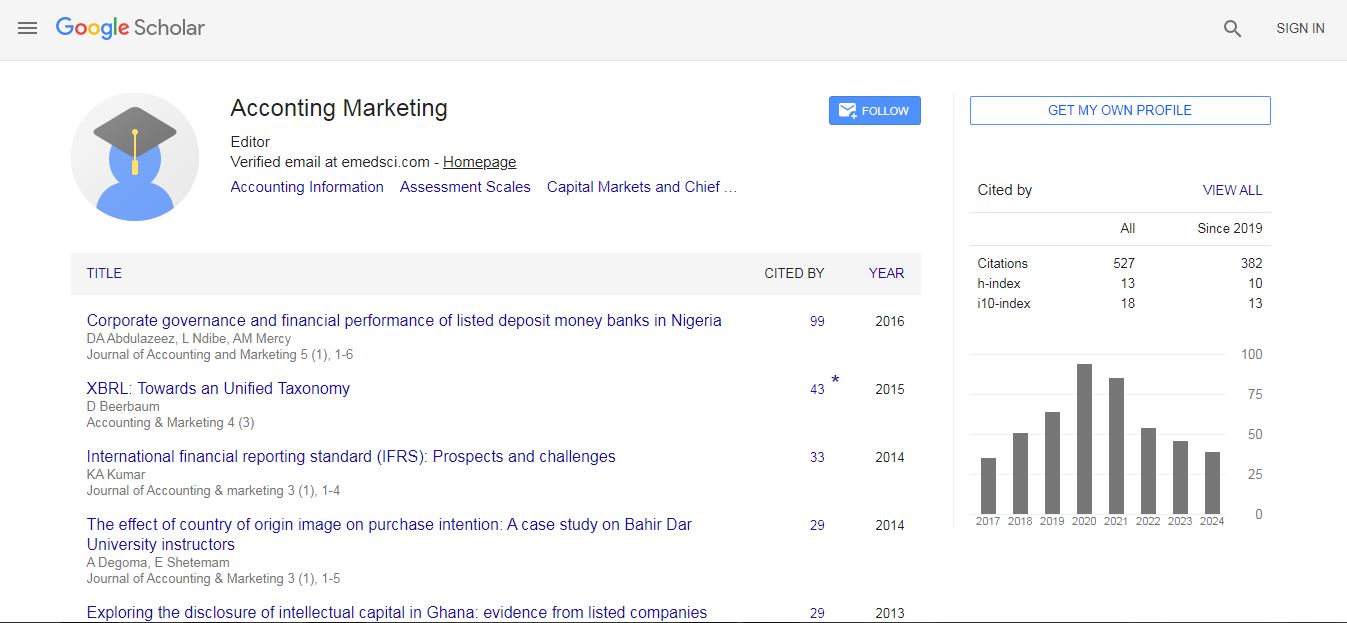
Accounting & Marketing received 487 citations as per Google Scholar report