Commentary - (2025) Volume 16, Issue 3
Received: 02-Jun-2025, Manuscript No. jar-25-176617;
Editor assigned: 04-Jun-2025, Pre QC No. P-176617;
Reviewed: 18-Jun-2025, QC No. Q-176617;
Revised: 23-Jun-2025, Manuscript No. R-176617;
Published:
30-Jun-2025
, DOI: 10.37421/2155-6113.2025.16.1064
Citation: Petrova, Olga. ”Vaccine Evolution: Platforms, Global
Health, Equity.” J AIDS Clin Res 16 (2025):1064.
Copyright: © 2025 Petrova O. This is an open-access article distributed under the terms of the Creative Commons Attribution License, which permits unrestricted use,
distribution and reproduction in any medium, provided the original author and source are credited.
This piece highlights the rapid evolution of COVID-19 vaccine development, shifting from the initial emergency response to focusing on more sustainable, long-term strategies. It discusses the various vaccine platforms utilized and the challenges in ensuring global equitable access and continued innovation against emerging variants, underscoring the necessity for adaptable vaccine technologies and public health preparedness[1].
The article emphasizes the critical global health need for a universal influenza vaccine, one that provides broad, long-lasting protection against various strains, reducing the burden of seasonal flu and pandemic threats. It reviews current strategies and challenges, advocating for increased investment and coordinated international efforts in research and development to achieve this ambitious goal[2].
This review explores the cutting-edge vaccine platforms, including mRNA, viral vectors, and protein subunit technologies, detailing their mechanisms, advantages, and applications in combating infectious diseases. It highlights their role in accelerating vaccine development, especially in pandemic situations, and discusses ongoing innovations aimed at enhancing efficacy, safety, and rapid deployment capabilities[3].
This article details the ongoing international initiatives to develop new, more effective tuberculosis vaccines, moving beyond the current BCG vaccine. It covers various clinical trial candidates, novel immunological approaches, and the challenges in vaccine design, emphasizing the urgent need for a potent vaccine to control the global TB epidemic, especially in high-burden regions[4].
This systematic review delves into the complex factors influencing equitable vaccine access globally, identifying key barriers such as manufacturing capacity, supply chain issues, pricing, and vaccine hesitancy, alongside facilitators like international collaborations and robust public health communication. It stresses that effective vaccine development must be coupled with strategies to ensure fair distribution and uptake worldwide[5].
This review outlines the significant progress in therapeutic cancer vaccine development, focusing on personalized approaches like neoantigen vaccines and on strategies combining vaccines with other immunotherapies. It discusses how a deeper understanding of tumor immunology and sophisticated antigen discovery methods are paving the way for more effective treatments, aiming to induce robust anti-tumor immune responses[6].
This article examines the crucial role of adjuvants in enhancing vaccine efficacy and developing next-generation vaccines. It discusses how novel adjuvant formulations are designed to tailor immune responses, improving the breadth and durability of protection against various pathogens. The piece emphasizes the importance of understanding adjuvant mechanisms for optimizing vaccine performance and safety[7].
The article provides an overview of the complex landscape of Human Immunodeficiency Virus (HIV) vaccine development, detailing the ongoing challenges and promising scientific breakthroughs. It highlights strategies focusing on broadly neutralizing antibodies, T-cell responses, and novel vaccine platforms, underscoring the persistent need for a safe and effective vaccine to curb the global Human Immunodeficiency Virus (HIV) epidemic[8].
This review assesses the advancements and hurdles in developing effective dengue vaccines, a critical need given the global burden of the disease. It discusses the complexities of inducing balanced immunity against all four dengue serotypes and evaluates the performance of existing and pipeline vaccine candidates, emphasizing the ongoing efforts to improve safety and efficacy profiles[9].
This article explores the innovative advancements transforming vaccine manufacturing, addressing both the opportunities for increased efficiency, scalability, and cost reduction, and the challenges related to regulatory hurdles, quality control, and global supply chain resilience. It emphasizes the shift towards modular and continuous manufacturing processes to enhance responsiveness during public health crises[10].
Vaccine development has undergone a profound transformation, moving decisively from reactive emergency responses, like those witnessed during the initial phases of the COVID-19 pandemic, to more forward-thinking, sustainable, and long-term global health strategies. This evolution in COVID-19 vaccine development specifically emphasizes adaptable vaccine technologies and robust public health preparedness, ensuring readiness for future health challenges [1]. Central to this progress are advanced vaccine platforms, which encompass technologies such as Messenger Ribonucleic Acid (mRNA), viral vectors, and protein subunits. These platforms are not only critical for accelerating the pace of vaccine development but also for enhancing overall efficacy, safety, and rapid deployment capabilities, especially crucial during widespread pandemic situations [3]. Supporting these technological leaps is significant innovation in vaccine manufacturing. This includes a strategic shift towards modular and continuous manufacturing processes, which are designed to significantly improve efficiency, scalability, and responsiveness of vaccine production, particularly vital during public health emergencies [10]. These foundational changes are essential for establishing a more resilient and effective global vaccine infrastructure capable of meeting diverse health needs.
Addressing specific infectious diseases remains a paramount global health priority. One such goal is the creation of a universal influenza vaccine, which aims to provide broad, enduring protection against a multitude of influenza strains. This would substantially reduce the burden of seasonal flu and mitigate potential pandemic threats globally [2]. Parallel efforts are concentrated on developing new, more effective tuberculosis vaccines. These initiatives seek to advance beyond the limitations of the current Bacillus Calmette-Guérin (BCG) vaccine, exploring novel immunological approaches and various clinical trial candidates with the urgent goal of controlling the persistent global tuberculosis epidemic, especially in high-burden regions [4]. The development of effective dengue vaccines presents unique complexities, particularly in inducing a balanced and protective immune response against all four dengue serotypes. Researchers are actively evaluating existing and pipeline vaccine candidates, with a clear focus on enhancing their safety and efficacy profiles to better protect affected populations [9]. Similarly, in the ongoing battle against Human Immunodeficiency Virus (HIV), the scientific community is exploring innovative strategies. These include approaches that focus on generating broadly neutralizing antibodies and potent T-cell responses, alongside utilizing novel vaccine platforms, all underscoring the persistent and critical need for a safe and effective vaccine to curb the global Human Immunodeficiency Virus (HIV) epidemic [8]. These targeted and diverse research endeavors highlight the complexity and dedicated focus required for modern vaccinology in combating infectious diseases.
Beyond the realm of infectious pathogens, remarkable progress is also being achieved in the field of therapeutic cancer vaccine development. This area is characterized by a strong emphasis on personalized medicine, particularly through approaches like neoantigen vaccines, and the strategic combination of vaccines with other immunotherapies. A deeper and evolving understanding of tumor immunology, coupled with sophisticated antigen discovery methods, is effectively paving the way for more potent and tailored treatments. These treatments aim to induce robust and lasting anti-tumor immune responses, offering new hope in cancer therapy [6]. Furthermore, a critical component in enhancing the overall performance and effectiveness of a wide array of vaccines is the judicious use and innovative design of adjuvants. These formulations are specifically engineered to precisely tailor immune responses, thereby significantly improving the breadth and durability of protection against various pathogens. A thorough understanding of adjuvant mechanisms is absolutely paramount for optimizing both the performance and safety of next-generation vaccines [7]. These advancements collectively demonstrate the expansive scope of modern vaccinology, extending its transformative impact across a broad spectrum of health challenges, from infectious diseases to complex conditions like cancer.
Despite these significant scientific and technological advancements, the ultimate success of vaccine development hinges crucially on ensuring equitable global access. A comprehensive systematic review clearly identifies several key barriers that impede fair distribution and uptake. These include critical limitations in manufacturing capacity, persistent supply chain issues, challenges related to vaccine pricing, and the pervasive problem of vaccine hesitancy. Conversely, the review also highlights powerful facilitators, such as robust international collaborations and clear, consistent public health communication strategies. The overarching message is unmistakable: the development of highly effective vaccines must be inextricably linked with well-conceived strategies that guarantee their fair and widespread distribution and uptake across the globe [5]. This holistic and integrated perspective is essential to ensure that groundbreaking scientific discoveries translate into tangible and meaningful public health benefits, ultimately reaching and protecting all populations in need, irrespective of their geographical or socioeconomic circumstances.
The field of vaccine development is undergoing rapid transformation, evolving from immediate crisis responses, as seen with COVID-19, to a focus on sustainable, long-term global health strategies. This paradigm shift involves harnessing advanced vaccine platforms like mRNA, viral vectors, and protein subunit technologies, which are critical for accelerating development and ensuring both efficacy and safety. A central concern is the global imperative for vaccines against prevalent and emerging threats. Efforts are underway to create a universal influenza vaccine for broad, lasting protection, and to develop new tuberculosis vaccines that surpass current options. Researchers are also navigating complexities in developing effective Dengue vaccines, aiming for balanced immunity against multiple serotypes, and persistently working towards safe and effective Human Immunodeficiency Virus (HIV) vaccines by exploring novel platforms and immune responses. Significant strides are also being made in therapeutic cancer vaccines, which employ personalized neoantigen approaches and combine with other immunotherapies to generate potent anti-tumor immunity. Underlying all these advancements is the crucial role of adjuvants in fine-tuning immune responses for improved protection. Yet, the challenge of achieving equitable global vaccine access persists, requiring solutions for manufacturing, supply chain, pricing, and overcoming vaccine hesitancy through international collaboration and public health communication. Furthermore, innovation in vaccine manufacturing, emphasizing modular and continuous processes, is vital for efficient, scalable, and responsive production during health emergencies.
Indexed at, Google Scholar, Crossref
Indexed at, Google Scholar, Crossref
Indexed at, Google Scholar, Crossref
Indexed at, Google Scholar, Crossref
Indexed at, Google Scholar, Crossref
Indexed at, Google Scholar, Crossref
Indexed at, Google Scholar, Crossref
Indexed at, Google Scholar, Crossref
Indexed at, Google Scholar, Crossref
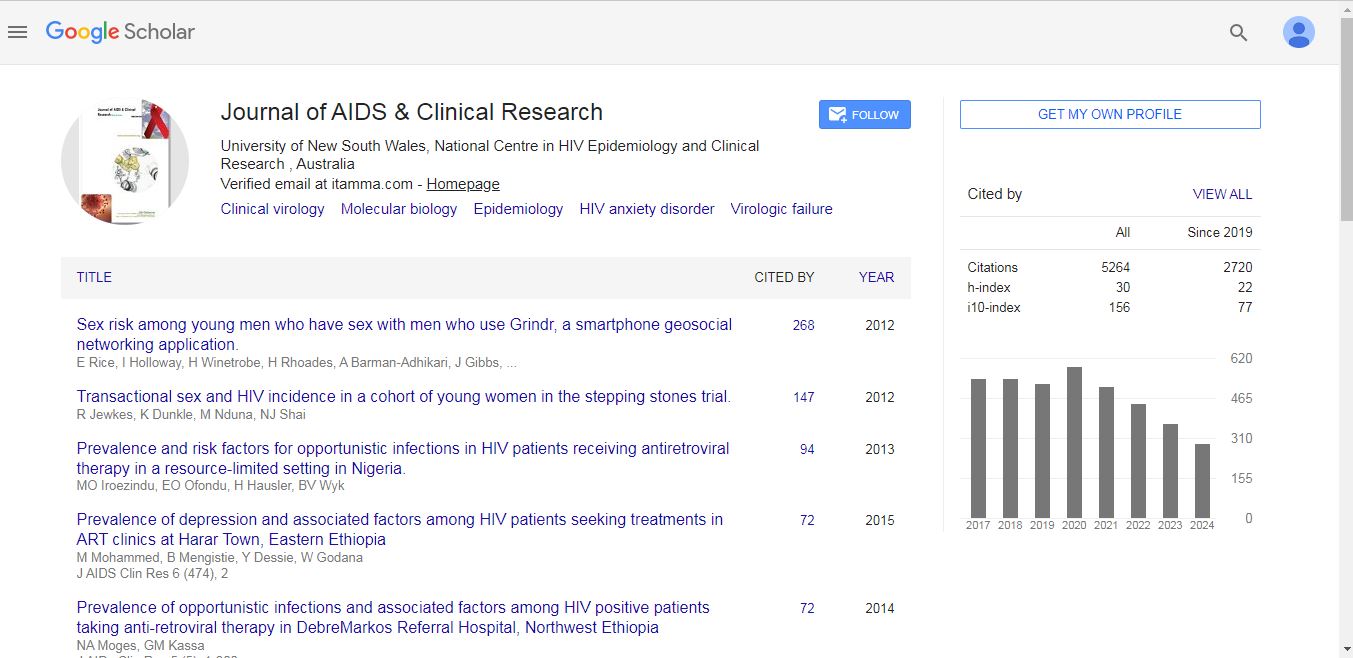
Journal of AIDS & Clinical Research received 5264 citations as per Google Scholar report