Brief Report - (2025) Volume 15, Issue 2
Received: 02-Jun-2025, Manuscript No. jpdbd-25-164657;
Editor assigned: 04-Jun-2025, Pre QC No. P-164657;
Reviewed: 16-Jun-2025, QC No. Q-164657;
Revised: 23-Jun-2025, Manuscript No. R-164657;
Published:
30-Jun-2025
, DOI: 10.37421/2153-0769.2025.15.414
Citation: Prieto, Welty. “Unlocking Cancer’s Secrets with Metabolomic Insights.” Metabolomics 15 (2025): 414.
Copyright: © 2025 Prieto W. This is an open-access article distributed under the terms of the Creative Commons Attribution License, which permits unrestricted use, distribution, and reproduction in any medium, provided the original author and source are credited.
Cancer remains one of the most complex and challenging diseases in the world. Despite major advances in medicine, many of its mysteries still puzzle scientists. To better understand cancer, researchers are looking beyond genes and proteins. One exciting area of study is metabolomics the study of small molecules, or metabolites, that are involved in our body’s metabolism. These molecules give us a closer look at how cancer cells behave, grow, and spread. Metabolomic insights are helping scientists uncover hidden clues about cancer and opening the door to new ways to detect, diagnose, and treat it [1].
Metabolism refers to all the chemical reactions that happen in our bodies to keep us alive. These reactions break down food into energy and create the building blocks our cells need to function. Metabolites are the tiny molecules produced during these reactions. Examples include sugars, fats, amino acids, and waste products. The collection of all these metabolites in the body is called the metabolome. Metabolomics also contributes to our understanding of cancer metabolism and the tumor microenvironment. By elucidating the metabolic pathways dysregulated in cancer cells, researchers can identify potential target Metabolomics is the science of studying the metabolome. It looks at changes in metabolite levels and patterns in different conditions like cancer. By comparing healthy cells and cancer cells, scientists can identify what’s different in their metabolism. These differences can be used to understand the disease better and find new ways to treat it [2].
Cancer changes how cells use energy and nutrients. These changes are not always visible at the genetic or protein level, but they show up clearly in the metabolome. That’s why metabolomics is so important. It reveals how cancer cells are rewiring their metabolism to grow faster, survive longer, and avoid the body’s defenses. These insights can lead to better tools for early detection, diagnosis, and treatment [3]. One key feature of cancer is its ability to reprogram metabolism. Normally, cells get most of their energy through a process called oxidative phosphorylation. But many cancer cells prefer a less efficient method called glycolysis, even when oxygen is available. This is known as the Warburg effect. While glycolysis produces less energy, it helps cancer cells grow quickly by providing materials they need for making new cells.
To study metabolites, scientists use powerful tools like Mass Spectrometry (MS) and Nuclear Magnetic Resonance (NMR) spectroscopy. These tools can detect and measure hundreds or even thousands of different metabolites in a single sample. Researchers often analyze blood, urine, or tissue samples to study the metabolome. Advanced computers and software help sort through the huge amounts of data to find patterns and important differences [4]. Metabolomics can also play a big role in personalized medicine. Because every tumor is unique, treatments that work for one person may not work for another. By studying a patient’s specific metabolic profile, doctors can choose therapies that target their cancer’s weaknesses. This approach can improve outcomes and reduce side effects [5].
Google Scholar Cross Ref Indexed at
Google Scholar Cross Ref Indexed at
Google Scholar Cross Ref Indexed at
Google Scholar Cross Ref Indexed at
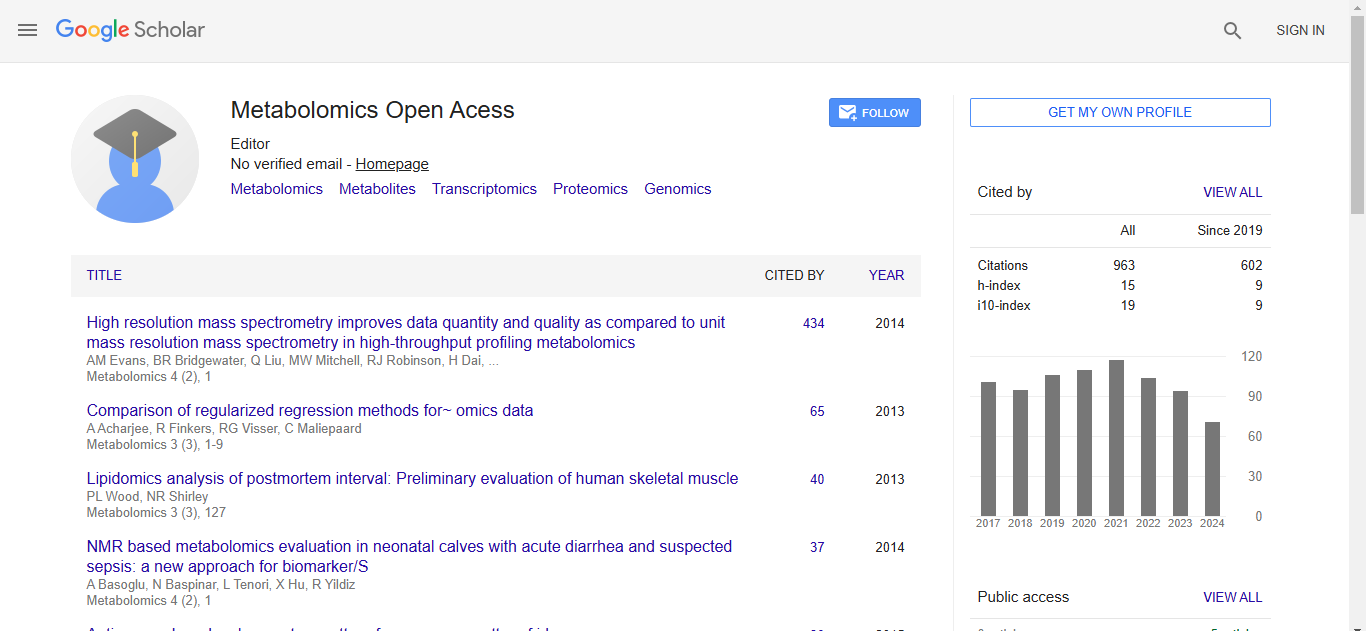
Metabolomics:Open Access received 895 citations as per Google Scholar report