Opinion - (2025) Volume 15, Issue 2
Received: 02-Jun-2025, Manuscript No. jpdbd-25-164658;
Editor assigned: 04-Jun-2025, Pre QC No. P-164658;
Reviewed: 16-Jun-2025, QC No. Q-164658;
Revised: 23-Jun-2025, Manuscript No. R-164658;
Published:
30-Jun-2025
, DOI: 10.37421/2153-0769.2025.15.415
Citation: Boum, Joseph. “Tracing Health: A Deep Dive into Metabolic Profiling.” Metabolomics 15 (2025): 415.
Copyright: © 2025 Boum J. This is an open-access article distributed under the terms of the Creative Commons Attribution License, which permits unrestricted use, distribution, and reproduction in any medium, provided the original author and source are credited.
Tracing health through metabolic profiling offers a fascinating window into the complexities of the human body. Metabolic profiling also known as metabolomics is the large-scale study of small molecules commonly referred to as metabolites within cells bio fluids tissues or organisms. These molecules and their interactions reflect the underlying biochemical activity and state of cells and tissues. As a result metabolic profiling has emerged as a critical tool in modern biomedical research providing deep insights into physiological and pathological processes and opening new frontiers in diagnostics precision medicine and public health. At its core metabolic profiling involves the systematic identification and quantification of metabolites in a biological sample. This process captures a snapshot of the metabolic state of an organism at a given time. By analyzing patterns of metabolites researchers can uncover alterations in metabolic pathways that are associated with disease states or responses to treatment. For example shifts in energy metabolism are often observed in cancer patients while certain lipid metabolites might serve as early indicators of cardiovascular diseases or metabolic syndromes. This detailed biochemical insight enables a more personalized approach to health management where interventions can be tailored to an individual’s specific metabolic profile [1].
The technology underpinning metabolic profiling has advanced rapidly in recent years. Key techniques include nuclear magnetic resonance spectroscopy and mass spectrometry each offering unique strengths in sensitivity resolution and throughput. These technologies are typically paired with advanced computational tools that help decipher the complex datasets generated during analysis. Data from metabolic profiling often require multivariate statistical analysis machine learning or systems biology approaches to translate findings into meaningful biological interpretations. With the right tools researchers can map out entire metabolic pathways and monitor their fluctuations under various conditions such as stress diet exercise or drug treatment. What makes metabolic profiling so powerful is its dynamic nature. Unlike the genome which remains largely static the metabolome reflects the immediate state of the organism and responds quickly to environmental or physiological changes. This responsiveness makes it a particularly useful tool in monitoring disease progression or treatment efficacy. For instance the onset of diabetes is often preceded by subtle changes in glucose and lipid metabolism. By catching these shifts early clinicians can intervene sooner potentially reversing the course of the disease. Similarly monitoring metabolite levels in cancer patients undergoing chemotherapy can help tailor dosages to minimize side effects while maximizing efficacy.
The application of metabolic profiling extends far beyond diagnostics. In the field of nutrition it offers a scientific basis for personalized dietary recommendations. Traditional dietary guidelines often adopt a one-size-fits-all approach which fails to account for individual variability in metabolism. Metabolomic data can help identify how different people metabolize nutrients and how their bodies respond to specific foods or supplements. This information is invaluable for designing customized nutrition plans aimed at improving overall health managing chronic conditions or enhancing athletic performance [2].In pharmacology metabolic profiling plays a vital role in drug development and safety assessment. Drugs often affect multiple metabolic pathways sometimes producing unintended side effects. Profiling the metabolic changes induced by a drug provides insight into its mechanism of action and potential toxicity. Moreover metabolic signatures can serve as biomarkers for predicting drug response allowing for better patient stratification in clinical trials. This is particularly important in the era of precision medicine where the goal is to match the right treatment to the right patient at the right time. Another important aspect of metabolic profiling is its ability to uncover hidden relationships between lifestyle factors and health outcomes. Factors such as sleep patterns stress levels environmental exposures and physical activity all influence metabolism. By integrating metabolic data with information from wearable devices genomic data and electronic health records researchers can construct comprehensive models of health and disease. These models not only help in identifying risk factors but also in designing preventive strategies that are proactive rather than reactive [3-5].
Despite its promise metabolic profiling is not without challenges. The metabolome is highly complex comprising thousands of metabolites with diverse chemical properties. This diversity makes comprehensive coverage difficult and no single analytical technique can capture the full spectrum of metabolites. Additionally metabolite concentrations can be influenced by a wide range of external factors including diet medication and sample handling. As a result standardization of protocols and rigorous quality control are essential to ensure reproducibility and reliability of results.
Ethical considerations also arise in the context of metabolic profiling particularly with respect to data privacy and informed consent. Because metabolomic data can reveal sensitive health information there is a need for clear guidelines on how this data is stored shared and used. Participants should be fully informed about the potential implications of the analysis and have the right to control their personal health data. As with other forms of biomedical research trust transparency and respect for individual autonomy are paramount. Looking ahead the integration of metabolic profiling with other omics technologies such as genomics proteomics and transcriptomics holds the potential to transform our understanding of human biology. This systems biology approach provides a holistic view of the body as a dynamic and interconnected network of biological processes. By examining how genes proteins and metabolites interact researchers can gain deeper insights into disease mechanisms and identify novel therapeutic targets. Furthermore advances in artificial intelligence and machine learning are poised to accelerate the discovery of meaningful patterns in large-scale omics data enabling more accurate predictions and faster translation from bench to bedside.
Google Scholar Cross Ref Indexed at
Google Scholar Cross Ref Indexed at
Google Scholar Cross Ref Indexed at
Google Scholar Cross Ref Indexed at
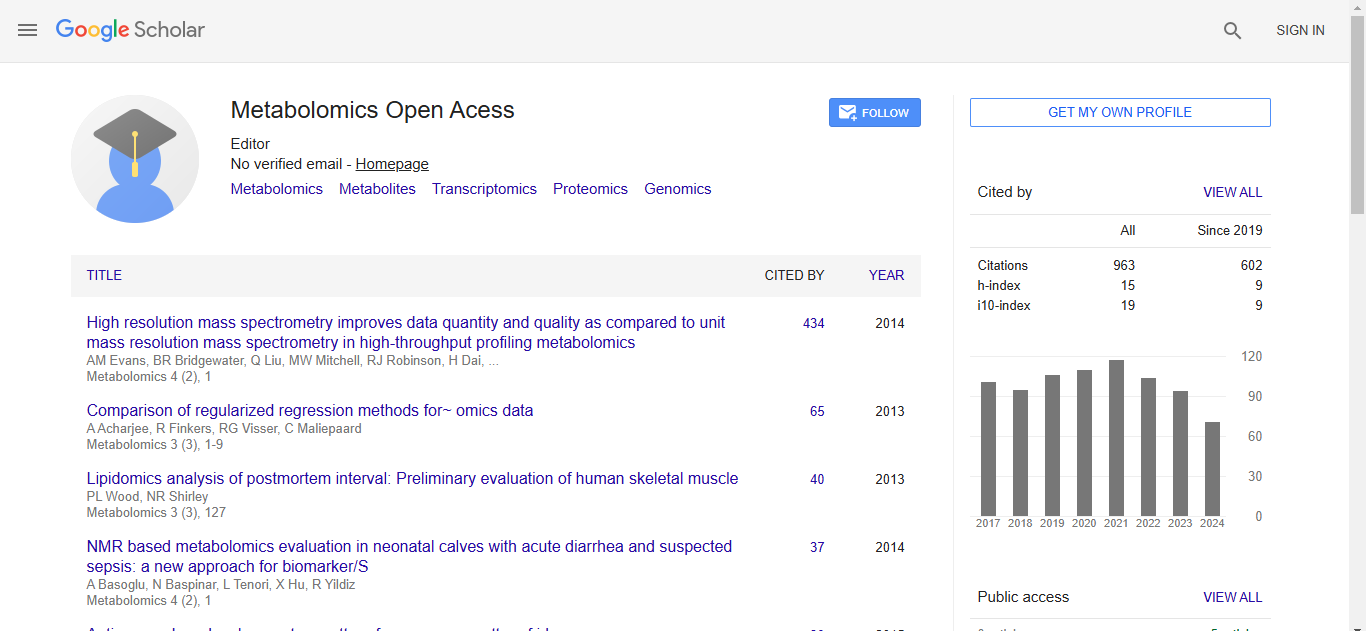
Metabolomics:Open Access received 895 citations as per Google Scholar report