Commentary - (2025) Volume 11, Issue 3
Received: 01-May-2025, Manuscript No. aso-26-184611;
Editor assigned: 05-May-2025, Pre QC No. P-184611;
Reviewed: 19-May-2025, QC No. Q-184611;
Revised: 22-May-2025, Manuscript No. R-184611;
Published:
29-May-2025
, DOI: 10.37421/2471-2671.2025.11.170
Citation: Grant, Oliver. ”Surgical Oncology Therapies: Personalizing
Treatment for Better Outcomes.” Arch Surg Oncol 11 (2025):170.
Copyright: © 2025 Grant O. This is an open-access article distributed under the terms of the Creative Commons Attribution License, which permits unrestricted use, distribution
and reproduction in any medium, provided the original author and source are credited.
Neoadjuvant and adjuvant therapies represent cornerstones of modern surgical oncology, fundamentally shaping treatment paradigms and significantly enhancing patient prognoses. Neoadjuvant therapy, strategically administered prior to surgical intervention, is designed to achieve tumor regression, facilitate complete surgical resection, and address potential micrometastatic disease, thereby improving the chances of successful surgical intervention [1].
In the realm of gastrointestinal malignancies, the evolution of neoadjuvant chemotherapy has led to marked improvements in local tumor control and downstaging, culminating in higher rates of R0 resection, which signifies complete tumor removal. This approach is particularly vital for enabling less invasive surgical procedures and enhancing sphincter preservation in cancers such as rectal and esophageal cancer [2].
Complementing pre-operative strategies, adjuvant therapies are administered post-surgery to eradicate any residual microscopic cancer cells, thereby substantially reducing the risk of disease recurrence. The continuous advancement in targeted therapies and immunotherapies is revolutionizing post-operative cancer care, offering new avenues for treatment [3].
The optimal utilization of both neoadjuvant and adjuvant treatments is intrinsically linked to a robust multidisciplinary team (MDT) approach. Regular MDT meetings ensure comprehensive case reviews, allowing for the consideration of all therapeutic modalities within the patient's holistic care plan [4].
Emerging technologies such as radiomics and artificial intelligence (AI) are poised to play a pivotal role in personalizing neoadjuvant and adjuvant treatment strategies. These advanced analytical tools can predict treatment response and identify high-risk patients, thereby guiding more precise therapeutic decisions [5].
In the context of breast cancer management, neoadjuvant chemotherapy has proven instrumental in facilitating breast-conserving surgery and in assessing treatment response. Concurrently, adjuvant endocrine therapy and HER2-targeted agents have dramatically improved outcomes for specific subtypes of breast cancer [6].
The landscape of lung cancer treatment has also been significantly impacted by neoadjuvant therapies. For non-small cell lung cancer (NSCLC), neoadjuvant immunotherapy, often in combination with chemotherapy, is demonstrating promising results in improving resectability and reducing recurrence rates [7].
For complex malignancies like locally advanced pancreatic cancer, a neoadjuvant strategy, encompassing chemotherapy and chemoradiation, is frequently employed to downstage tumors and enhance surgical resectability. Adjuvant chemotherapy remains a standard, though its optimal application is under continuous investigation [8].
The therapeutic journey in colorectal cancer management is increasingly guided by refined neoadjuvant and adjuvant strategies. Neoadjuvant chemoradiotherapy for rectal cancer has become a standard for select patients, significantly improving local control, while adjuvant chemotherapy regimens for colon cancer are tailored to reduce recurrence risk [9].
Ultimately, the successful integration of personalized medicine into surgical oncology hinges on a profound understanding of how neoadjuvant and adjuvant therapies can be precisely tailored to individual patient and tumor profiles, driven by advancements in biomarkers and imaging [10].
Neoadjuvant and adjuvant systemic therapies are integral components of modern surgical oncology, playing a critical role in the enhancement of patient outcomes across various cancer types. Neoadjuvant therapy, administered before surgical intervention, is primarily aimed at reducing tumor size, facilitating complete tumor resection, and potentially eradicating micrometastatic disease, thereby optimizing the conditions for surgery [1].
The evolution of neoadjuvant chemotherapy, particularly in the treatment of gastrointestinal cancers, has yielded substantial improvements in local disease control and tumor downstaging, leading to higher rates of R0 resection. This strategic approach aims to enable less invasive surgical procedures and improve outcomes such as sphincter preservation in specific oncological contexts [2].
Adjuvant therapies, administered after surgical removal of the primary tumor, are crucial for targeting any residual cancer cells that may remain, thereby significantly decreasing the risk of cancer recurrence. The ongoing development of novel targeted therapies and immunotherapies is actively transforming the landscape of post-operative cancer treatment strategies [3].
The successful and optimized application of both neoadjuvant and adjuvant treatments mandates a comprehensive, multidisciplinary approach. Regular meetings of multidisciplinary teams (MDTs) are essential for discussing complex cases and ensuring that all treatment options are considered within the patient's overall health status and preferences [4].
Emerging technologies, including radiomics and artificial intelligence (AI), are becoming powerful tools for personalizing neoadjuvant and adjuvant treatment strategies. These technologies can extract quantitative features from medical images to predict treatment response and identify patients at higher risk of recurrence, guiding more precise therapeutic decisions [5].
In the management of breast cancer, neoadjuvant chemotherapy has been well-established for its role in facilitating breast-conserving surgery and evaluating treatment response. Furthermore, adjuvant endocrine therapy and HER2-targeted agents have markedly improved the prognoses for hormone-receptor-positive and HER2-positive breast cancers, respectively [6].
For lung cancer, neoadjuvant immunotherapy, often combined with chemotherapy, is demonstrating promising results in improving the resectability of tumors and reducing recurrence rates in patients with stages II and III non-small cell lung cancer (NSCLC) [7].
The management of locally advanced pancreatic cancer frequently involves a neoadjuvant approach, including chemotherapy and chemoradiation, to downstage tumors and improve surgical outcomes. Adjuvant chemotherapy is considered a standard of care, although research continues to explore its optimal duration and regimen [8].
In colorectal cancer, the principles guiding neoadjuvant and adjuvant therapy are continuously being refined. Neoadjuvant chemoradiotherapy for rectal cancer has significantly enhanced local control and is now standard for specific patient populations, while adjuvant chemotherapy regimens for colon cancer are individualized to mitigate recurrence risk [9].
The integration of personalized medicine into surgical oncology requires a deep understanding of how neoadjuvant and adjuvant therapies can be tailored to the unique profiles of individual patients and their tumors, supported by advances in biomarkers and imaging technologies [10].
Neoadjuvant and adjuvant therapies are essential components of surgical oncology, aimed at improving patient outcomes by shrinking tumors before surgery and eliminating residual cancer cells afterward. These treatments are evolving with advances in chemotherapy, targeted therapy, and immunotherapy, requiring a multidisciplinary team approach for optimal application. Emerging technologies like radiomics and AI are enabling personalized treatment strategies, while specific applications are well-established in cancers such as breast, lung, gastrointestinal, and colorectal malignancies. The ultimate goal is to tailor these therapies to individual patient and tumor characteristics for improved survival and quality of life.
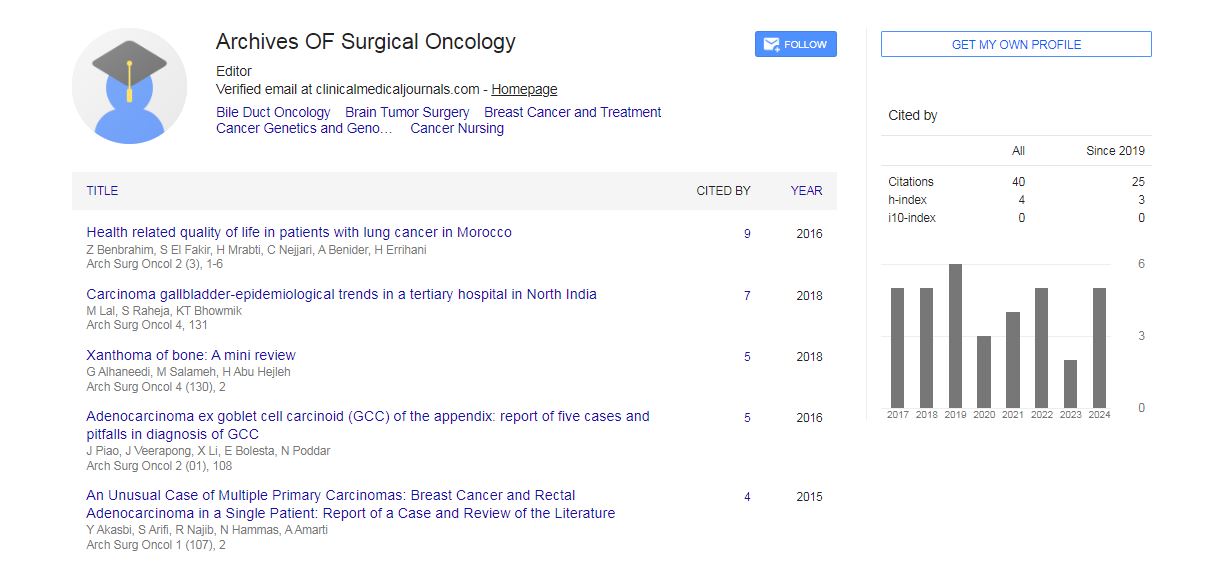
Archives of Surgical Oncology received 37 citations as per Google Scholar report