Commentary - (2025) Volume 14, Issue 6
Received: 01-Dec-2025, Manuscript No. jees-26-187939;
Editor assigned: 03-Dec-2025, Pre QC No. P-187939;
Reviewed: 17-Dec-2025, QC No. Q-187939;
Revised: 22-Dec-2025, Manuscript No. R-187939;
Published:
29-Dec-2025
, DOI: 10.37421/2332-0796.2025.14.207
Citation: Johansso, Erik. ”Smart Home Electrical Systems: Innovations,
Challenges, and Trends.” J Electr Electron Syst 14 (2025):207.
Copyright: © 2025 Johansso E. This is an open-access article distributed under the terms of the Creative Commons Attribution License, which permits unrestricted use,
distribution and reproduction in any medium, provided the original author and source are credited.
The evolution of smart home electrical systems is marked by significant advancements driven by the integration of the Internet of Things (IoT), Artificial Intelligence (AI), and machine learning, leading to enhanced automation, improved energy efficiency, and greater user convenience [1].
Despite these strides, challenges persist in areas such as cybersecurity, interoperability, and standardization, while emerging trends like proactive maintenance and personalized user experiences powered by data analytics are being actively explored. This domain continues to mature, promising more sophisticated and integrated living environments. A novel distributed control architecture for smart home energy management systems has been proposed, which effectively leverages blockchain technology to ensure secure and transparent energy trading [2].
This innovative approach optimizes energy consumption by considering real-time pricing and individual user preferences, demonstrating tangible improvements in cost savings and contributing to greater grid stability. Research into the security vulnerabilities of smart home IoT devices has highlighted the need for robust protective measures, leading to the proposal of lightweight intrusion detection systems (IDS) based on machine learning [3].
Such systems are designed to effectively identify and mitigate common cyberattacks, thereby fostering a more secure smart home environment without imposing substantial operational overhead. An adaptive energy management strategy for smart homes has been introduced, which learns user behavior patterns to accurately predict future energy needs and consequently adjust appliance operation [4].
This strategy is specifically designed to enhance overall energy efficiency by minimizing waste and effectively reducing peak load demand. The potential of federated learning for smart home applications is being explored, offering a method for collaborative model training across multiple homes without the need to centralize sensitive user data [5].
This approach not only enhances user privacy but also contributes to improving the accuracy of personalized automation services. A framework for context-aware smart home automation has been presented, which dynamically adjusts system behavior based on occupants' activities, prevailing environmental conditions, and their specific preferences [6].
The primary objective of this framework is to deliver intuitive and responsive automation that operates seamlessly without requiring explicit user commands. The utilization of edge computing is being investigated for smart home automation, enabling real-time data processing and decision-making capabilities [7].
This technology reduces latency and enhances reliability by offloading computation from the cloud to local devices, thereby improving both privacy and responsiveness within the smart home ecosystem. A smart home electrical monitoring system has been designed and implemented, providing real-time insights into the energy consumption patterns of individual appliances [8].
This system employs advanced sensor technology and sophisticated data analytics to empower users with the necessary information to make informed decisions regarding their energy usage. The performance of various communication protocols for smart home automation is being evaluated through comparative studies, assessing their efficiency, reliability, and power consumption [9].
The outcomes of these studies offer valuable guidance for selecting the most appropriate protocols for a wide range of smart home applications. A framework for personalized smart home automation has been developed, which adapts to individual user preferences and habits over time [10].
By leveraging machine learning algorithms, this framework learns from user interactions to deliver a more intuitive and highly customized smart home experience.
The rapid advancement of smart home electrical systems is largely attributed to the synergistic integration of the Internet of Things (IoT), Artificial Intelligence (AI), and machine learning, which collectively enhance automation capabilities, optimize energy efficiency, and elevate user convenience [1].
Concurrently, persistent challenges related to cybersecurity, interoperability, and standardization necessitate ongoing research and development, while promising emerging trends such as proactive maintenance and data-driven personalized user experiences are continuously being explored. A pioneering distributed control architecture for smart home energy management systems has been conceptualized, incorporating blockchain technology to facilitate secure and transparent energy trading [2].
This system adeptly optimizes energy consumption by dynamically responding to real-time pricing and user preferences, yielding substantial improvements in cost savings and bolstering grid stability. In response to the identified security vulnerabilities within smart home IoT devices, a novel lightweight intrusion detection system (IDS) grounded in machine learning principles has been proposed [3].
This IDS is engineered for the effective detection and mitigation of prevalent cyberattacks, thereby fortifying the smart home environment against threats without introducing significant performance degradation. An innovative adaptive energy management strategy tailored for smart homes has been developed, which capitalizes on user behavior prediction to anticipate future energy demands and dynamically adjust appliance operation [4].
This strategy is instrumental in augmenting energy efficiency by minimizing wastage and mitigating peak load demand. The application of federated learning within smart home ecosystems is gaining traction, enabling collaborative model training across distributed user devices without compromising the privacy of sensitive data [5].
This decentralized learning paradigm enhances user privacy while simultaneously improving the predictive accuracy of personalized automation services. A sophisticated framework for context-aware smart home automation has been introduced, designed to dynamically recalibrate system operations based on occupants' real-time activities, ambient environmental conditions, and their distinct preferences [6].
The overarching goal is to deliver an intuitive and highly responsive automation experience that requires minimal explicit user intervention. The integration of edge computing for smart home automation promises to revolutionize real-time data processing and decision-making capabilities [7].
By offloading computational tasks from centralized cloud servers to local devices, this approach significantly reduces latency, enhances system reliability, and reinforces user privacy. A robust smart home electrical monitoring system has been meticulously designed and implemented, offering granular, real-time insights into the energy consumption profiles of individual appliances [8].
This system leverages cutting-edge sensor technology and advanced data analytics to empower homeowners with actionable intelligence for optimizing energy usage. A comprehensive comparative analysis of various communication protocols employed in smart home automation has been conducted to assess their relative efficiency, reliability, and power consumption characteristics [9].
The findings derived from this study offer critical guidance for selecting optimal communication solutions tailored to diverse smart home application requirements. This research introduces a framework for personalized smart home automation that dynamically adapts to user-specific preferences and evolving habits over time [10].
Through the application of advanced machine learning algorithms, the system continuously learns from user interactions, thereby facilitating a more personalized and user-centric smart home experience.
This collection of research explores various facets of smart home electrical systems, focusing on advancements, challenges, and emerging trends. Key areas of innovation include the integration of AI, IoT, and machine learning for enhanced automation and energy efficiency, as well as the application of blockchain for secure energy trading. Security vulnerabilities in IoT devices are addressed with machine learning-based intrusion detection systems. Adaptive energy management strategies learn user behavior to optimize consumption, while federated learning offers privacy-preserving collaborative model training. Context-aware frameworks enable dynamic system adjustments, and edge computing facilitates real-time, localized processing. Smart electrical monitoring systems provide detailed energy insights, and comparative studies guide the selection of optimal communication protocols. Personalized automation learns user preferences for a tailored experience.
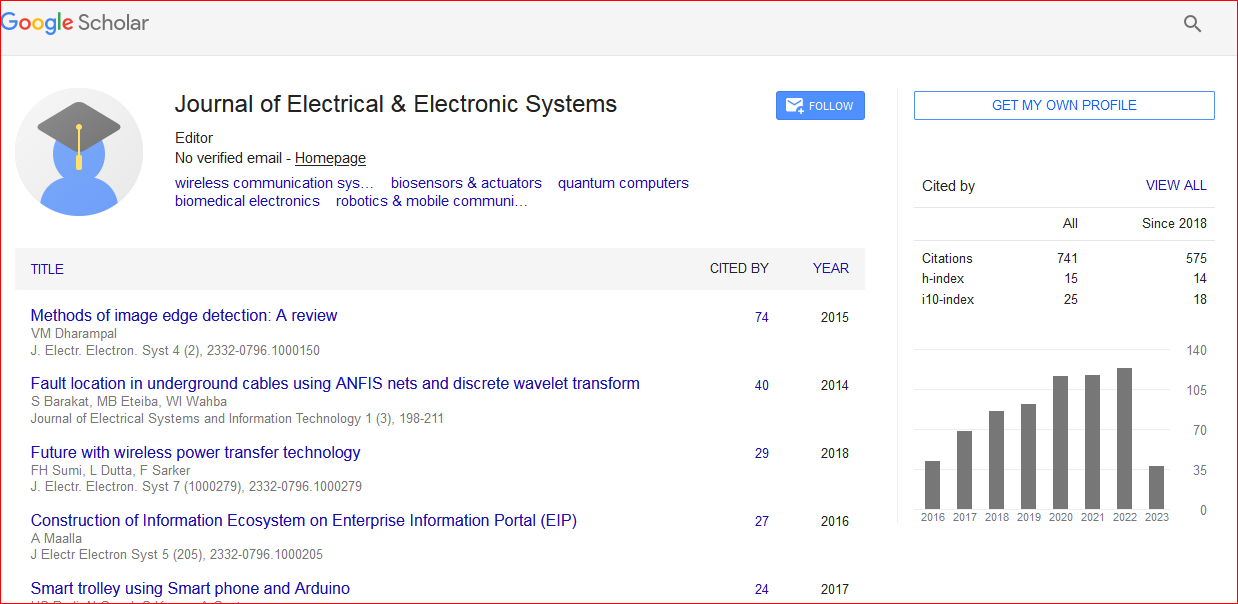
Journal of Electrical & Electronic Systems received 733 citations as per Google Scholar report