Perspective - (2025) Volume 11, Issue 3
Received: 02-Jun-2025, Manuscript No. jctt-26-188408;
Editor assigned: 04-Jun-2025, Pre QC No. P-188408;
Reviewed: 18-Jun-2025, QC No. Q-188408;
Revised: 23-Jun-2025, Manuscript No. R-188408;
Published:
30-Jun-2025
, DOI: 10.37421/2471-9323.2024.10.326
Citation: Morales, Javier. ”Scalp, Skin, and Vitality: Integrated Health Insights.” J Cosmo Tricho 11 (2025):326.
Copyright: © 2025 Morales J. This is an open-access article distributed under the terms of the Creative Commons Attribution License, which permits unrestricted use, distribution and reproduction in any medium, provided the original author and source are credited.
The intricate connection between scalp health and hair vitality is a burgeoning area of research, revealing that the biochemical pathways influencing hair growth and shedding are profoundly linked to the scalp's condition. Novel ingredients and advanced delivery systems are emerging as critical tools to enhance scalp barrier function and stimulate follicular activity, ultimately leading to improved hair density and strength. This burgeoning field underscores the importance of microbiome balance and targeted nutrient delivery for optimal hair follicle function, marking a new frontier in hair care and trichology [1].
Furthermore, an understanding of skin aging has been significantly advanced by research investigating the molecular mechanisms behind dermal degradation. Oxidative stress and inflammation are identified as key contributors to the appearance of wrinkles and loss of skin elasticity. The potential of antioxidants and anti-inflammatory agents, particularly those derived from natural sources, is being explored for their ability to protect skin cells and promote collagen synthesis, thus maintaining a youthful complexion [2].
Complementing these insights, the efficacy of plant-derived actives in enhancing skin barrier function and moisture retention is a significant focus. Ingredients such as ceramides and hyaluronic acid demonstrate synergistic effects in preventing transepidermal water loss, thereby improving skin hydration and texture. This research also highlights the crucial role of maintaining an optimal skin pH for a healthy skin barrier [3].
In parallel, the trend towards personalized cosmetic formulations, driven by genetic profiling and lifestyle factors, is reshaping the future of skincare and haircare. Tailoring solutions based on an individual's unique biological makeup promises more effective and targeted approaches, addressing specific concerns such as predisposition to hair thinning or skin sensitivity [4].
The profound impact of environmental stressors, including UV radiation and pollution, on both skin and hair health is another critical area of investigation. Understanding the mechanisms of damage, such as DNA damage, lipid peroxidation, and inflammation, is vital for developing effective protective strategies. Antioxidants and photoprotective agents are key in mitigating these effects, which can also accelerate hair aging and loss [5].
Delving deeper into hair biology, the biochemical signaling pathways that regulate hair follicle cycling and growth are being elucidated. The roles of growth factors, Wnt signaling, and other molecular cues in initiating and maintaining the anagen phase are crucial for developing advanced treatments for alopecia and promoting hair regeneration [6].
The physiological effects of stress on skin and hair are also under scrutiny. Chronic stress is shown to disrupt the skin barrier, exacerbate inflammatory skin conditions, and negatively impact hair follicle function, leading to increased hair shedding and thinning. Hormonal changes and immune system responses play significant roles in these processes [7].
In the realm of skin moisturization and barrier repair, natural emollients and humectants are gaining attention. Their chemical properties and therapeutic benefits, exemplified by ingredients like shea butter, jojoba oil, and glycerin, are essential for restoring skin hydration and suppleness, thereby contributing to healthy-looking skin [8].
Novel approaches to scalp treatments are also emerging, particularly the use of peptides and growth factors to stimulate hair follicles and enhance hair density. The scientific understanding of their mechanism of action offers promising avenues for treating various forms of hair loss and advancing trichological innovation [9].
Finally, the internal strategies for supporting skin health through nutraceuticals are gaining recognition. The benefits of vitamins, minerals, and botanical extracts in combating oxidative stress, promoting collagen production, and improving skin hydration and resilience offer a holistic approach that complements topical treatments [10].
The field of trichology is experiencing a significant paradigm shift with the exploration of the scalp microbiome and its direct correlation to hair vitality. This research elucidates the complex biochemical pathways governing hair growth and shedding, identifying novel ingredients and sophisticated delivery systems designed to fortify the scalp's barrier function and invigorate follicular activity. The ultimate aim is to achieve tangible improvements in hair density and strength by ensuring a balanced microbiome and delivering essential nutrients precisely where they are needed, thereby optimizing hair follicle performance and addressing a key frontier in hair care [1].
Concurrently, the dermatological sciences are making strides in understanding the multifaceted process of skin aging. Investigations into the molecular underpinnings of aging reveal how cumulative oxidative stress and chronic inflammation contribute to the structural degradation of the dermis, manifesting as wrinkles and a loss of elasticity. This understanding has spurred the development and investigation of antioxidants and anti-inflammatory agents, many sourced from natural compounds, with the goal of protecting skin cells from damage and stimulating collagen synthesis to preserve a youthful appearance [2].
Further strengthening the foundation of skin health, significant attention is being paid to the role of plant-derived actives in fortifying the skin's natural barrier and enhancing its moisture-retaining capabilities. Key ingredients such as ceramides and hyaluronic acid are recognized for their potent synergistic effects, which are crucial in minimizing transepidermal water loss and consequently improving overall skin hydration and texture. The importance of maintaining a balanced skin pH for optimal barrier function is also a recurring theme in this research [3].
The integration of personalized approaches in cosmetic science is rapidly advancing, driven by the potential of genetic profiling and an individual's unique lifestyle. By understanding an individual's specific biological characteristics, cosmetic formulations can be tailored to be more effective and targeted, addressing particular concerns like a genetic predisposition to hair thinning or increased skin sensitivity [4].
Environmental factors, including pervasive UV radiation and air pollution, pose significant threats to both skin and hair health. Research in this area focuses on delineating the precise mechanisms by which these stressors inflict damage, such as DNA alteration, lipid peroxidation, and inflammatory responses. Consequently, effective protective strategies involving antioxidants and photoprotective agents are being developed to counteract these detrimental effects, which are also implicated in the acceleration of hair aging and hair loss [5].
Within the intricate biology of hair, a detailed understanding of the biochemical signaling cascades that orchestrate hair follicle morphogenesis and cyclical growth is paramount. Insights into the roles of various growth factors, the Wnt signaling pathway, and other critical molecular signals are vital for advancing treatments for alopecia and fostering hair regeneration, offering new hope for individuals experiencing hair loss [6].
The physiological impact of chronic stress on both the integumentary system and hair is an area of growing concern. Stress is understood to compromise the skin barrier, amplify existing inflammatory skin conditions, and disrupt the delicate functioning of hair follicles, often resulting in increased hair shedding and thinning. The interplay of hormonal fluctuations and immune system responses plays a crucial role in these stress-induced changes [7].
In the context of maintaining skin hydration and promoting barrier repair, natural emollients and humectants are proving invaluable. Scientific reviews highlight the specific chemical properties and therapeutic benefits of ingredients like shea butter, jojoba oil, and glycerin, which are essential for restoring the skin's natural hydration levels and improving its suppleness, thereby contributing to overall skin health and appearance [8].
Innovative strategies for scalp treatments are emerging, with a particular focus on the use of peptides and growth factors. These advanced ingredients are being investigated for their ability to stimulate hair follicles and enhance hair density. A deeper understanding of their underlying mechanisms of action is paving the way for more effective treatments for various forms of hair loss and pushing the boundaries of trichological innovation [9].
Complementing topical interventions, the role of nutraceuticals in supporting skin health from within is increasingly recognized. This research emphasizes the benefits of various vitamins, minerals, and botanical extracts in combating systemic oxidative stress, fostering endogenous collagen production, and bolstering skin hydration and overall resilience, offering a comprehensive, holistic approach to skin care [10].
This collection of research highlights the interconnectedness of scalp and skin health with overall vitality. Studies explore the intricate biochemical pathways governing hair growth and vitality, emphasizing the role of the scalp microbiome and novel ingredients in enhancing hair density and strength. The impact of oxidative stress and inflammation on skin aging is examined, with a focus on natural antioxidants and anti-inflammatory agents. The efficacy of plant-derived actives and natural emollients in improving skin barrier function, hydration, and texture is also discussed. Advances in personalized cosmetic formulations based on genetic profiling and lifestyle factors offer targeted solutions. Environmental stressors like UV radiation and pollution are identified as significant threats, necessitating protective strategies. Research into the molecular mechanisms of hair follicle cycling and the physiological effects of stress on skin and hair further deepens our understanding. Emerging treatments involving peptides and growth factors for hair stimulation, alongside the internal benefits of nutraceuticals for skin health, point towards a holistic approach to beauty and well-being.
None
None
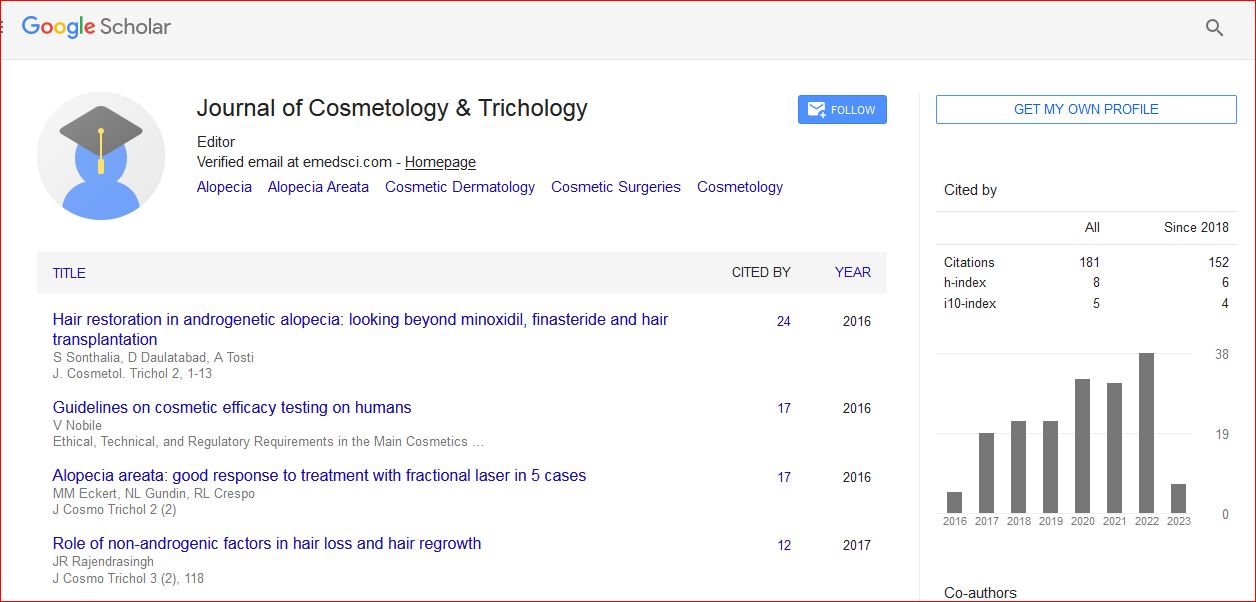
Journal of Cosmetology & Trichology received 180 citations as per Google Scholar report