Brief Report - (2025) Volume 11, Issue 6
Received: 01-Dec-2025, Manuscript No. jpnp-25-178321;
Editor assigned: 03-Dec-2025, Pre QC No. P-178321;
Reviewed: 17-Dec-2025, QC No. Q-178321;
Revised: 22-Dec-2025, Manuscript No. R-178321;
Published:
29-Dec-2025
, DOI: 10.37421/2472-0992.2025.11.391
Citation: Merrow, Alina. ”Saponins: Broad Therapeutic Potential and Applications.” J Pharmacogn Nat Prod 11 (2025):391.
Copyright: © 2025 Merrow A. This is an open-access article distributed under the terms of the Creative Commons Attribution License, which permits unrestricted use, distribution and reproduction in any medium, provided the original author and source are credited.
Saponins, a diverse class of natural compounds, are comprehensively reviewed to delineate their varied classifications, intricate biosynthetic pathways, and established methodologies for isolation and precise characterization. This foundational work extends its focus to explore their significant biological activities observed in both plant and human systems, thereby offering essential insights into their prospective therapeutic applications across a broad spectrum of health conditions [1].
Specifically, triterpenoid saponins derived from various plant sources have garnered considerable attention for their potent anticancer mechanisms. Research delves into their potential as therapeutic agents, meticulously highlighting the various pathways through which these compounds exert cytotoxic effects on cancer cells, pointing towards promising future applications in oncology and the broader field of drug development [2].
Further systematic evaluation positions saponins as highly promising antiviral agents. Current research is synthesized to understand their specific mechanisms of action against diverse viruses, identifying particular types of saponins that demonstrate significant inhibitory effects and underscoring their therapeutic potential in combating viral infections, which in turn opens new avenues for antiviral drug discovery and innovation [3].
Beyond their direct medicinal uses, the immunomodulatory effects of saponins are a subject of ongoing examination. This area of study clarifies how these complex compounds can finely regulate immune responses. Various mechanisms are outlined, including the stimulation of cytokine production and the enhancement of antigen presentation, suggesting future applications in immune-related therapies and as crucial vaccine adjuvants [4].
Saponins also serve critical roles as natural adjuvants and effective drug delivery carriers. Contemporary insights illustrate their mechanisms for significantly enhancing vaccine efficacy and facilitating improved drug transport within biological systems. The discussions cover both their inherent advantages and the challenges faced, while outlining future directions for their integration into advanced pharmaceutical formulations designed to optimize therapeutic outcomes [5].
Recent advancements in understanding saponins underscore their efficacy as potent natural antioxidants. A detailed summary explains their mechanisms of action in neutralizing harmful free radicals and effectively mitigating oxidative stress. This highlights their considerable potential benefits in areas such as food preservation, the development of functional foods, and various health applications specifically aimed at preventing oxidative damage [6].
From a microbiological perspective, antibacterial saponins sourced from medicinal plants are extensively reviewed for their proven efficacy against a wide array of bacterial strains. The mechanisms by which these natural compounds successfully inhibit bacterial growth are thoroughly discussed, emphasizing their potential as viable alternatives or effective complements to conventional antibiotics, particularly relevant in the escalating challenge of antimicrobial resistance [7].
Furthermore, saponins and their numerous derivatives are investigated for their remarkable anti-obesity and hypocholesterolemic properties. This review elaborates on the precise mechanisms through which these natural compounds contribute to reducing body weight and significantly lowering cholesterol levels, thereby positioning them as promising candidates for managing metabolic disorders and actively promoting robust cardiovascular health [8].
Notably, triterpenoid saponins emerge as particularly promising compounds due to their significant neuroprotective properties. Research explores their crucial roles in safeguarding neuronal health, actively mitigating neuroinflammation, and effectively preventing oxidative stress within the brain. This suggests their substantial therapeutic value for addressing complex neurological disorders, including Alzheimer's and Parkinson's diseases [9].
Finally, a review of recent advances highlights saponins exhibiting significant anti-diabetic activity. Their mechanisms, such as enhancing insulin sensitivity, reducing glucose absorption, and promoting insulin secretion, are detailed. This firmly positions them as valuable natural compounds for effective diabetes management and potential candidates for drug development to tackle this widespread global health challenge [10].
Saponins are a diverse group of natural compounds extensively studied for their wide-ranging biological activities and therapeutic potential. Fundamental research delineates their complex classifications, biosynthetic pathways, and established methods for isolation and characterization, laying a groundwork for understanding their roles in both plants and human health [1]. This includes exploring their broad potential across various health conditions, from basic cellular interactions to complex systemic effects.
The therapeutic landscape for saponins is notably broad, encompassing significant applications in combating major diseases. Triterpenoid saponins from plants, for instance, are particularly recognized for their potent anticancer mechanisms. These compounds exert cytotoxic effects on cancer cells through various pathways, suggesting their promising role as therapeutic agents in oncology and drug development [2]. Similarly, saponins are systematically evaluated as powerful antiviral agents, demonstrating significant inhibitory effects against various viruses. This positions them as critical components for new antiviral drug discovery, offering new avenues in the fight against viral infections [3]. Their immunomodulatory effects are also well-documented, showing how saponins can regulate immune responses by stimulating cytokine production and enhancing antigen presentation, making them valuable for immune-related therapies and vaccine adjuvants [4].
Beyond direct therapeutic action, saponins demonstrate utility in pharmaceutical formulations. They function effectively as natural adjuvants, significantly enhancing vaccine efficacy. Moreover, their capabilities as drug delivery carriers facilitate improved drug transport, presenting both advantages and challenges that researchers are actively addressing to optimize therapeutic outcomes [5]. Their role as potent natural antioxidants is also a key area of study. Recent advancements summarize their mechanisms in neutralizing free radicals and mitigating oxidative stress, suggesting benefits for food preservation, functional foods, and health applications aimed at preventing oxidative damage [6]. Furthermore, antibacterial saponins derived from medicinal plants exhibit proven efficacy against various bacterial strains. These natural compounds offer potential alternatives or complements to conventional antibiotics, crucial in addressing the growing global concern of antimicrobial resistance [7].
Metabolic health represents another critical area where saponins show considerable promise. Saponins and their derivatives are investigated for their significant anti-obesity and hypocholesterolemic properties. They function by reducing body weight and lowering cholesterol levels, positioning them as valuable candidates for managing metabolic disorders and promoting robust cardiovascular health [8]. Additionally, saponins are acknowledged for their anti-diabetic activity. Research highlights mechanisms such as improving insulin sensitivity, reducing glucose absorption, and promoting insulin secretion, making them valuable natural compounds for diabetes management and potential drug development to combat this prevalent challenge [10].
Finally, the neuroprotective properties of triterpenoid saponins are particularly compelling. These compounds play crucial roles in safeguarding neuronal health, actively mitigating neuroinflammation, and preventing oxidative stress within the brain. This research points to their substantial therapeutic value for neurological disorders, including complex conditions such as Alzheimer's and Parkinson's diseases, offering new directions for neurotherapeutic interventions [9].
Saponins are a diverse and significant class of natural compounds found across the plant kingdom, garnering extensive research interest for their broad spectrum of biological activities and therapeutic potential. These compounds are characterized by their varied classifications, intricate biosynthetic pathways, and established methods for isolation and characterization. Across numerous studies, saponins have been identified for their potent anticancer effects, especially triterpenoid saponins, which exhibit cytotoxic mechanisms against cancer cells. They are also recognized as promising antiviral agents, demonstrating inhibitory effects against various viruses, thereby contributing to new antiviral drug discovery. Beyond fighting pathogens and abnormal cell growth, saponins display crucial immunomodulatory effects, regulating immune responses by stimulating cytokine production and enhancing antigen presentation. Their utility extends to pharmaceutical applications, where they serve as natural adjuvants to boost vaccine efficacy and as effective drug delivery carriers. Saponins are also powerful natural antioxidants, effectively neutralizing free radicals and mitigating oxidative stress, which holds benefits for food preservation and health applications. Furthermore, certain saponins from medicinal plants possess antibacterial properties, offering alternatives to conventional antibiotics. Metabolic health benefits are also notable, with saponins demonstrating anti-obesity, hypocholesterolemic, and anti-diabetic activities through mechanisms like reducing cholesterol, body weight, and improving insulin sensitivity. Finally, triterpenoid saponins show significant neuroprotective properties, protecting neuronal health, reducing neuroinflammation, and preventing oxidative stress in the brain, suggesting therapeutic value for neurological disorders. This body of research collectively highlights saponins as versatile natural compounds with immense potential in various health and pharmaceutical domains.
None
None
Zizhong T, Yuan M, Chen Y. "Saponins: Classification, Biosynthesis, Isolation, Characterization, and Biological Activities in Plants and Humans".Molecules 26 (2021):4502.
Indexed at, Google Scholar, Crossref
Zhaowei L, Xiaohui Z, Xiaoli C. "Triterpenoid Saponins from Plants: A Review on Their Anticancer Mechanisms and Potential Therapeutic Applications".Molecules 27 (2022):2020.
Indexed at, Google Scholar, Crossref
Alireza S, Maryam G, Siavash F. "Saponins as Potential Antiviral Agents: A Systematic Review".Phytother Res 37 (2023):772-788.
Indexed at, Google Scholar, Crossref
Bing H, Jing X, Yongqiang D. "Immunomodulatory effects of saponins: Current understanding and future perspectives".Int Immunopharmacol 126 (2024):111160.
Indexed at, Google Scholar, Crossref
Wei Z, Yanyan Z, Yufeng Y. "Saponins as Natural Adjuvants and Drug Delivery Carriers: Current Insights and Future Perspectives".Pharmaceutics 14 (2022):700.
Indexed at, Google Scholar, Crossref
Hongyan D, Yingying W, Yong Y. "Saponins as natural antioxidants: A review of recent advances".Food Chem 401 (2023):134141.
Indexed at, Google Scholar, Crossref
Sijia H, Peng L, Jiao S. "Antibacterial Saponins from Medicinal Plants: A Review".Antibiotics (Basel) 12 (2023):253.
Indexed at, Google Scholar, Crossref
Hamed M, Maryam P, Reza H. "Saponins and their derivatives: Natural compounds with anti-obesity and hypocholesterolemic effects".Phytochem Rev 19 (2020):299-317.
Indexed at, Google Scholar, Crossref
Ying Y, Zhengguo W, Xinfeng T. "Triterpenoid Saponins: Promising Compounds with Neuroprotective Properties".Molecules 25 (2020):5063.
Indexed at, Google Scholar, Crossref
Hongyan D, Yingying W, Yong Y. "Saponins with anti-diabetic activity: A review of recent advances".Phytomedicine 79 (2021):153342.
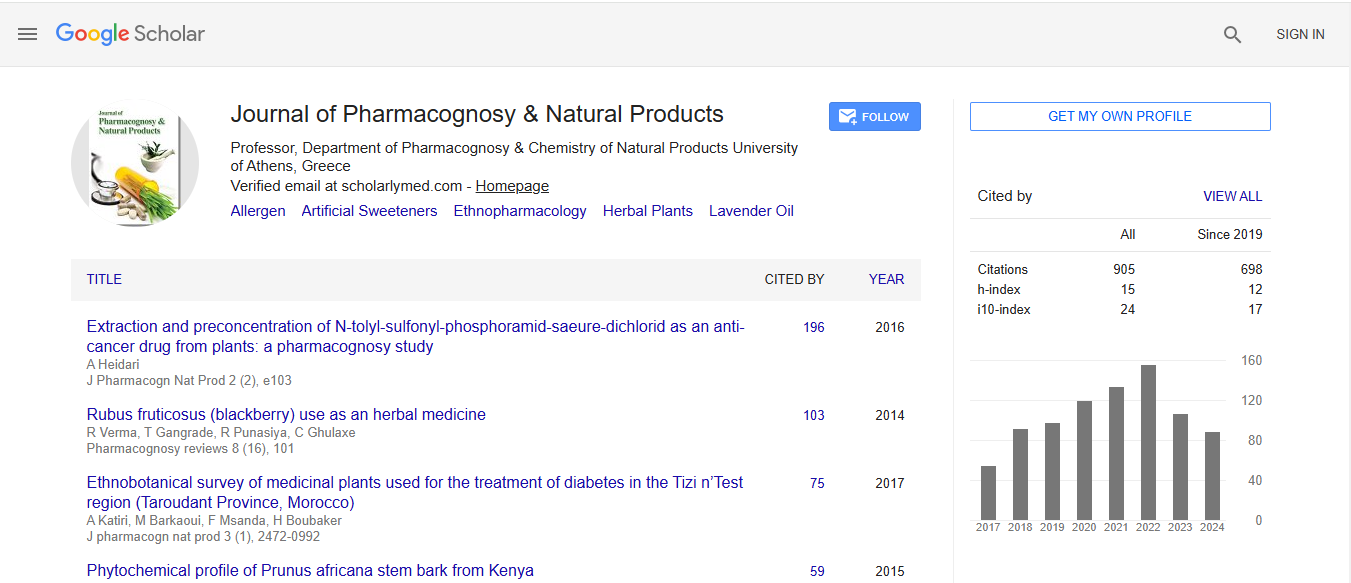
Journal of Pharmacognosy & Natural Products received 606 citations as per Google Scholar report