Brief Report - (2025) Volume 15, Issue 5
Received: 01-Sep-2025, Manuscript No. jnt-26-178957;
Editor assigned: 03-Sep-2025, Pre QC No. P-178957;
Reviewed: 17-Sep-2025, QC No. Q-178957;
Revised: 22-Sep-2025, Manuscript No. R-178957;
Published:
29-Sep-2025
, DOI: 10.37421/2161-0959.2025.15.582
Citation: Korhonen, Elina. ”Revolutionary Renal Imaging: Better Kidney Disease Care.” J Nephrol Ther 15 (2025):582.
Copyright: © 2025 Korhonen E. This is an open-access article distributed under the terms of the Creative Commons Attribution License, which permits unrestricted use, distribution and reproduction in any medium, provided the original author and source are credited.
Recent advancements in renal imaging are significantly transforming the diagnosis and management of kidney disorders, offering unprecedented insights into renal pathophysiology and disease progression. Techniques such as diffusion-weighted MRI (DW-MRI) are demonstrating considerable promise in the non-invasive assessment of kidney fibrosis and inflammation, thereby providing critical information on how these conditions evolve over time [1].
Complementing these advancements, contrast-enhanced ultrasound (CEUS) offers real-time functional data, proving invaluable in the detailed characterization of renal masses and the identification of vascular abnormalities within the kidney [1].
The integration of artificial intelligence (AI) with imaging data is further enhancing diagnostic accuracy and the ability to predict patient responses to therapeutic interventions, paving the way for more personalized and precise nephrology care [1].
Diffusion-weighted magnetic resonance imaging (DW-MRI) stands out as a non-invasive methodology for evaluating renal function and the intrinsic characteristics of kidney tissue. Its application in detecting and accurately staging kidney fibrosis represents a significant stride, with the potential to guide and optimize therapeutic strategies. This technique achieves its diagnostic capability by measuring the diffusion of water molecules, a process that is predictably altered in various kidney conditions, including chronic kidney disease (CKD) [2].
Contrast-enhanced ultrasound (CEUS) is rapidly emerging as a highly valuable tool for the precise characterization of renal lesions and for assessing renal perfusion dynamics. The capacity of CEUS to deliver real-time, dynamic imaging without exposing the patient to ionizing radiation makes it an especially advantageous modality for individuals with compromised kidney function. CEUS plays a crucial role in differentiating between benign and malignant renal masses and in evaluating the patency of renal vasculature, a factor of paramount importance in the management of conditions like renal artery stenosis and complications arising after kidney transplantation [3].
The strategic application of artificial intelligence (AI) within the domain of renal imaging is poised to bring about substantial improvements in both diagnostic efficiency and overall accuracy. AI algorithms possess the capability to meticulously analyze intricate imaging patterns derived from CT, MRI, and ultrasound examinations, thereby enabling the detection of subtle abnormalities, precise quantification of disease burden, and more reliable prediction of patient outcomes. This synergistic integration is particularly beneficial for identifying the earliest signs of diabetic nephropathy and other manifestations of CKD, thus facilitating timely and effective interventions [4].
Advanced MRI techniques, encompassing susceptibility-weighted imaging (SWI) and multiparametric MRI, are actively enhancing the comprehensive evaluation of renal vascular health and the intricate tissue composition of the kidney. SWI, in particular, possesses the capability to detect even minute microhemorrhages and calcifications, while multiparametric MRI integrates a variety of imaging sequences to furnish a holistic assessment of renal tumors and inflammatory conditions, such as ANCA-associated vasculitis [5].
Low-field MRI systems are progressively gaining prominence in the field of renal imaging, presenting a compelling alternative that is potentially more accessible and cost-effective compared to traditional high-field MRI. Despite their lower field strength, these systems are capable of delivering valuable diagnostic information pertinent to a wide spectrum of kidney disorders, including the assessment of kidney damage and the diligent monitoring of treatment response, especially within settings where resources may be limited [6].
Novel contrast agents are currently under active development, with the primary objective of significantly enhancing the sensitivity and specificity of renal imaging procedures. These innovative agents are meticulously designed to target specific cellular processes or anatomical structures within the kidney, thereby providing more granular functional and molecular information. Their utilization in conjunction with advanced imaging modalities, such as PET-MRI, holds considerable promise for the early detection of diseases and the facilitation of personalized therapeutic approaches [7].
Quantitative imaging biomarkers, derived from sophisticated CT and MRI analyses, are proving indispensable for the objective assessment of disease progression and the precise evaluation of treatment efficacy in the context of renal disorders. Techniques like radiomics are instrumental in extracting a vast array of quantitative features from medical images, which can subsequently be correlated with clinical outcomes and pathological findings. This data-driven approach significantly aids in the critical task of patient stratification and the subsequent tailoring of individualized treatment plans [8].
Hybrid imaging techniques, with a particular focus on PET-MRI, are furnishing unprecedented insights into the complex pathophysiology of renal diseases. The synergistic combination of the metabolic and functional information obtained from PET imaging with the superior soft-tissue contrast provided by MRI enables a more comprehensive and nuanced evaluation of inflammatory processes, accurate tumor staging, and a more precise assessment of treatment response in various kidney diseases [9].
The ongoing development and refinement of ultra-high field MRI technology are progressively pushing the boundaries of renal imaging resolution. This advancement allows for the visualization of finer anatomical details and more subtle pathological changes within the kidney. This cutting-edge technique is proving particularly valuable for the in-depth study of the renal microvasculature and cellular architecture, thereby opening up new avenues for research into the earliest signs of renal damage and the development of highly targeted therapies [10].
Recent advancements in renal imaging are revolutionizing the diagnosis and management of kidney disorders, offering non-invasive yet highly informative techniques. Diffusion-weighted MRI (DW-MRI) is showing significant promise in assessing kidney fibrosis and inflammation, providing crucial insights into disease progression without the need for invasive procedures. This technique allows for a detailed examination of tissue characteristics and can aid in understanding the underlying mechanisms of kidney damage [1].
Contrast-enhanced ultrasound (CEUS) complements MRI by providing real-time functional information, which is essential for accurately characterizing renal masses and identifying vascular abnormalities. Its dynamic imaging capabilities are particularly useful in clinical scenarios where precise, immediate assessment is required [1].
The integration of artificial intelligence (AI) with imaging data represents a paradigm shift, enhancing diagnostic accuracy and improving the prediction of treatment responses, ultimately leading to more personalized and effective nephrology care [1].
Diffusion-weighted magnetic resonance imaging (DW-MRI) offers a non-invasive approach to evaluate renal function and tissue characteristics, making it a powerful tool in nephrology. Its utility in detecting and staging kidney fibrosis is a significant development, offering the potential to guide therapeutic interventions more effectively. By measuring the diffusion of water molecules, which is altered in diseased kidney tissue, DW-MRI can differentiate between healthy and compromised renal parenchyma, especially in conditions like chronic kidney disease (CKD) [2].
Contrast-enhanced ultrasound (CEUS) is emerging as a vital modality for characterizing renal lesions and assessing renal perfusion. Its ability to provide real-time, dynamic imaging without the use of ionizing radiation makes it particularly beneficial for patients with impaired kidney function. CEUS aids in distinguishing benign from malignant renal masses and is critical for evaluating vascular patency, which is crucial for managing conditions such as renal artery stenosis and post-transplant complications [3].
The application of artificial intelligence (AI) in renal imaging is set to significantly enhance diagnostic efficiency and accuracy. AI algorithms can meticulously analyze complex imaging patterns from various modalities, including CT, MRI, and ultrasound, to identify subtle abnormalities, quantify disease burden, and predict patient outcomes. This integration is especially valuable for early detection of diabetic nephropathy and other CKD manifestations, enabling timely and targeted interventions [4].
Advanced MRI techniques, such as susceptibility-weighted imaging (SWI) and multiparametric MRI, are improving the evaluation of renal vascular health and tissue composition. SWI is capable of detecting microhemorrhages and calcifications, while multiparametric MRI combines different sequences for a comprehensive assessment of renal tumors and inflammatory conditions like ANCA-associated vasculitis [5].
Low-field MRI systems are becoming increasingly relevant for renal imaging, offering a more accessible and cost-effective alternative to high-field MRI. These systems can still provide valuable diagnostic information for various kidney disorders, aiding in the assessment of kidney damage and monitoring treatment response, particularly in resource-limited settings [6].
Novel contrast agents are being developed to boost the sensitivity and specificity of renal imaging. These agents are designed to target specific cellular processes or structures within the kidney, providing enhanced functional and molecular information. Their use with advanced modalities like PET-MRI holds promise for early disease detection and personalized therapies [7].
Quantitative imaging biomarkers derived from CT and MRI are essential for objectively assessing disease progression and treatment efficacy in renal disorders. Radiomics, for instance, extracts numerous quantitative features from medical images that can be correlated with clinical outcomes and pathological findings, aiding in patient stratification and treatment planning [8].
Hybrid imaging techniques, especially PET-MRI, offer unparalleled insights into renal pathophysiology. By combining PET's functional and metabolic data with MRI's superior soft-tissue contrast, a more comprehensive evaluation of inflammatory processes, tumor staging, and treatment response in kidney diseases is possible [9].
The development of ultra-high field MRI is advancing renal imaging resolution, allowing for the visualization of finer anatomical details and subtle pathological changes. This is crucial for studying the renal microvasculature and cellular architecture, opening new research avenues for early renal damage and targeted therapies [10].
Recent breakthroughs in renal imaging are revolutionizing kidney disorder diagnosis and management. Techniques like diffusion-weighted MRI (DW-MRI) offer non-invasive assessment of fibrosis and inflammation, while contrast-enhanced ultrasound (CEUS) provides real-time functional data for characterizing lesions and vascular abnormalities. The integration of artificial intelligence (AI) is enhancing diagnostic accuracy and predicting treatment responses, leading to more personalized nephrology care. Advanced MRI techniques, including multiparametric MRI, are improving the evaluation of vascular health and tissue composition. Low-field MRI systems present a more accessible option, and novel contrast agents are being developed to increase imaging sensitivity and specificity. Quantitative imaging biomarkers and hybrid imaging like PET-MRI are providing deeper insights into disease processes and treatment efficacy. Ultra-high field MRI is pushing resolution limits for detailed anatomical and cellular analysis, ultimately driving progress towards more precise and effective kidney disease care.
None
None
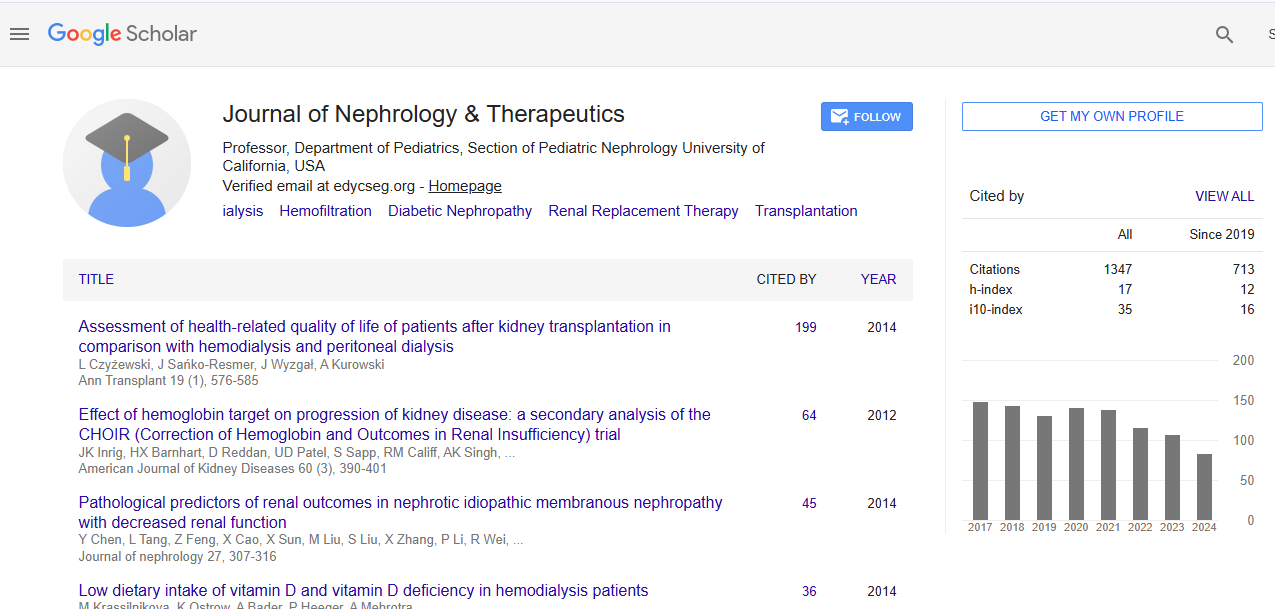
Journal of Nephrology & Therapeutics received 784 citations as per Google Scholar report