Commentary - (2025) Volume 16, Issue 1
Received: 01-Jan-2025, Manuscript No. jnmrt-25-172716;
Editor assigned: 03-Jan-2025, Pre QC No. P-172716;
Reviewed: 18-Jan-2025, QC No. Q-172716;
Revised: 24-Jan-2025, Manuscript No. R-172716;
Published:
31-Jan-2025
, DOI: 10.37421/2155-9619.2025.16.624
Citation: Schroeder, Helen M.. ”PET: Evolving for Personalized Precision Medicine.” J Nucl Med Radiat Ther 16 (2025):624.
Copyright: © 2025 Schroeder M. Helen This is an open-access article distributed under the terms of the Creative Commons Attribution License, which permits unrestricted use, distribution and reproduction in any medium, provided the original author and source are credited.
PET imaging plays an increasingly vital and evolving role in cancer care. It has transformed from a mere diagnostic instrument into a critical component for treatment selection, monitoring disease progression, and providing prognostic insights. This shift is supported by the development of novel radiotracers, the integration of hybrid imaging techniques such as PET/MRI, and the growing application of Artificial Intelligence (AI) to enhance image interpretation and quantitative analysis. These innovations collectively contribute to making PET more precise and personalized in the complex field of oncology [1].
Beyond oncology, cutting-edge developments in PET imaging are making significant strides in understanding and managing various neurological conditions. These include debilitating diseases like Alzheimer's disease, Parkinson's disease, and epilepsy. Advances involve new radiopharmaceuticals designed to target specific pathological proteins and neurotransmitter systems within the brain. What this really means is that these advancements are dramatically improving early diagnosis and allowing for more accurate monitoring of disease progression. This progress is also paving the way for the development of more targeted therapies and a deeper, more comprehensive understanding of complex brain disorders [2].
Here's the thing: PET imaging has truly established its importance in assessing cardiovascular health. This technology provides valuable applications in detecting critical conditions such as myocardial ischemia, assessing myocardial viability, and identifying inflammation within the heart. Furthermore, it plays a crucial role in guiding the management of heart failure. PET offers unparalleled functional information, moving beyond conventional anatomical insights to deliver critical data for highly personalized patient care in cardiology. This is particularly true with the introduction of new tracers and advanced hybrid imaging modalities [3].
The emergence of total-body PET systems represents a transformative impact on medical imaging. These innovative systems achieve significantly increased sensitivity and comprehensive body coverage. This allows for dynamic imaging of the entire body, leading to reduced scan times and lower radiation doses for patients. What this really means is that these systems offer unprecedented insights into whole-body pharmacokinetics and the spread of disease. It is truly a game-changer for both routine clinical practice, especially in areas like oncology and inflammation, and for groundbreaking research across many scientific disciplines [4].
Let's break this down: PET is increasingly indispensable for accurately pinpointing sites of infection and inflammation within the body. This approach leverages current clinical uses of ¹â¸F-FDG PET and introduces newer, more specific infection-targeting tracers. These new tracers might target bacterial metabolism or specific immune cells. PET proves particularly helpful in scenarios where traditional imaging techniques fall short, offering highly sensitive and specific detection capabilities. This is crucial for guiding effective treatment strategies in complex infectious and inflammatory diseases, leading to better patient outcomes [5].
Artificial Intelligence (AI) is actively transforming PET imaging by bringing significant improvements across various stages. AI demonstrates utility in tasks such as image reconstruction, effectively reducing noise in scans, segmenting regions of interest, and performing quantitative analysis. The ultimate goal here is to improve diagnostic accuracy and enhance overall efficiency in the imaging workflow. The integration of AI is expected not only to streamline processes but also to unlock deeper, more complex insights from PET data, pushing the very boundaries of what is possible in molecular imaging [6].
Significant progress is being made in the development of new radiopharmaceuticals for PET. This includes a wide array of novel tracers designed to target diverse biological pathways, extending beyond the commonly used ¹â¸F-FDG. These new agents are being developed for applications in oncology, neurology, and cardiology. The primary focus here is on enabling more specific and accurate disease detection, precise staging, and improved assessment of therapy response. This underscores the vital role that innovative chemistry plays in continually advancing the capabilities of molecular imaging [7].
What this really means is that quantitative PET imaging is becoming critically important for precise disease characterization and for effective treatment monitoring. Achieving accurate quantification presents several methodological hurdles, including challenges like motion correction, accounting for partial volume effects, and ensuring standardization across different scanner types. Despite these challenges, the clinical benefits derived from reliable quantitative data are significant, particularly in assessing how patients respond to therapy and in predicting outcomes across various pathologies, ultimately leading to more informed medical decisions [8].
This piece focuses on PET's crucial role in precision medicine, showcasing its ability to tailor medical care to individual patients. PET, with its powerful molecular imaging capabilities, can non-invasively assess detailed tumor biology, accurately predict a patient's response to specific therapies, and monitor the efficacy of treatments in real-time. This personalized approach, guided by the unique insights provided by PET, empowers clinicians to select the most effective treatments for each patient. This minimizes adverse effects while maximizing therapeutic benefits, marking a new era in patient-centric care [9].
Here's the thing about PET: it is constantly evolving, with significant technological breakthroughs continually emerging. This involves innovations in detector materials and design, the development of advanced image reconstruction algorithms, and the seamless integration of machine learning for more sophisticated data processing. What this really means is that these advancements are collectively leading to higher resolution images, faster scan times, and greater quantitative accuracy. These improvements ultimately enhance PET's overall clinical utility across a broad spectrum of medical fields, driving progress in diagnostics and patient management [10].
Positron Emission Tomography (PET) imaging has firmly established itself as an indispensable tool in modern medicine, extending its reach across a multitude of specialties. In cancer care, PET has evolved significantly, shifting from a basic diagnostic instrument to a pivotal element in guiding treatment selection, precisely monitoring therapeutic responses, and offering crucial prognostic information. This transformation is driven by novel radiotracers, advanced hybrid imaging techniques such as PET/MRI, and the increasing integration of Artificial Intelligence (AI) for enhanced image analysis, leading to more personalized oncology approaches [1]. Similarly, in neurology, PET is at the forefront of understanding complex brain disorders. Cutting-edge developments include new radiopharmaceuticals that target specific pathological proteins and neurotransmitter systems, vastly improving early diagnosis and monitoring disease progression in conditions like Alzheimer's, Parkinson's, and epilepsy [2].
When it comes to cardiovascular health, PET imaging provides unparalleled functional insights, moving beyond mere anatomical details. It is invaluable for detecting myocardial ischemia, assessing tissue viability, identifying inflammation, and informing the management of heart failure, thereby enabling highly personalized patient care [3]. Furthermore, PET proves vital in accurately pinpointing sites of infection and inflammation, utilizing both conventional ¹â¸F-FDG PET and newer, infection-specific tracers. This capability is especially critical in cases where traditional imaging methods are insufficient, offering highly sensitive and specific detection essential for guiding treatment in complex infectious and inflammatory diseases [5].
The field of PET imaging is experiencing rapid technological innovation, which significantly expands its diagnostic and research capabilities. The introduction of total-body PET systems, for example, marks a transformative leap. These systems boast dramatically increased sensitivity and comprehensive body coverage, enabling dynamic imaging of the entire body. This leads to shorter scan times, reduced radiation doses, and offers unprecedented insights into whole-body pharmacokinetics and the systemic spread of disease. It is truly a game-changer for both clinical practice and groundbreaking research [4]. Key to these advancements is the continuous progress in developing new radiopharmaceuticals. This involves a diverse array of novel tracers that target specific biological pathways relevant to oncology, neurology, and cardiology, moving beyond the traditional ¹â¸F-FDG. These new agents are designed to enable more specific disease detection, precise staging, and accurate assessment of therapy responses, highlighting the indispensable role of innovative chemistry in pushing molecular imaging capabilities forward [7]. Underpinning these improvements are technological breakthroughs in PET detector materials and design, alongside sophisticated image reconstruction algorithms. The integration of machine learning further enhances data processing, leading to consistently higher resolution images, faster acquisition times, and improved quantitative accuracy, collectively elevating PET's clinical utility across various medical disciplines [10].
Artificial Intelligence (AI) is fundamentally transforming PET imaging. AI applications are revolutionizing tasks such as image reconstruction, noise reduction, precise segmentation of anatomical structures or lesions, and advanced quantitative analysis. The primary objective of AI integration is to significantly improve diagnostic accuracy and operational efficiency. Experts suggest that AI will not only streamline workflow but also unlock deeper, more profound insights from PET data, effectively expanding the possibilities within molecular imaging [6]. What this really means is that reliable quantitative PET imaging is becoming increasingly crucial for precise disease characterization and effective treatment monitoring. While achieving accurate quantification faces methodological hurdles, including challenges like motion correction, accounting for the partial volume effect, and standardizing procedures across different scanner models, the clinical benefits of reliable quantitative data are substantial. This data is particularly valuable for assessing therapy response and predicting patient outcomes across various pathologies [8].
Ultimately, PET's molecular imaging capabilities are central to the realization of precision medicine. It provides a non-invasive way to assess tumor biology, predict how individual patients will respond to specific therapies, and monitor the effectiveness of treatments in real-time. This ability to personalize care, guided by the unique insights from PET, empowers clinicians to select the most effective treatments for each patient. This approach minimizes adverse effects while maximizing therapeutic benefits, representing a significant advancement in patient-centric healthcare [9].
Positron Emission Tomography (PET) imaging is rapidly evolving, moving beyond simple diagnostics to become a central tool in personalized medicine. Its applications span various medical fields, significantly enhancing diagnosis, monitoring, and treatment guidance. In oncology, PET is crucial for treatment selection, monitoring, and prognosis, utilizing novel radiotracers, hybrid imaging like PET/MRI, and Artificial Intelligence (AI) for improved analysis, making cancer care more precise and personalized. For neurological conditions like Alzheimer's, Parkinson's, and epilepsy, PET advances include new radiopharmaceuticals that target specific pathological proteins, improving early diagnosis and understanding complex brain disorders. In cardiovascular health, PET provides unparalleled functional information for assessing myocardial ischemia, viability, inflammation, and guiding heart failure management, moving beyond anatomical insights for personalized patient care. PET is also vital for pinpointing infection and inflammation sites, employing ¹â¸F-FDG PET and newer specific tracers, which helps when traditional imaging falls short, offering sensitive and specific detection crucial for guiding treatment. The introduction of total-body PET systems marks a significant advance, increasing sensitivity and coverage, reducing scan times and radiation dose, and offering unprecedented insights into whole-body pharmacokinetics and disease spread. Development of new radiopharmaceuticals is crucial, with novel tracers targeting diverse biological pathways across oncology, neurology, and cardiology, enabling more specific disease detection and therapy response assessment. Technological breakthroughs, including detector innovations, advanced image reconstruction, and machine learning integration, are leading to higher resolution, faster scans, and greater quantitative accuracy, enhancing PET's clinical utility. AI is transforming PET by improving image reconstruction, noise reduction, segmentation, and quantitative analysis, boosting diagnostic accuracy and efficiency while uncovering deeper insights from data. Quantitative PET is increasingly important for precise disease characterization and monitoring, despite methodological hurdles, offering significant clinical benefits in assessing therapy response. Ultimately, PET's molecular imaging capabilities are pivotal in precision medicine, non-invasively assessing tumor biology, predicting therapy response, and monitoring efficacy in real-time, allowing clinicians to select effective, personalized treatments.
None
None
Indexed at, Google Scholar, Crossref
Indexed at, Google Scholar, Crossref
Indexed at, Google Scholar, Crossref
Indexed at, Google Scholar, Crossref
Indexed at, Google Scholar, Crossref
Indexed at, Google Scholar, Crossref
Indexed at, Google Scholar, Crossref
Indexed at, Google Scholar, Crossref
Indexed at, Google Scholar, Crossref
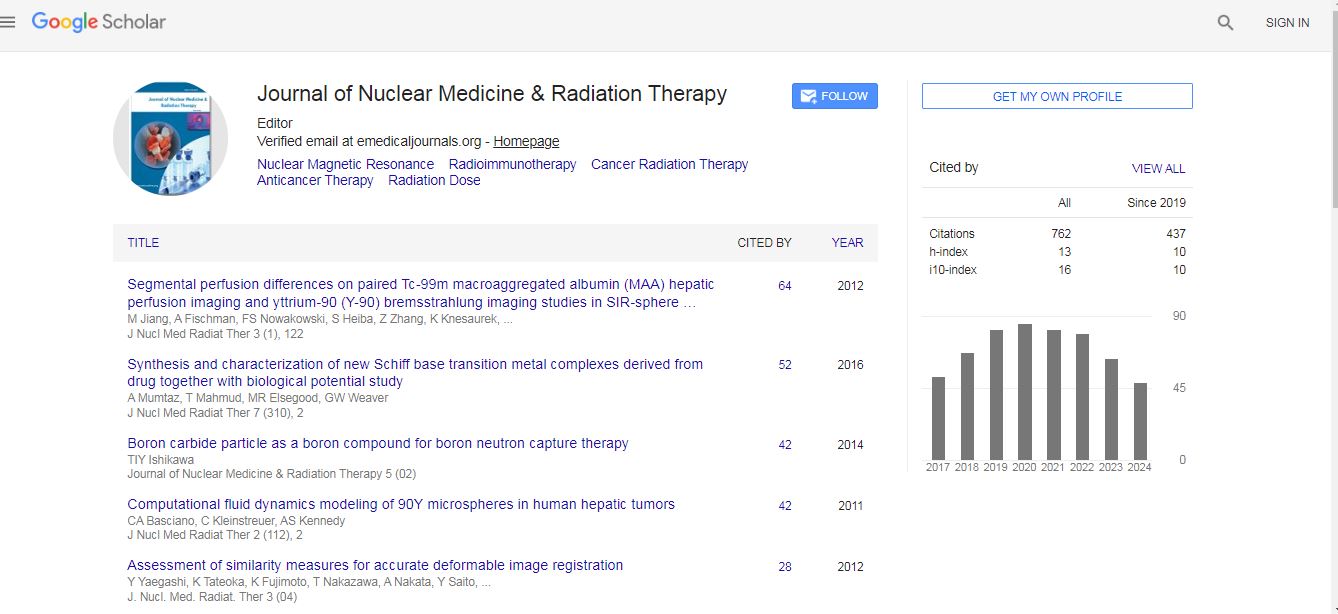
Nuclear Medicine & Radiation Therapy received 706 citations as per Google Scholar report