Short Communication - (2025) Volume 16, Issue 5
Received: 01-Oct-2025, Manuscript No. jar-25-177621;
Editor assigned: 03-Oct-2025, Pre QC No. P-177621;
Reviewed: 17-Oct-2025, QC No. Q-177621;
Revised: 22-Oct-2025, Manuscript No. R-177621;
Published:
29-Oct-2025
, DOI: 10.37421/2155-6113.2025.16.1090
Citation: Khan, Amira. ”Persistent HIV OIs: Diagnosis, Treatment,
Care.” J AIDS Clin Res 16 (2025):1090.
Copyright: © 2025 Khan A. This is an open-access article distributed under the terms of the Creative Commons Attribution License, which permits unrestricted use, distribution
and reproduction in any medium, provided the original author and source are credited.
Opportunistic infections continue to present significant challenges for individuals living with Human Immunodeficiency Virus (HIV) worldwide, despite advances in Antiretroviral Therapy (ART). Cryptococcal Meningitis (CM) stands out as a condition with a persistently high burden in sub-Saharan Africa, demanding early diagnosis through rapid point-of-care tests and prompt treatment to reduce mortality [1].
Human Immunodeficiency Virus (HIV) co-infection markedly worsens the treatment outcomes for drug-resistant tuberculosis (DR-TB), resulting in increased rates of treatment failure and death when compared to HIV-negative individuals [2].
Kaposi's Sarcoma (KS) remains a substantial concern for people with HIV in East Africa, frequently presenting at advanced stages even with the widespread availability of ART, necessitating enhanced screening and access to effective chemotherapy [3].
Pneumocystis jirovecii Pneumonia (PCP), while less common due to Combination Antiretroviral Therapy (cART), still poses a serious risk, particularly in individuals with undiagnosed HIV or poor ART adherence, highlighting the continuous need for prophylaxis and early diagnosis [4].
Toxoplasma gondii infection incidence has declined significantly with potent ART, yet it persists in patients with advanced immunosuppression who are not on ART or have poor adherence, underlining the ongoing need for vigilance and primary prophylaxis [5].
Cytomegalovirus (CMV) retinitis, despite a reduction in incidence with effective cART, continues to affect those with advanced HIV disease and often indicates poor immune reconstitution or treatment non-adherence, emphasizing early diagnosis and anti-CMV therapy [6].
Progressive Multifocal Leukoencephalopathy (PML), caused by the JC virus, is a devastating demyelinating disease primarily affecting severely immunocompromised individuals, where prompt diagnosis and ART optimization are critical for survival and neurological outcomes [7].
Oral candidiasis is highly prevalent among HIV-positive patients, showing a clear inverse correlation with CD4+ T lymphocyte counts and exacerbated by poor oral hygiene, thus requiring regular oral health assessments and appropriate antifungal prophylaxis [8].
Undiagnosed histoplasmosis represents a significant burden in hospitalized patients with advanced HIV disease, frequently leading to delayed treatment and poor outcomes, particularly in endemic regions where rapid diagnostic tests are crucial [9].
Herpes Zoster (HZ) remains a common and often severe opportunistic infection in people living with HIV, especially those with lower CD4 counts, even in the ART era, reinforcing the need for early antiviral treatment and consideration of HZ vaccination [10].
Collectively, these studies emphasize the persistent challenges posed by various opportunistic infections in the context of HIV. They highlight the crucial role of early and accurate diagnosis, optimized treatment regimens, consistent ART adherence, and integrated care approaches. Many of these conditions continue to disproportionately affect individuals in resource-limited settings or those with advanced immune suppression, underscoring the necessity for sustained efforts in prevention, surveillance, and management to improve the prognosis and reduce morbidity and mortality among people living with HIV. The ongoing research reinforces the dynamic interplay between HIV progression, immune status, and the emergence or re-emergence of opportunistic pathogens, demanding a comprehensive and adaptive public health response.
Opportunistic infections (OIs) remain a major health concern for individuals living with Human Immunodeficiency Virus (HIV), despite substantial advancements in Antiretroviral Therapy (ART). The presented research illustrates a spectrum of these challenges, from common fungal infections to severe neurological conditions, and their varied impact across different populations and settings.
Cryptococcal Meningitis (CM), for instance, continues to be a high-burden disease in sub-Saharan Africa, underscoring the critical need for early diagnostic tools like CrAg LFA and pre-emptive treatments to improve patient outcomes [1]. Similarly, the co-infection of HIV with drug-resistant tuberculosis (DR-TB) leads to significantly worse treatment outcomes, highlighting the urgent requirement for integrated care strategies and optimized treatment regimens for this vulnerable group [2]. Kaposi's Sarcoma (KS) also persists as a notable issue, particularly in East Africa, often presenting at advanced stages, which points to gaps in screening and the need for better access to chemotherapy alongside consistent ART adherence [3].
Furthermore, other common OIs like Pneumocystis jirovecii Pneumonia (PCP) and Toxoplasma gondii infection, while having reduced incidence due to cART, still pose threats, especially for individuals with undiagnosed HIV, poor ART adherence, or advanced immunosuppression [4, 5]. These studies stress the importance of ongoing vigilance, primary prophylaxis, and early diagnostic interventions. Cytomegalovirus (CMV) retinitis, though less frequent, continues to impact those with advanced HIV, often signaling inadequate immune reconstitution, making early diagnosis and specific anti-CMV therapy crucial to prevent visual impairment [6].
Severe neurological conditions such as Progressive Multifocal Leukoencephalopathy (PML), caused by the JC virus, predominantly affect severely immunocompromised individuals. For PML, prompt diagnosis and the initiation or optimization of ART are vital, as there is no specific antiviral treatment for the virus itself [7]. Oral candidiasis, a widespread fungal infection, shows a clear correlation with lower CD4+ T lymphocyte counts and poor oral hygiene among HIV-positive patients, emphasizing the need for regular oral health assessments and appropriate antifungal measures [8]. The burden of undiagnosed histoplasmosis, particularly in endemic regions, contributes to delayed treatment and poor outcomes in hospitalized patients with advanced HIV, advocating for increased awareness and routine use of rapid diagnostic tests [9]. Finally, Herpes Zoster (HZ) remains a frequent and severe opportunistic infection, even in the ART era, particularly for those with lower CD4 counts, necessitating early antiviral treatment and consideration of HZ vaccination [10].
In essence, these findings collectively underscore the multifaceted nature of managing HIV and its associated opportunistic infections. Despite therapeutic advancements, challenges remain, especially concerning early diagnosis, treatment adherence, and equitable access to care. The continued impact of these OIs highlights the ongoing need for robust public health interventions, comprehensive patient support, and further research to mitigate morbidity and mortality, particularly in resource-limited settings where the burden often remains highest.
The body of research presented collectively highlights the persistent and varied challenges posed by opportunistic infections (OIs) in individuals living with Human Immunodeficiency Virus (HIV), even in the era of effective Antiretroviral Therapy (ART). Conditions such as Cryptococcal Meningitis (CM) in sub-Saharan Africa, drug-resistant tuberculosis (DR-TB) co-infection, and Kaposi's Sarcoma (KS) in East Africa continue to cause significant morbidity and mortality. These studies emphasize the critical need for integrated care, early diagnosis using rapid point-of-care tests, and optimized treatment regimens to improve patient outcomes. For instance, CM requires pre-emptive treatment, while DR-TB in HIV-positive patients demands intensified support due to worse treatment outcomes. Pneumocystis jirovecii Pneumonia (PCP) and Toxoplasma gondii infection, though reduced in incidence by cART, remain threats for those with undiagnosed HIV, poor adherence, or advanced immunosuppression, underscoring the importance of ongoing prophylaxis and vigilance. Similarly, Cytomegalovirus (CMV) retinitis and Progressive Multifocal Leukoencephalopathy (PML) continue to affect individuals with advanced HIV, necessitating prompt diagnosis and ART optimization. Furthermore, common infections like oral candidiasis are prevalent among HIV-positive patients and correlate with lower CD4 counts, highlighting the need for good oral hygiene and antifungal measures. Undiagnosed histoplasmosis contributes to poor outcomes in endemic regions, advocating for rapid diagnostic tests, and Herpes Zoster (HZ) remains a severe infection requiring early antiviral treatment. These findings collectively reinforce that while ART has dramatically improved the lives of people with HIV, a comprehensive approach involving early diagnosis, consistent ART adherence, and targeted management of OIs is essential to further reduce disease burden and improve quality of life, particularly in resource-limited settings.
Indexed at, Google Scholar, Crossref
Indexed at, Google Scholar, Crossref
Indexed at, Google Scholar, Crossref
Indexed at, Google Scholar, Crossref
Indexed at, Google Scholar, Crossref
Indexed at, Google Scholar, Crossref
Indexed at, Google Scholar, Crossref
Indexed at, Google Scholar, Crossref
Indexed at, Google Scholar, Crossref
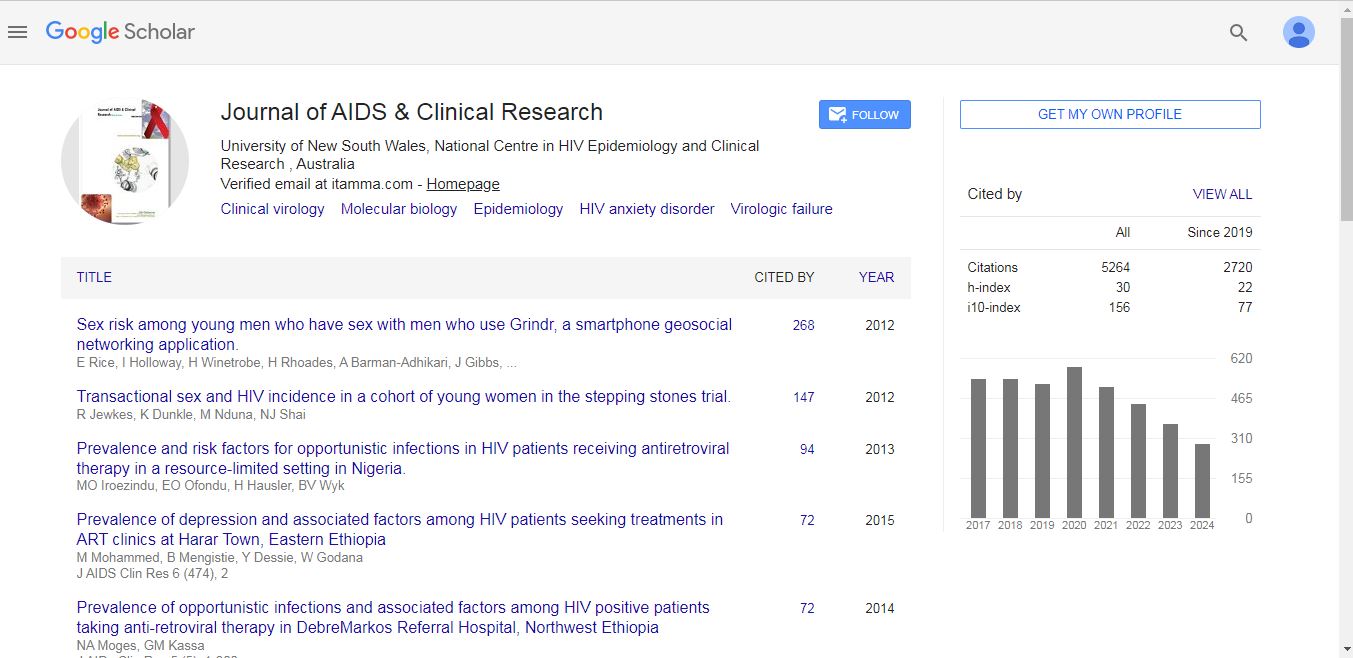
Journal of AIDS & Clinical Research received 5264 citations as per Google Scholar report