Perspective - (2025) Volume 10, Issue 6
Received: 01-Dec-2025, Manuscript No. jidm-26-188115;
Editor assigned: 03-Dec-2025, Pre QC No. P-188115;
Reviewed: 17-Dec-2025, QC No. Q-188115;
Revised: 22-Dec-2025, Manuscript No. R-188115;
Published:
29-Dec-2025
, DOI: 10.37421/2576-1420.2025.10.436
Citation: Hernandez, Luis. ”Novel Treatments For Emerging Infectious
Diseases.” J Infect Dis Med 10 (2025):436.
Copyright: © 2025 Hernandez L. This is an open-access article distributed under the terms of the Creative Commons Attribution License, which permits unrestricted use,
distribution and reproduction in any medium, provided the original author and source are credited.
The landscape of infectious diseases is continually evolving, presenting persistent challenges to global public health. A critical area of ongoing research and development involves the creation of novel therapeutic agents aimed at combating a spectrum of pathogens, including those that have developed resistance to existing treatments. Infections caused by resistant bacteria remain a significant concern, necessitating the exploration of new antimicrobial compounds. This review delves into the clinical outcomes of novel antimicrobial agents, highlighting their efficacy in combating resistant pathogens. It discusses the challenges in development and the promising therapeutic strategies emerging from recent clinical trials, particularly for infections caused by Gram-positive and Gram-negative bacteria [1].
The persistent threat of tuberculosis, particularly multidrug-resistant strains, demands innovative treatment modalities. Exploring the clinical efficacy of new antibiotics against multidrug-resistant tuberculosis (MDR-TB), this study presents data from Phase III trials. It emphasizes improvements in treatment duration and patient outcomes compared to existing regimens, offering a beacon of hope for this global health threat [2].
Complicated urinary tract infections, especially those caused by carbapenem-resistant Enterobacteriaceae (CRE), pose a formidable clinical challenge due to limited treatment options. This article examines the clinical utility of phage therapy in treating complicated urinary tract infections (cUTIs) caused by carbapenem-resistant Enterobacteriaceae (CRE). It provides case study evidence of successful eradication of infection and resolution of symptoms, underscoring its potential as a personalized treatment option [3].
Invasive fungal infections (IFIs) continue to be a major cause of morbidity and mortality, particularly in immunocompromised individuals. The review focuses on newer antifungal agents, particularly their impact on invasive fungal infections (IFIs) in immunocompromised patients. It highlights enhanced spectrum of activity and improved safety profiles of agents like isavuconazole and rezafungin, leading to better clinical outcomes [4].
Bacterial pneumonia, especially community-acquired forms, remains a leading cause of infectious disease-related deaths. This clinical trial evaluates the effectiveness of omadacycline in treating community-acquired bacterial pneumonia (CABP). It demonstrates non-inferiority to standard treatment, with a favorable safety profile and good tolerability, offering a valuable oral and intravenous option [5].
The emergence of novel viral infections poses a continuous threat to global health security, necessitating the development of effective antiviral strategies. The article discusses the role of new antiviral agents in managing emerging viral threats, such as severe acute respiratory syndrome coronavirus 2 (SARS-CoV-2). It reviews their mechanisms of action, clinical trial results, and impact on patient recovery and mortality rates [6].
Hematopoietic stem cell transplantation (HSCT) recipients are particularly vulnerable to opportunistic infections, including cytomegalovirus (CMV). This research investigates the clinical experience with letermovir for the prophylaxis and treatment of cytomegalovirus (CMV) infections in hematopoietic stem cell transplant (HSCT) recipients. It highlights reduced CMV disease incidence and improved survival outcomes [7].
The rise of extended-spectrum beta-lactamase (ESBL)-producing Enterobacteriaceae has led to significant treatment challenges in common bacterial infections. The study evaluates the efficacy of newer cephalosporins combined with beta-lactamase inhibitors against extended-spectrum beta-lactamase (ESBL)-producing Enterobacteriaceae. It demonstrates significant activity and improved clinical cure rates in patients with complicated intra-abdominal and urinary tract infections [8].
Respiratory tract infections continue to be a common cause of morbidity worldwide, with increasing concerns regarding antimicrobial resistance. This paper assesses the clinical benefits of newer macrolides in treating respiratory tract infections, focusing on their pharmacokinetic/pharmacodynamic properties and activity against resistant strains. It discusses improved patient adherence and reduced treatment failures [9].
Gram-negative bacterial infections, especially those caused by multidrug-resistant strains, represent a critical unmet medical need. The review examines the clinical impact of novel antibiotics targeting Gram-negative bacteria, such as ceftazidime-avibactam and meropenem-vaborbactam. It highlights their effectiveness in treating serious infections caused by difficult-to-treat pathogens and the importance of stewardship programs [10].
The clinical application of novel antimicrobial agents is crucial for addressing the growing threat of resistant bacterial infections. These new agents are being evaluated for their efficacy against a broad range of pathogens, including Gram-positive and Gram-negative bacteria, which are responsible for many serious infections. The development process faces significant challenges, but recent clinical trials are showing promising therapeutic strategies for these difficult-to-treat infections [1].
Multidrug-resistant tuberculosis (MDR-TB) continues to be a global health crisis, and the development of new treatment regimens is a priority. This study presents data from Phase III trials that explore the clinical efficacy of novel antibiotics specifically designed for MDR-TB. The findings indicate improvements in treatment duration and better patient outcomes when compared to existing treatment protocols, offering a renewed sense of hope for managing this devastating disease [2].
Carbapenem-resistant Enterobacteriaceae (CRE) are a major concern in healthcare settings, particularly in complicated urinary tract infections (cUTIs). The clinical utility of phage therapy is being investigated as a potential alternative or adjunct treatment. Case studies have demonstrated successful eradication of CRE infections and resolution of symptoms, suggesting that phage therapy could offer a personalized approach to managing these challenging infections [3].
Invasive fungal infections (IFIs) present a significant risk to immunocompromised patients, and advancements in antifungal therapy are vital. This review highlights newer antifungal agents and their impact on IFIs. Agents such as isavuconazole and rezafungin are showing enhanced spectrum of activity and improved safety profiles, which are contributing to better clinical outcomes in this vulnerable patient population [4].
Community-acquired bacterial pneumonia (CABP) is a common but potentially severe infection. The effectiveness of omadacycline in treating CABP has been evaluated in a Phase 3 randomized trial. The results indicate that omadacycline is non-inferior to standard treatments and possesses a favorable safety profile, making it a valuable oral and intravenous option for patients [5].
Emerging viral threats, such as SARS-CoV-2, necessitate the rapid development of effective antiviral therapies. This article reviews the role of new antiviral agents in managing these novel viral infections. It examines their mechanisms of action, the results from clinical trials, and their impact on patient recovery and mortality rates, providing insight into current strategies for combating viral outbreaks [6].
Cytomegalovirus (CMV) infections are a serious complication in hematopoietic stem cell transplant (HSCT) recipients. Clinical experience with letermovir for the prophylaxis and treatment of CMV infections in this population has shown promising results. The use of letermovir has been associated with a reduced incidence of CMV disease and improved survival outcomes, highlighting its importance in post-transplant care [7].
Extended-spectrum beta-lactamase (ESBL)-producing Enterobacteriaceae are increasingly prevalent, complicating the treatment of common bacterial infections. This study assesses the efficacy of newer cephalosporin-beta-lactamase inhibitor combinations against these resistant strains. The findings demonstrate significant activity and improved clinical cure rates for patients with complicated intra-abdominal and urinary tract infections [8].
Respiratory tract infections are a significant cause of morbidity, and the development of resistance to existing antibiotics is a growing concern. Newer macrolides are being studied for their role in treating these infections. This paper focuses on their pharmacokinetic/pharmacodynamic properties and their activity against resistant strains, discussing how they can lead to improved patient adherence and reduced treatment failures [9].
Treating infections caused by Gram-negative bacteria, particularly those with limited susceptibility to conventional antibiotics, is a major clinical challenge. Novel agents like ceftazidime-avibactam and meropenem-vaborbactam are being developed to combat these difficult-to-treat pathogens. This review discusses their clinical impact in treating serious infections and emphasizes the importance of antimicrobial stewardship programs to ensure their continued effectiveness [10].
This compilation of research highlights significant advancements in the treatment of various infectious diseases. Novel antimicrobial agents are showing efficacy against resistant bacterial strains, while new antibiotics offer hope for multidrug-resistant tuberculosis. Phage therapy is emerging as a potential treatment for carbapenem-resistant Enterobacteriaceae infections, and newer antifungal agents are improving outcomes for invasive fungal infections. Omadacycline demonstrates effectiveness for community-acquired bacterial pneumonia, and new antiviral therapies are being developed for emerging viral threats. Letermovir shows promise in preventing and treating cytomegalovirus infections in transplant recipients. Novel cephalosporin-beta-lactamase inhibitor combinations are effective against ESBL-producing Enterobacteriaceae, and newer macrolides are beneficial for respiratory tract infections. Finally, new agents targeting Gram-negative bacteria are crucial for treating difficult-to-treat infections.
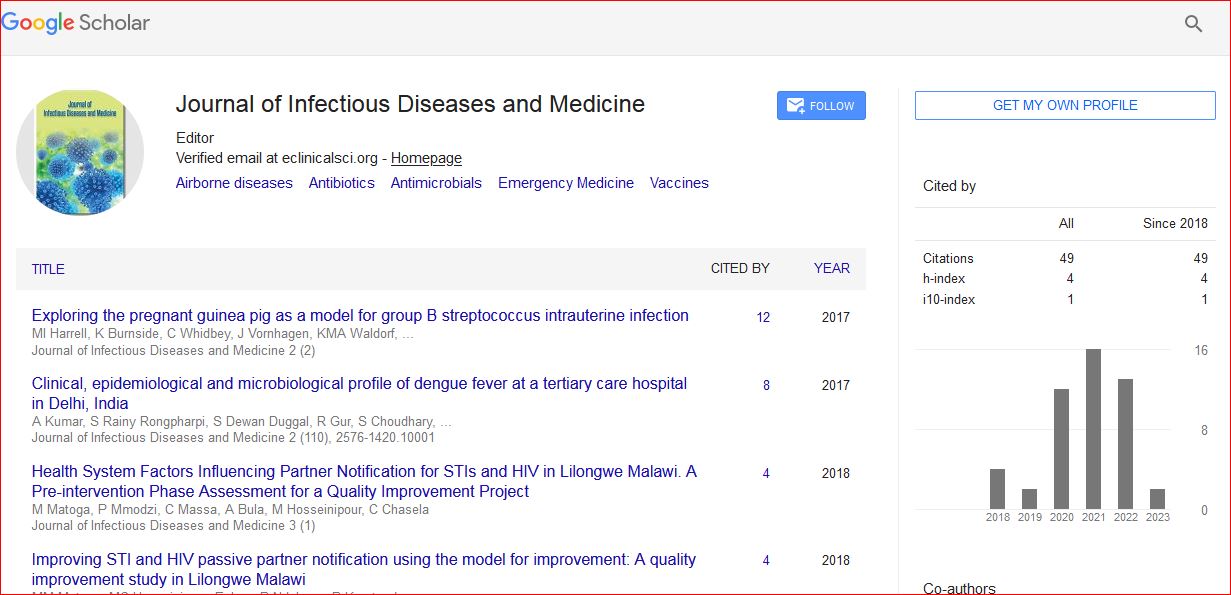
Journal of Infectious Diseases and Medicine received 1059 citations as per Google Scholar report